Home > Mammal Articles > What Is the Loudest Animal? Why Decibels Can Mislead

What Is the Loudest Animal? Why Decibels Can Mislead

Published on

The sperm whale is widely credited with producing the loudest sound measured from an animal: highly directional echolocation clicks with reported source levels around 230 decibels underwater. But that number cannot be compared directly with a 230 dB sound in air. Different reference pressures, distances and measurement methods make a single “loudest animals” ranking more complicated than it appears.

Key takeaways

  • Sperm-whale echolocation clicks are among the most intense biological sounds ever measured underwater.
  • Underwater dB values use a different reference pressure from airborne values, so the numbers cannot be placed on one simple scale.
  • The white bellbird produced the loudest bird call documented in a controlled scientific comparison: up to 125 dB at an equivalent distance of one meter.
  • Claims that howler monkeys routinely reach 140 dB are repeated widely but are difficult to trace to comparable field measurements.
  • Distance, direction, frequency, duration and whether a figure is a peak or average all affect a sound-level claim.

What is the loudest animal in the world?

If the question means the highest recorded source level from a living animal, the best-supported answer is the sperm whale (Physeter macrocephalus). It sends short, focused clicks through the water while searching for prey in dark ocean depths.

Measurements depend on both the click metric and the animal’s orientation to the hydrophone. Research led by bioacoustician Bertel Møhl reported on-axis source levels up to 223 dB re 1 μPa using a root-mean-square measure in one study, while later work reported peak-to-peak levels reaching about 236 dB re 1 μPa at one meter. “Around 230 dB underwater” is therefore a useful summary, not one universal reading for every click.
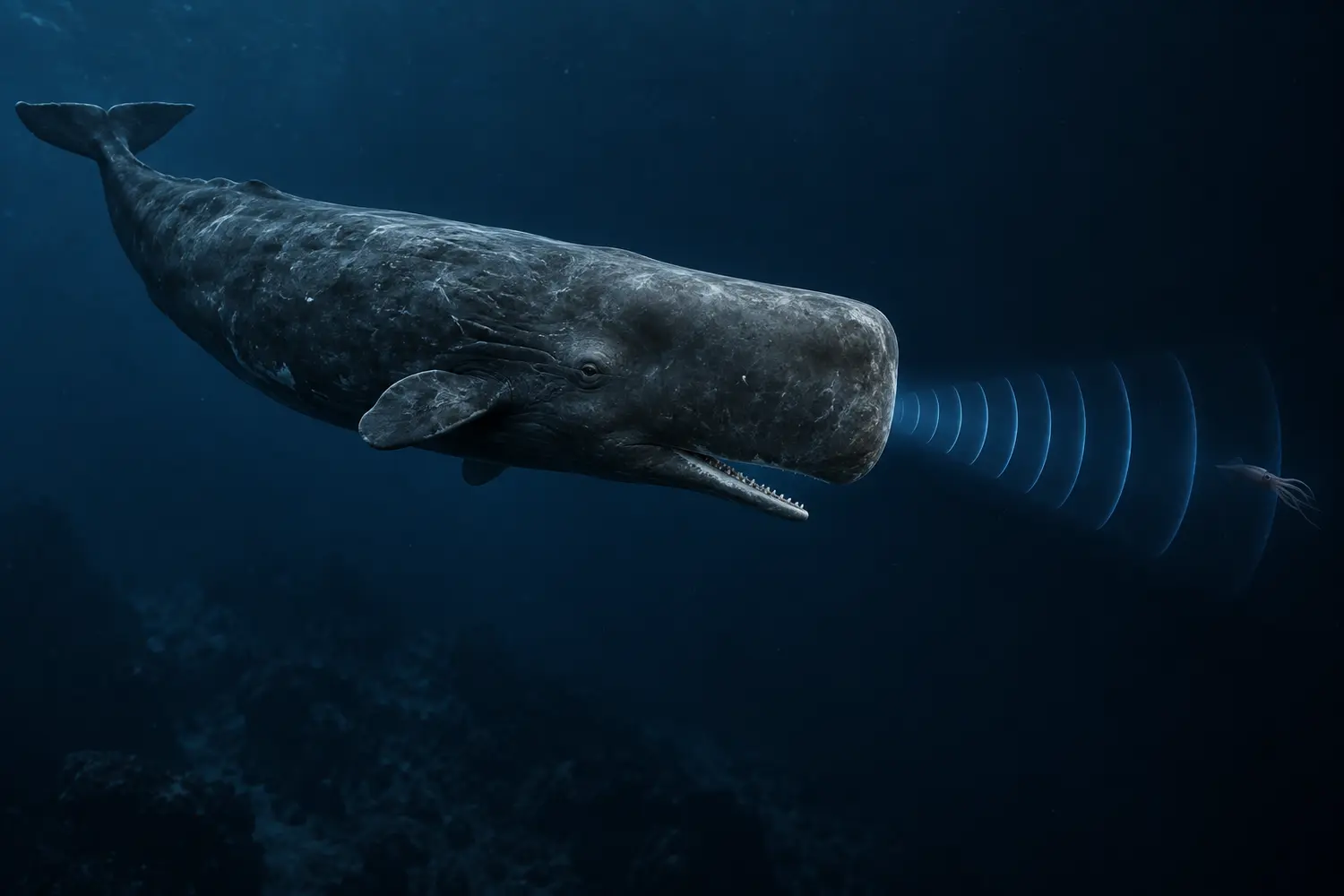
Sperm whale directing an illustrated echolocation beam toward a squid in deep water.
Sperm whales aim short, intense echolocation clicks through the water. AI-generated scientific illustration; the wave arcs are schematic.

Why 230 dB underwater is not 230 dB in air

A decibel is a logarithmic ratio, not a standalone amount of sound. The ratio must be calculated against a reference pressure. Airborne acoustics normally use 20 micropascals, while underwater acoustics use 1 micropascal. Water and air also differ greatly in density and acoustic impedance.

That is why describing a sperm-whale click as “louder than a rocket” by comparing the printed dB numbers is misleading. The underwater figure should be written with its reference—dB re 1 μPa—and compared with other underwater measurements made in compatible ways.

Loud-animal records that can be supported

AnimalSupported measurementWhat the sound doesImportant limitation
Sperm whaleRoughly 230 dB underwater; published maxima vary by metricEcholocation and prey detectionUnderwater source level; highly directional and extremely brief
White bellbirdUp to 125 dB SPL at an equivalent 1 mMale courtship songAirborne measurement; brief call
Common coquíAbout 90–95 dB SPL at 0.5 m for an individual callTerritorial signaling and mate attractionLevel changes sharply with distance; a chorus is a different measurement
Howler monkeyLong-range, low-frequency roars; no universal 140 dB value established hereGroup spacing and social signalingPopular 140 dB claim often lacks distance and measurement details

White bellbird: the loudest measured bird

In 2019, Jeffrey Podos and Mario Cohn-Haft compared the songs of male white bellbirds (Procnias albus) with those of screaming pihas in the Brazilian Amazon. Their Current Biology study found that the bellbird’s loudest song reached 125 dB SPL at an equivalent distance of one meter—more than 9 dB above the piha in that comparison.

The bird does not sustain that maximum continuously. Its loudest songs are short, and the researchers found a trade-off between amplitude and song duration. Males may also turn toward nearby females while singing, making the display remarkable not just for volume but for close-range courtship behavior.

Male white bellbird with white plumage and a long black wattle calling from a rainforest branch.
A male white bellbird calling from a rainforest perch. AI-generated wildlife illustration.

How loud is a coquí frog?

The tiny common coquí (Eleutherodactylus coqui) is a better example of exceptional output from a small body than of an absolute world record. Acoustical measurements place an individual calling at roughly 90–95 dB SPL from half a meter away. A field study that normalized calls to one meter reported a lower average “co” note of about 70 dB, illustrating how distance and methods change the headline number.

The two-part call also carries information: the “co” note is important in male-to-male interactions, while the “quí” note helps attract females. Dense introduced populations can create persistent nighttime choruses, but a chorus reading should not be confused with the peak level at a frog’s mouth or ear.

Are howler monkeys really 140 dB?

Howler monkeys unquestionably produce powerful low-frequency roars that travel through forest and help groups advertise their presence. Their enlarged hyoid apparatus acts as part of a resonating vocal system, and research has linked hyoid size with evolutionary investment in vocal display.

However, the exact “140 dB” figure commonly attached to howlers is often presented without a species, distance, reference, averaging method or primary field measurement. It should not be treated as directly equivalent to the carefully standardized one-meter result for the white bellbird. “Among the most far-carrying primate calls” is a safer description than declaring a precise land-mammal record from that unsupported number.

How to read animal decibel claims

  1. Check the medium: air and water use different acoustic conventions.
  2. Look for distance: a measurement near the source will be much higher than one taken farther away.
  3. Check the metric: peak, peak-to-peak and RMS values are not interchangeable.
  4. Consider direction: sperm-whale clicks form a narrow beam, so an off-axis hydrophone records less energy.
  5. Separate intensity from reach: frequency, habitat and background noise influence how far a call travels.
  6. Prefer a primary study: comparison articles often repeat figures after their original conditions have disappeared.

Frequently asked questions

Can a sperm whale click harm a human?

Close exposure to an intense underwater sound can be hazardous, but a source-level estimate is not the same as the received level at a swimmer. Distance, direction and the surrounding water determine actual exposure. Claims that sperm whales routinely “vibrate divers to death” are not supported by these source-level measurements.

Is the white bellbird louder than a howler monkey?

The bellbird has a published 125 dB standardized measurement. A direct conclusion about howlers requires measurements taken with comparable methods; the popular 140 dB claim does not provide enough information for a reliable head-to-head verdict.

References