
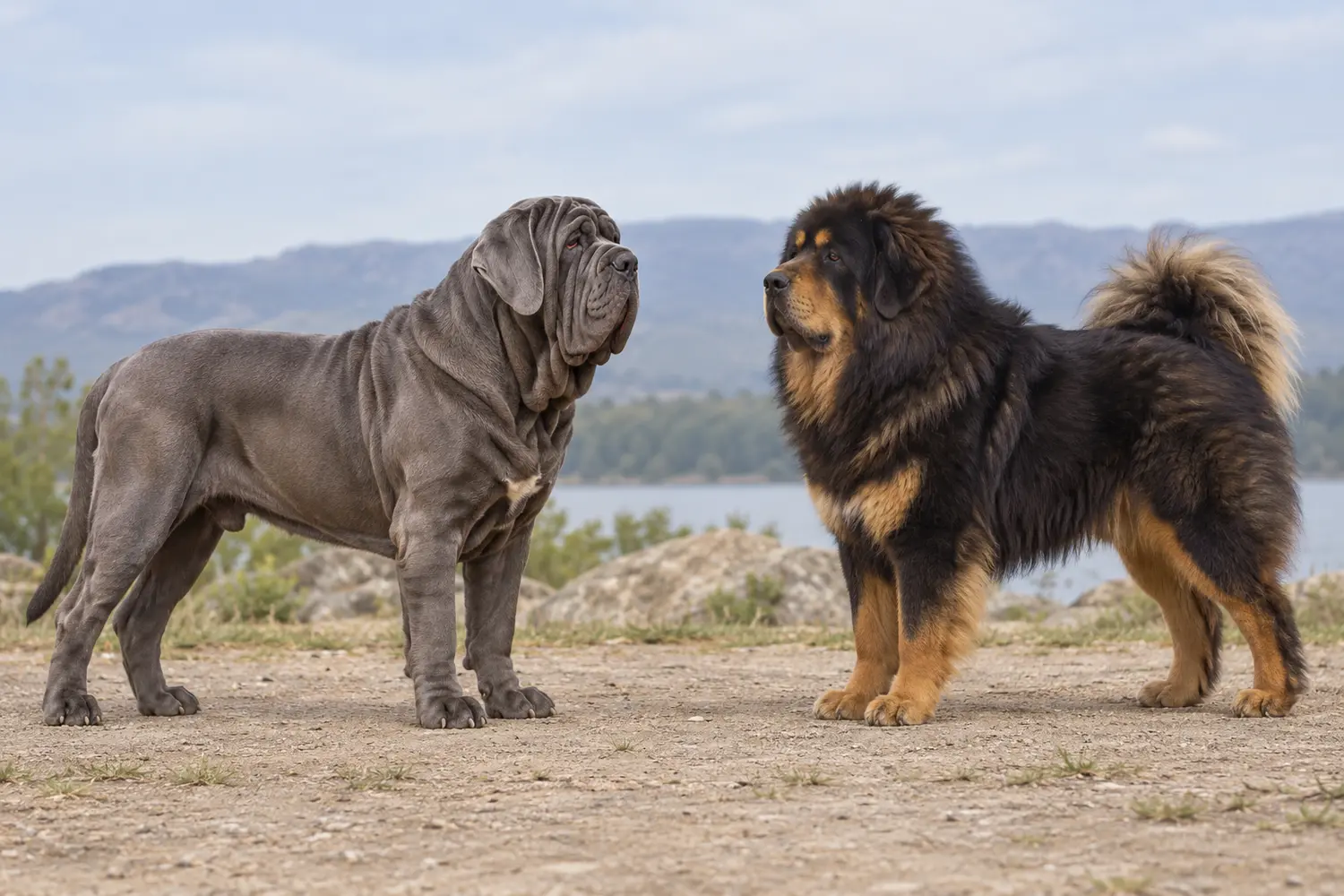
Neapolitan Mastiff vs. Tibetan Mastiff comparisons often turn into dramatic claims about weight, bite pressure and which dog would “win.” That framing misses what makes both breeds remarkable. The Neapolitan Mastiff was shaped as a massive property guardian in Italy, while the Tibetan Mastiff developed as a watchful guardian associated with Himalayan herders and monasteries. Their bodies, coats and temperaments reflect those different jobs.
This guide compares verified breed standards, working roles, daily care and ownership demands. It does not promote dog fighting, and it avoids viral bite-force rankings that are not backed by standardized breed-level tests.
Neapolitan Mastiff vs. Tibetan Mastiff at a glance
| Trait | Neapolitan Mastiff | Tibetan Mastiff |
|---|---|---|
| Traditional role | Guard and defend owner and property | Companion, watch and guard dog; guardian linked with Himalayan herders and monasteries |
| Overall build | Massive, heavy-boned and rectangular | Powerful, substantial and comparatively more athletic |
| Coat | Short, dense coat with abundant loose skin and wrinkles | Dense double coat with a pronounced neck ruff, especially in males |
| AKC male size | 26–31 inches; about 150 pounds | At least 26 inches; 90–150 pounds |
| Typical temperament | Dignified, loyal, watchful and steady with family | Watchful, reserved, independent and territorial |
| Best suited to | Experienced owners prepared for a very heavy guardian | Experienced owners who understand independent guardian behavior and heavy seasonal shedding |
These numbers are reference ranges, not promises. Sex, lineage, condition and the registry standard used can all affect an individual dog’s size.
Origins and working roles
Neapolitan Mastiff: an Italian property guardian
The Neapolitan Mastiff, or Mastino Napoletano, is an Italian mastiff breed. The American Kennel Club standard describes it as a heavy-boned, massive dog bred to guard and defend its owner and property. Its imposing outline, enormous head and loose skin create a strong visual deterrent. That appearance should not be confused with a requirement for uncontrolled aggression. A sound guardian must remain manageable, stable and responsive to its owner.
The breed was reorganized and standardized in Italy during the twentieth century, although mastiff-type dogs have a much longer history in the region. Modern breed history is clearer than sweeping claims that every Neapolitan Mastiff descends directly and unchanged from Roman war dogs.
Tibetan Mastiff: a Himalayan watch and guard dog
The Fédération Cynologique Internationale lists the Tibetan Mastiff’s utilization as companion, watch and guard dog. Its historical summary associates the breed with nomadic herders of the Himalaya and the guardianship of Tibetan monasteries. That role favored vigilance, independence and the confidence to patrol or assess unusual activity without constant direction.
Calling the Tibetan Mastiff a dog “built to hunt down apex predators” is misleading. Livestock guardian dogs are primarily deterrents and defenders. Their job is to remain with or near animals and territory, alert people, confront threats when necessary and reduce opportunities for predation—not to pursue snow leopards or wolves as hunting quarry.
Size and physical build
The Neapolitan Mastiff usually creates the heavier visual impression. AKC lists males at 26–31 inches and about 150 pounds, with females at 24–29 inches and about 110 pounds. The FCI standard gives males a height of 65–75 cm and a weight of 60–70 kg, again emphasizing a massive, heavy-boned body. Some individuals exceed those figures, but “up to 200 pounds” should not be treated as the normal target for every healthy dog.
AKC lists male Tibetan Mastiffs at a minimum of 26 inches and 90–150 pounds, and females at a minimum of 24 inches and 70–120 pounds. The standard calls the breed large but not giant. Much of its apparent volume comes from the dense double coat and pronounced ruff. Underneath the coat, the Tibetan Mastiff should be powerful and substantial rather than excessively bulky.
In practical terms, the Neapolitan tends toward more mass, heavier bone and a slower, deliberate outline. The Tibetan Mastiff generally has greater coat volume and a more functional mountain-dog silhouette. Neither standard supports turning those differences into a universal contest of strength or stamina.
Are wrinkles and thick fur “natural armor”?
No breed standard describes the Neapolitan Mastiff’s loose skin as damage-absorbing armor. The folds are a defining feature of breed type, especially around the head and neck. They also require care: skin folds should be kept clean and dry, and exaggerated skin can contribute to irritation or eye problems.
The Tibetan Mastiff’s double coat provides insulation from cold and weather. It may offer some incidental physical buffering, as any dense coat can, but calling it armor overstates the evidence. Coat density varies by season, climate, sex and individual dog. It should be discussed as climate adaptation and breed type, not protective equipment for combat.
What about the “550 PSI” bite-force claim?
There is no reliable, standardized study establishing 550 PSI as the Tibetan Mastiff’s fixed bite pressure. Veterinary reviews show that canine bite-force results vary with body weight, skull size and shape, tooth position, motivation, pain, the measuring device and whether force was measured directly or estimated from anatomy. Direct tests are especially variable because a conscious dog cannot be instructed to deliver a reproducible maximum bite.
Force measured in newtons is also not interchangeable with pressure in pounds per square inch unless the contact a