
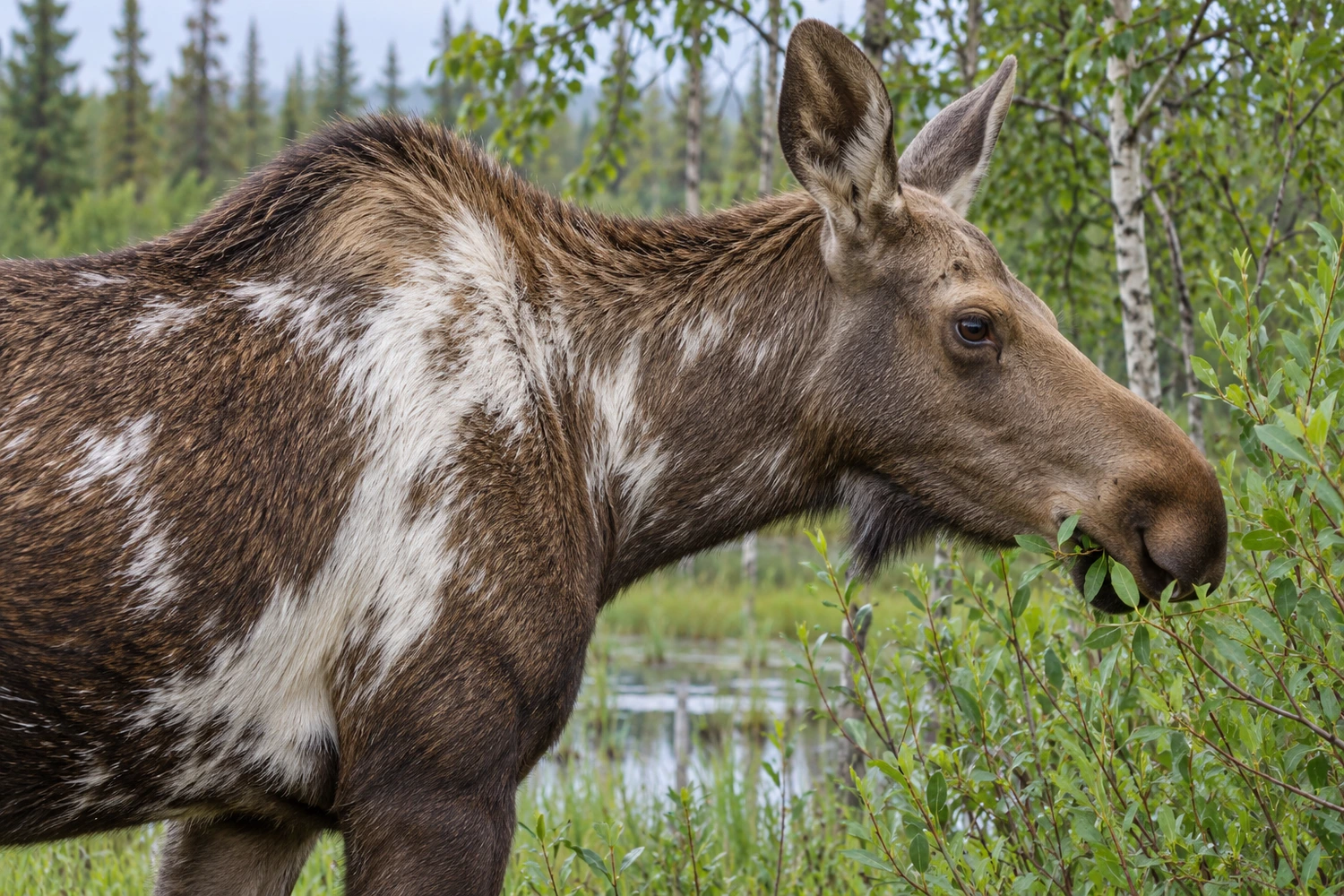
A piebald moose has irregular areas of white hair alongside its usual brown coat. The pattern can look startling, but it is a color variation, not a new species or a cross with another animal. A photograph can show the markings; it cannot, by itself, establish the animal’s genetic mutation, ancestry or location.
What does piebald mean?
Piebald describes a patchwork of unpigmented and normally colored areas. Wildlife sources often discuss this as partial leucism. The Alaska Department of Fish and Game explains that leucism can affect an entire animal or only patches, while the eyes retain normal-looking pigmentation. Its explanation of pale mammals provides useful background, although the featured case concerns bison rather than moose.
In a moose, white areas may interrupt a brown neck, flank or back. The amount and arrangement vary. A striking pattern alone does not establish poor health, an unusual temperament or a distinct subspecies.
Piebald moose versus albino moose
Leucism and albinism are related to pigmentation, but they are not interchangeable labels. The Swedish University of Agricultural Sciences’ moose FAQ distinguishes white leucistic moose from albinos and notes that leucism can affect particular areas of the body.
Dark eyes in a white or patchy animal support a leucistic interpretation. Albinism affects melanin production and can also alter eye and skin pigmentation. Lighting, image processing and distance make diagnosis from a social-media photograph uncertain. “White moose” is a description, not a complete genetic diagnosis.
Is a KIT mutation responsible?
The specific claim that all piebald moose owe their markings to the KIT gene goes beyond the evidence established here. In an August 16, 2017 research announcement, Swedish university scientists described plans to compare white and brown moose genomes to identify the cause. That announcement is evidence of an investigation, not a published identification of a causal variant.
KIT is relevant to some pigmentation conditions: a 1991 human family study identified a mutation linked to piebaldism. However, results from people cannot simply be assigned to moose. UC Davis also describes white spotting associated with MITF in dogs, illustrating why a similar appearance does not guarantee an identical genetic cause across species.
Where have white and spotted moose been reported?
The Swedish university announcement records both solid-white and white-spotted moose in Värmland, Sweden, and reports from North America. This supports the reality of unusual moose coloration. It does not authenticate every circulating photograph or establish a global frequency.
No defensible worldwide “one in a million” figure was established by the sources reviewed. Sightings are also affected by observer effort and repeated sharing of the same animal. Calling a particular image a new Canadian or Norwegian sighting requires a traceable photographer, date and location.
Does the coat change survival?
White patches can change an animal’s contrast against its surroundings, but a photograph cannot measure their effect on survival. Background, season, movement and predator behavior all matter. Claims that body size makes a pale moose effectively predator-proof are unsupported.
The Alaska moose profile lists wolves, black bears and brown bears as predators. Size varies with age, sex and population; a single heavyweight range should not be applied to every moose.
How should an unusual moose be observed?
Give it the same space as any other moose. Use a long lens, keep dogs away and avoid following or surrounding it. Unusual coloration is a reason for careful observation, not closer contact. Record the date and location privately if reporting the sighting to a wildlife agency, and distinguish your own observation from an image received online.