
Pit bull colors include black, reddish shades, blue-gray and combinations with white, but color and pattern are different traits. Merle is a mottled pattern rather than a separate breed. For the American Pit Bull Terrier specifically, the United Kennel Club (UKC) accepts many colors and patterns but disqualifies merle and albinism. Appearance alone cannot establish a dog’s pedigree.
What does “pit bull” mean in a color guide?
Everyday use of “pit bull” can be broader than the registered American Pit Bull Terrier. Related breeds and mixed dogs are often grouped under similar labels. The American Staffordshire Terrier, for example, has its own history and breed standard. A color chart should therefore identify which breed’s rules it is describing rather than treating all short-coated, muscular dogs as interchangeable. See the AKC American Staffordshire Terrier profile.
This guide uses “pit bull colors” as the common search phrase while separating visible coat traits from formal recognition. A photograph can illustrate a coat; it cannot certify ancestry or registration.
Common color names and what they describe
| Term | Visible feature | Important distinction |
|---|---|---|
| Blue or gray | A slate-gray appearance to pigmented coat areas | A dilution color, not a separate breed |
| Red | A reddish coat appearance | A descriptive label, not a complete genetic diagnosis |
| White or piebald | White areas with variable colored patches | White spotting differs from albinism |
| Brindle | Darker striping over a lighter background | A pattern rather than a single solid color |
| Merle | Irregular patches of diluted and stronger pigment | Excluded by the UKC American Pit Bull Terrier standard |
The UKC standard is the relevant primary reference for its own conformation requirements. Those requirements describe eligibility under that registry; they do not determine a dog’s worth as a companion.
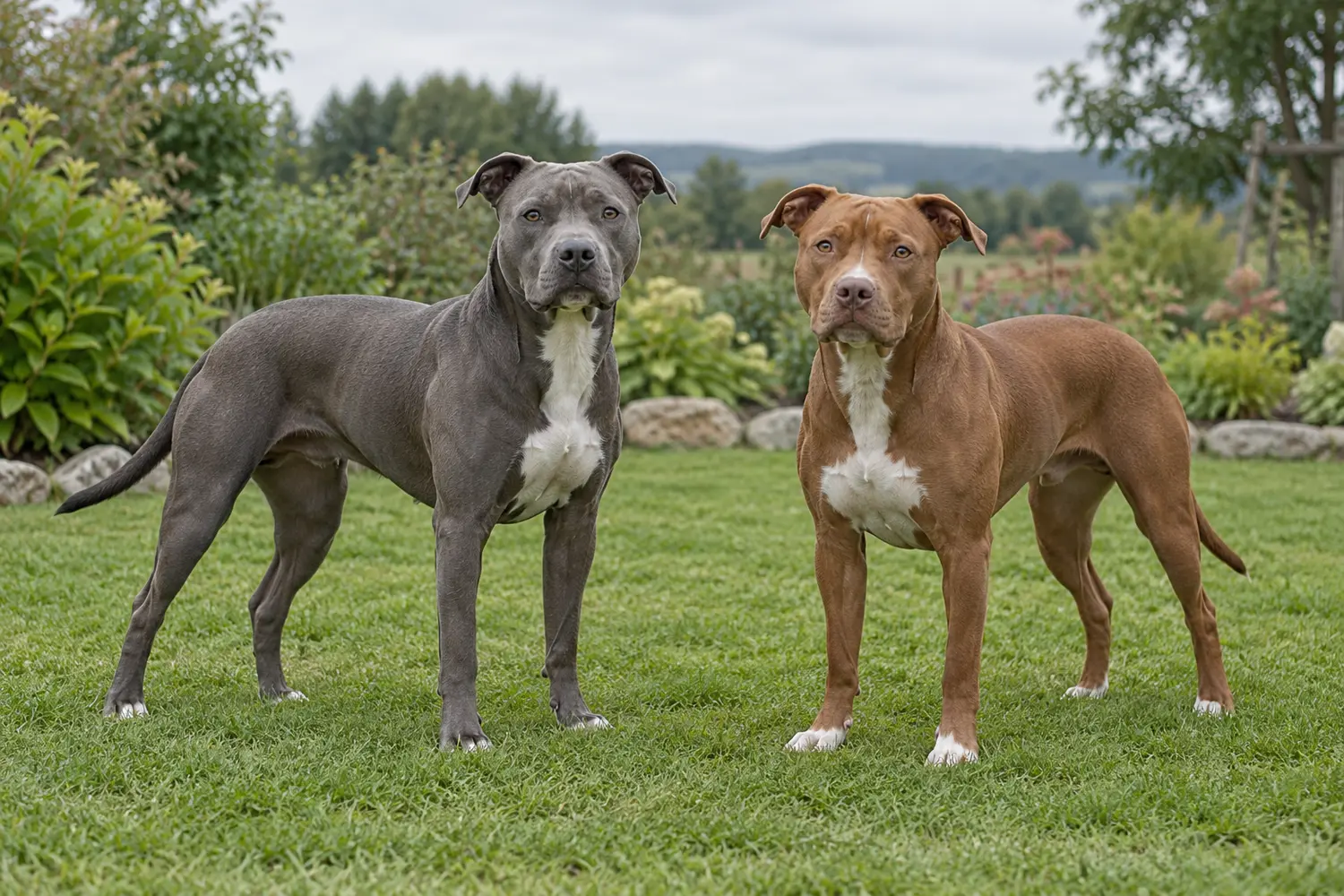
Why a blue coat looks gray
“Blue” is dog-color terminology, not a claim that the fur is bright blue. Dilution can lighten black pigment to a gray or slate appearance. UC Davis links the canine dilute trait to variants in MLPH, a gene involved in pigment distribution. Its Veterinary Genetics Laboratory guide explains the inheritance and available tests.
Lighting, camera processing and surrounding colors change how gray fur appears in a photograph. A picture is useful for description but cannot identify every relevant variant. Likewise, “blue nose” and “red nose” describe appearance and should not be treated as separate species or proof of a special temperament.
White markings are not automatically albinism
A white chest, feet or broad body patches can occur through white spotting. The amount of white varies. UC Davis identifies an MITF variant associated with piebald spotting in many breeds while emphasizing that white-pattern genetics are complex and not uniform across dogs. See its piebald and white-spotting reference.
Consequently, an all-white appearance alone does not establish albinism. Coat description, genetic explanation and a registry’s disqualification rules should remain distinct.
Why merle needs a separate explanation
Merle produces irregular areas of diluted pigment alongside more fully pigmented areas. UC Davis describes an insertion affecting PMEL, with variation in the insertion associated with a range of appearances. Some dogs carry variants with little obvious visible pattern. The laboratory’s merle guide explains why appearance alone can miss relevant genetics.
Merle is therefore more than another name for solid gray. UKC excludes it from the American Pit Bull Terrier standard. At the same time, seeing a merle dog marketed as a “pit bull” does not establish its exact ancestry or the origin of its pattern.
UC Davis also cautions that some offspring inheriting merle variants from both parents may have hearing, eye or other defects. Outcomes depend on the variants involved; it is inaccurate to say every merle dog is unhealthy. Breeding decisions require informed veterinary and genetic advice rather than a photograph or a fashionable color label.
Does color predict personality?
Color charts sometimes pair coat shades with broad claims about energy or loyalty. Coat appearance does not provide an individual behavioral assessment. Evaluate the actual dog’s history, behavior and needs instead of assigning a personality to a shade of fur.
What should readers remember?
Describe the visible coat first, distinguish base color from pattern, and specify the registry when discussing acceptance. Blue-gray, white spotting and merle have different explanations. A striking color is neither proof of pedigree nor a reason to overlook health and individual behavior.