
Primate bite force is often presented as a tidy leaderboard: one animal gets a number in newtons or PSI, another gets a smaller number, and the larger value supposedly identifies the “strongest” primate. Real biomechanics is not that simple. A bite estimate depends on the individual, tooth position, muscle assumptions, jaw leverage and measurement method. Values copied from different studies may not be directly comparable.
Why viral primate bite-force rankings are unreliable
Researchers can measure voluntary bites, estimate force from jaw-muscle anatomy, or simulate loading with computer models. Each approach answers a slightly different question. A 2025 review noted that maximum estimates for a single primate species can span hundreds of newtons. It also emphasized that molar bites normally exceed incisor bites because the back teeth sit closer to the jaw joint and benefit from greater mechanical leverage (Laird et al., 2025).
That makes a four-number social-media graphic misleading unless every value comes from comparable individuals, the same tooth position and the same protocol. Converting force to PSI adds another problem: pressure requires a contact area, which is rarely reported consistently. Newtons describe force; PSI describes pressure. They are not interchangeable labels for “jaw power.”
What actually creates a powerful bite?
Jaw performance comes from a system rather than one oversized muscle. Important variables include the physiological cross-sectional area of the masseter and temporalis muscles, their fiber types, the direction of muscle pull, skull shape, jaw length and the location of the biting tooth. Body size matters, but scaling alone does not explain every difference.
A broad analysis of 34 primate species reconstructed jaw-muscle resultants and estimated posterior bite force. The study showed that where the muscle resultant acts relative to the jaw joint changes the leverage available at the teeth (Dumont et al., 2012). More recent anatomical work also shows that muscle fiber architecture can change estimates substantially (Taylor et al., 2021).
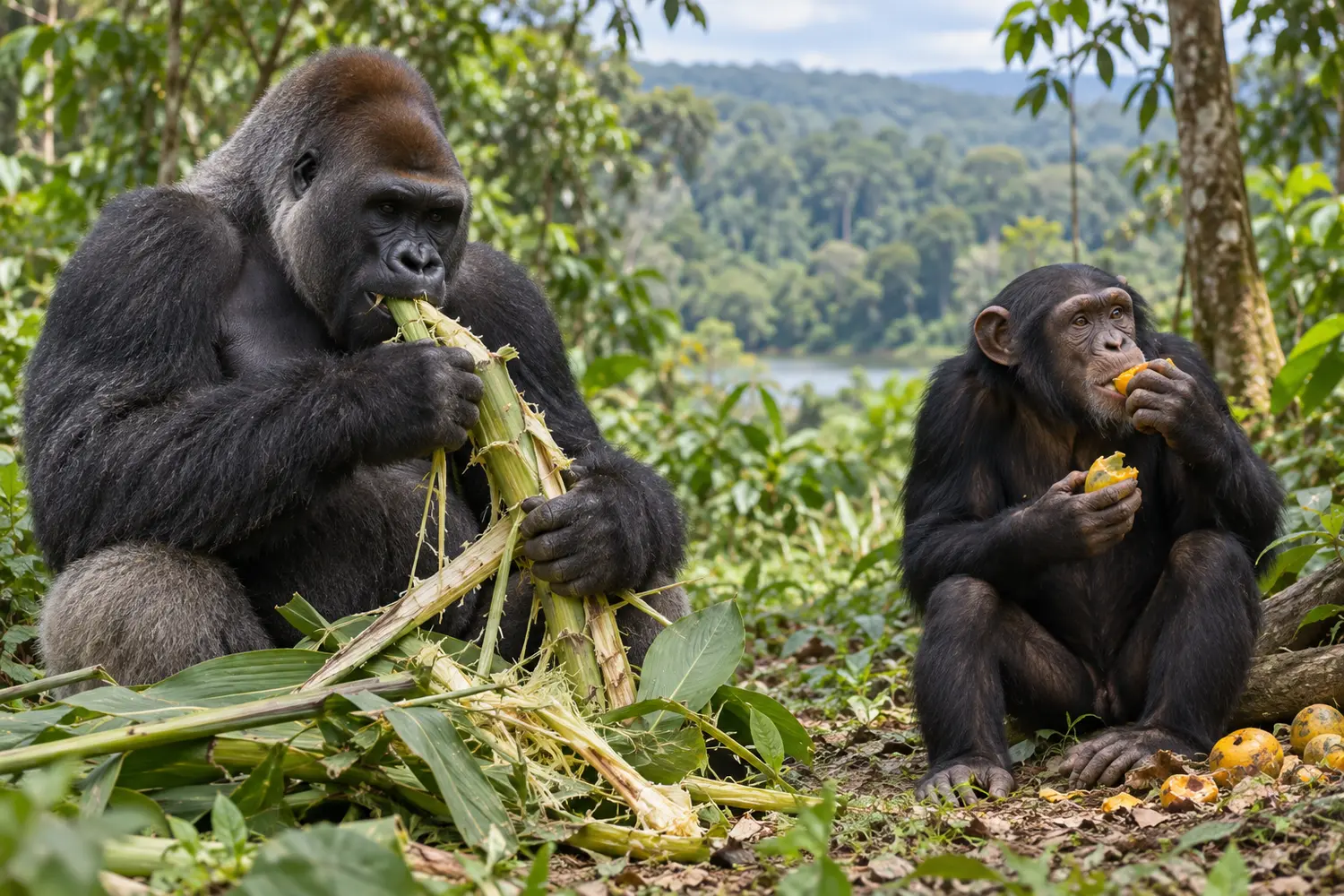
Gorilla and chimpanzee jaws are not simple opposites
Gorillas are much larger than chimpanzees, so an unadjusted maximum-force estimate from a large gorilla can be higher. One finite-element comparison estimated a second-molar bite of 1,723 N for its gorilla model and 1,511 N for its chimpanzee model. Those are model outputs from particular specimens—not universal species constants (Wroe et al., 2010).
Muscle physiology further complicates the comparison. A recent synthesis reports that gorillas appear adapted for lower-force, fatigue-resistant chewing, while chimpanzees may be capable of greater relative force but more fatigable chewing under some anatomical assumptions (Taylor & colleagues, 2025). That does not mean every chimpanzee outbites every gorilla. It means feeding systems can be specialized for different combinations of force, endurance and food properties.
Orangutans: tough foods without a universal number
Orangutans often eat fruit, but their fallback foods can include unripe fruit, bark, leaves, nuts and other mechanically challenging items. Their hands also help manipulate and open foods before the teeth finish the job. Laboratory fracture tests can estimate the force needed to break a food, but that value is not automatically the animal’s measured bite force.
For example, research on dental chipping and food fracture found that orangutans can process hard items and discussed forces above 2 kN for cracking macadamia nuts. Another dietary review cautioned that some exceptionally resistant wild foods would require forces that may exceed orangutan capacity if bitten directly (Constantino et al., 2010; Vogel et al., 2022). Food selection, tool-like hand use and repeated processing all matter.
Mandrills: canines are not the whole story
Adult male mandrills have conspicuous canine teeth, but long canines do not by themselves prove the highest bite force. Canines can function in threat displays, social competition and defense, while premolars and molars do much of the routine crushing and grinding. Anatomically derived work includes mandrills among primates adapted to mechanically challenging diets, yet the final estimate still depends on muscle architecture and jaw mechanics (Deutsch et al., 2020).
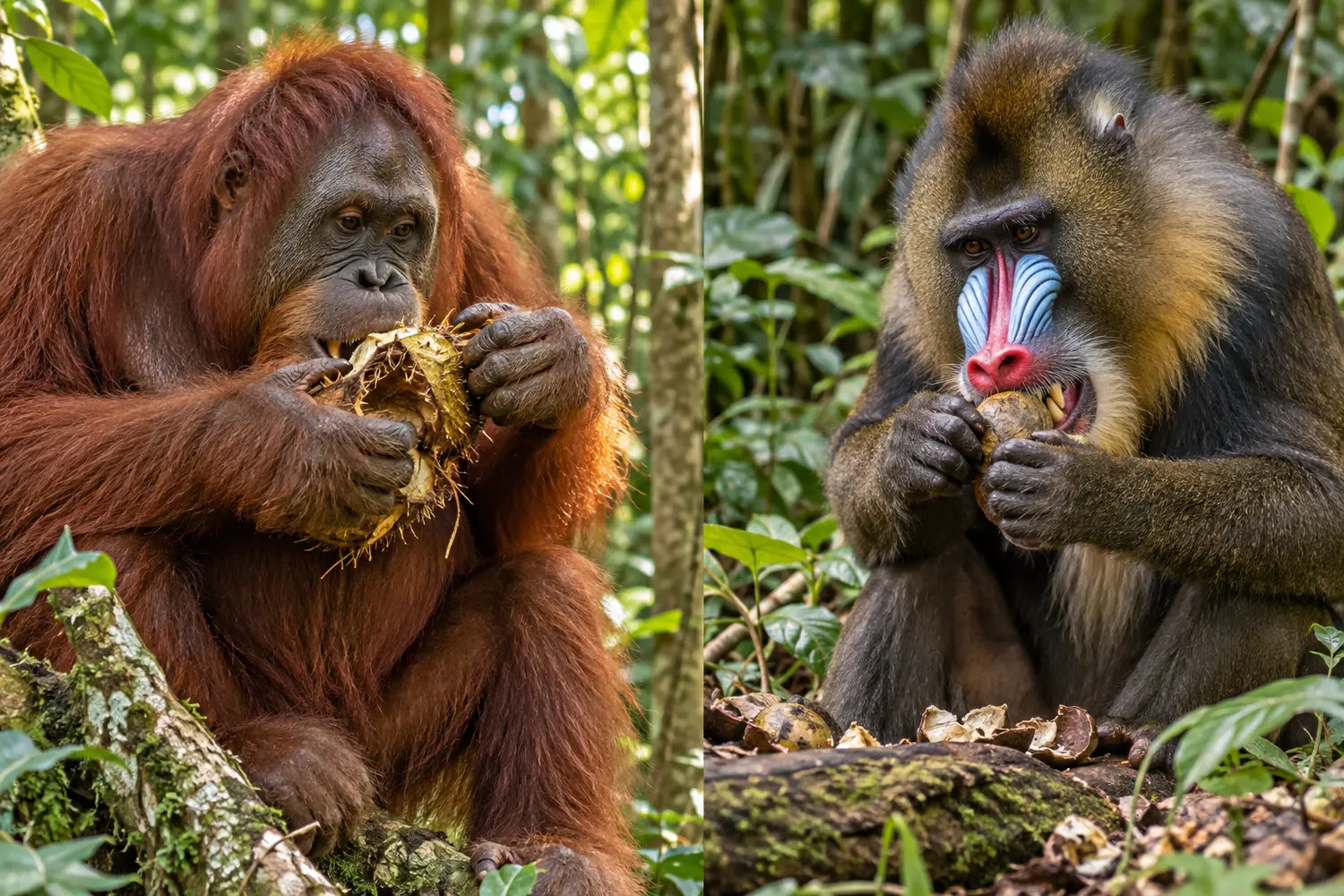
Can these four primates be ranked fairly?
Not from a viral graphic. A defensible comparison would need matched sex and body size information, identical tooth positions, the same definition of maximum force and the same measurement or modeling method. Even then, the result would describe bite performance—not total body strength, intelligence, fighting ability or ecological importance.
The best conclusion is therefore qualitative: gorillas, chimpanzees, orangutans and mandrills each have feeding systems shaped by body size, diet, muscle physiology and skull mechanics. Their differences are adaptations, not entries in a universal combat ranking.
Frequently asked questions
Which primate has the strongest bite?
There is no single experimentally standardized ranking covering all primates. Large apes can generate high absolute forces, but published values depend heavily on method, specimen and tooth position.
Is bite force the same as bite pressure?
No. Force is measured in newtons. Pressure, such as PSI, divides force by contact area. Without a consistently defined contact area, PSI comparisons can be especially misleading.
Why is a molar bite stronger than an incisor bite?
Molars sit closer to the jaw joint. That shorter out-lever generally gives the jaw-closing muscles a mechanical advantage compared with biting at the front teeth.
References
- Laird et al. (2025), A (Bite) Force to Be Reckoned With
- Dumont et al. (2012), jaw-adductor resultant and estimated bite force
- Taylor et al. (2021), jaw-muscle fiber types and bite-force estimates
- Wroe et al. (2010), hominoid cranio-mandibular mechanics
- Deutsch et al. (2020), anatomically derived maximum bite force