
Puma vs Boerboel comparisons are popular because both animals look powerful, but they were shaped for entirely different lives. The puma (Puma concolor) is a solitary wild felid and ambush predator. The Boerboel is a large domestic working dog developed as a confident farm and family guardian. A responsible comparison focuses on verified anatomy, behavior and function—not a staged fight or a viral bite-force score.
Puma vs Boerboel at a glance
| Feature | Puma | Boerboel |
|---|---|---|
| Scientific status | Wild felid, Puma concolor | Domestic dog breed, Canis lupus familiaris |
| Typical role | Solitary ambush predator | Property and family guardian |
| Reported adult size | Strongly varies by sex and region; large males may approach 200 lb (91 kg) | AKC reference range: 150–200 lb (68–91 kg) |
| Movement | Flexible spine, powerful hind limbs, climbing and pouncing ability | Heavy-boned, balanced, ground-based working build |
| Social setting | Usually solitary outside breeding and maternal care | Lives and works in a human-managed social environment |
The overlap at the upper end of body mass can be misleading. Weight alone does not make two animals equivalent. Proportions, limb mechanics, claws, dentition, training, health, age and context all matter. Even the largest published figures do not describe every individual.
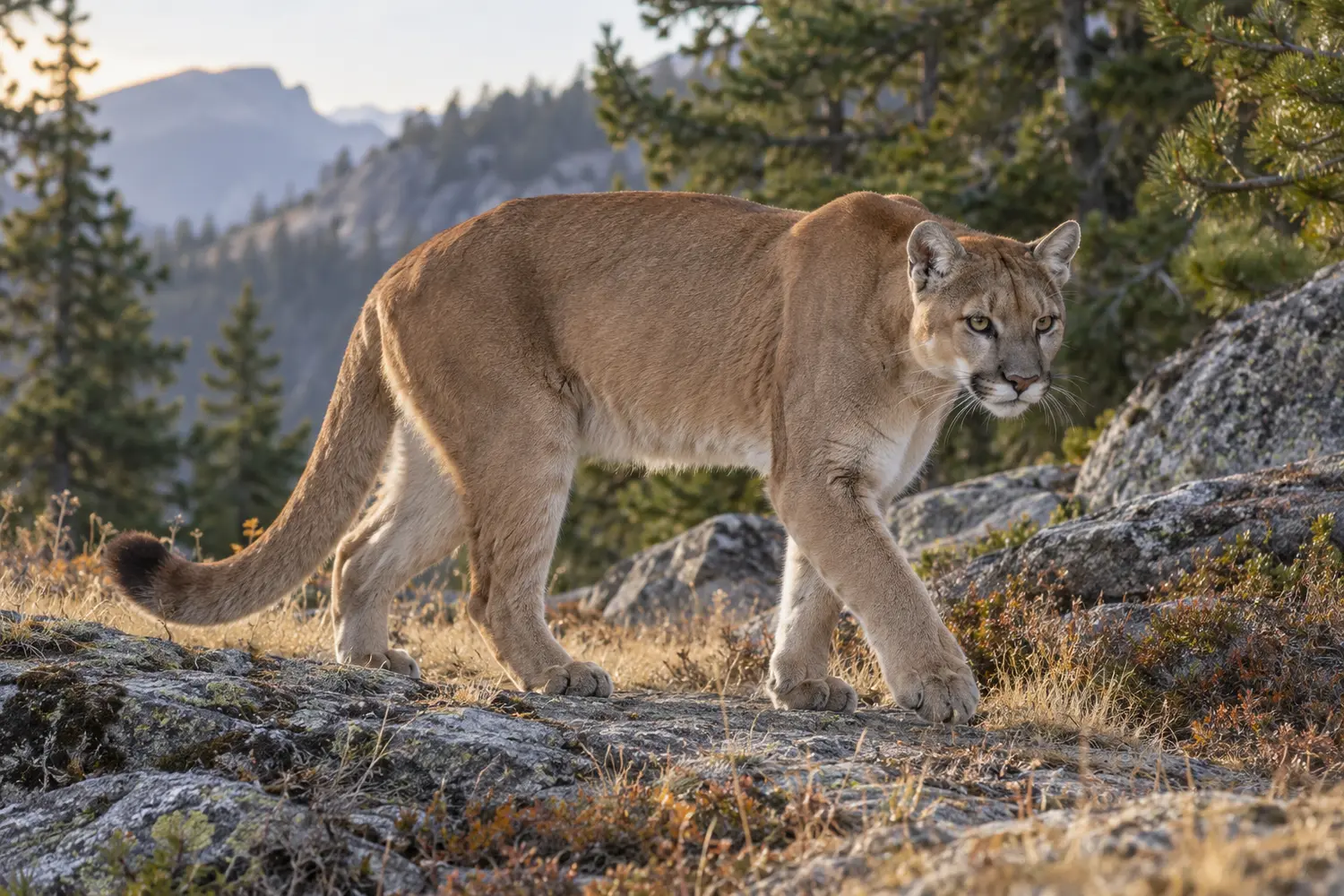
The puma: a specialist in stealth and acceleration
Pumas are known by several regional names, including cougar, mountain lion and panther. Their distribution spans a remarkable range of habitats in the Americas. The U.S. National Park Service describes mountain lions as elusive top predators and notes that large males can reach about 200 pounds, although size varies considerably across populations and between sexes.
A puma’s body is built for stalking and explosive movement. Long hind limbs, a flexible spine, retractile claws and a long tail support balance during quick turns and leaps. Research using accelerometers on free-ranging pumas found that the cats conserve energy by remaining cryptic and matching the force of a pounce to prey size. That finding supports the description of the puma as an ambush hunter, but it does not turn every encounter into a predictable contest.
Wild pumas normally avoid people and dogs when they can. If a person encounters one, wildlife agencies advise staying upright, facing the animal, making oneself look larger and backing away slowly rather than running. Those safety recommendations are more useful than imagining a fight outcome.
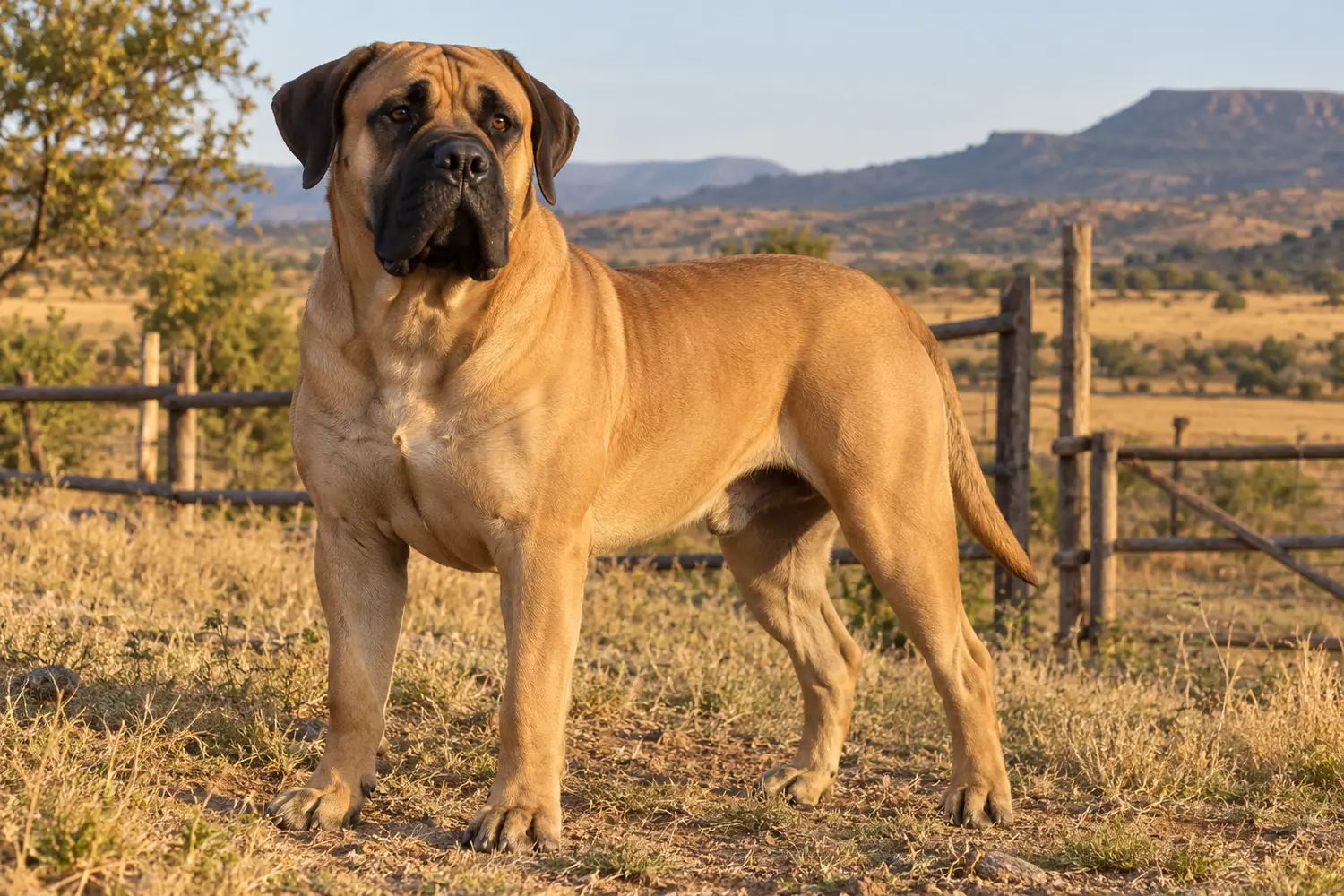
The Boerboel: a powerful domestic guardian
The Boerboel is a South African mastiff-type working dog. The American Kennel Club lists males at 24–27 inches (61–69 cm) at the shoulder, females at 22–25 inches (56–64 cm), and a general weight range of 150–200 pounds (68–91 kg). Its official standard emphasizes balance, proportion, sound movement, a broad muscular head and a calm, stable, confident temperament.
That is important: the breed standard does not describe a wild predator. A Boerboel is a domestic dog whose behavior depends heavily on breeding, socialization, training and management. Its strength and protective instincts demand experienced ownership, secure containment and careful introductions. “Guardian” should not be treated as permission to test a dog against wildlife.
Why viral bite-force numbers are unreliable
Graphics often assign the puma “400 PSI” and the Boerboel “800 PSI.” Those neat numbers should not be presented as established facts. Bite-force studies use different methods: direct measurements, skull-based models, muscle estimates and scaling equations. Results may be reported in newtons, pressure units or a body-mass-adjusted bite-force quotient. These values are not interchangeable.
Peer-reviewed carnivore studies do include modeled estimates for pumas, but a modeled force at a particular tooth position is not the same as a universal “PSI rating.” No recognized Boerboel breed standard supplies an official bite-force number. Therefore, a precise puma-versus-Boerboel PSI comparison creates more certainty than the evidence supports.
Could one defeat the other?
There is no ethical, scientifically controlled evidence base that can declare a reliable winner. Real encounters would vary with individual size, sex, age, health, motivation, terrain and the chance to escape. A puma has wild-predator adaptations, including claws and rapid grappling movements. A Boerboel has substantial mass, muscular strength and a guarding background. Those facts describe each animal; they do not justify a deterministic outcome.
Staging an encounter would endanger both animals and could violate animal-welfare or wildlife laws. The practical lesson is separation: supervise large dogs in puma country, bring pets indoors from dusk to dawn where risk is elevated, secure food and livestock attractants, and follow local wildlife-agency guidance.
The real comparison
The puma is optimized to locate, approach and subdue prey while minimizing energy costs. The Boerboel is the product of domestic selection for a steady, imposing guardian that works alongside people. Their superficial overlap in size hides a deeper contrast between ecological adaptation and human-directed breeding.
So the most accurate conclusion is not “which one wins.” It is that each animal’s power makes sense in its own setting—and that neither should be forced into the other’s.
Frequently asked questions
Is a puma the same animal as a cougar or mountain lion?
Yes. Puma, cougar and mountain lion are common names for Puma concolor. Regional naming varies across its range.
Is a Boerboel heavier than a puma?
Many adult Boerboels are heavier than many pumas, but their ranges overlap and individual variation is large. Published maximums should not be mistaken for typical weights.
Does a Boerboel have an 800 PSI bite?
No authoritative breed standard establishes that figure. Online PSI claims often omit the specimen, measurement method and original study, so they should not be treated as verified breed facts.
References
- U.S. National Park Service: Mountain Lions, Rocky Mountain National Park
- U.S. National Park Service: Mountain Lion Safety
- Williams et al. (2014): Instantaneous energetics of puma kills
- American Kennel Club: Boerboel breed information
- American Kennel Club: Official Standard for the Boerboel
- Wroe et al. (2005): Comparative bite force in mammals
- Christiansen and Wroe (2007): Bite forces and feeding ecology in carnivores