
Reindeer eyes change color seasonally because a reflective layer behind the retina changes its microscopic structure. In Arctic animals studied by researchers, this layer—the tapetum lucidum—looks golden in summer and deep blue in winter. The shift helps tune the eye to scarce winter light. It is not a seasonal repainting of the iris.
What part of a reindeer’s eye changes color?
The tapetum lucidum redirects light through the retina, giving photoreceptors another opportunity to detect it. In reindeer, its reflective surface contains collagen fibers. A 2013 study by Stokkan and colleagues found seasonal differences in both this tissue and retinal sensitivity: winter samples reflected blue rather than the summer gold.
This distinction matters when interpreting photographs. A blue iris painted onto an ordinary reindeer portrait does not explain the finding. The scientific observation concerns an internal reflector, not a visible change in the animal’s entire eye surface. Our featured illustration therefore keeps the reindeer’s external eyes natural.
Why does the reflector turn blue in winter?
A 2022 optical study by Fosbury and Jeffery linked the color shift to the spacing and organization of collagen fibrils and the fluid between them. Changing that arrangement changes which wavelengths the tissue reflects. Their model describes a broad summer reflector becoming more strongly tuned toward blue in winter.
The researchers tested this explanation by monitoring reflection as isolated tapetal tissue lost fluid. Their results support a structural explanation rather than a simple change of pigment. The reflector is effectively being retuned through its physical arrangement.
The cause inside a living eye needs more careful wording. The earlier study measured higher intraocular pressure in winter animals and proposed that prolonged pupil dilation could affect drainage and compress the tissue. The 2022 paper treated pressure as a possible trigger, not a fully established chain of events. “Pressure makes reindeer eyes blue” is therefore too definite.
Arctic twilight is dim, but it is still light
Polar night means the sun stays below the horizon; it does not mean every hour is completely lightless. A 2022 scientific commentary explains how low sunlight passing through the atmosphere produces a particularly blue twilight spectrum. The winter reflector’s properties correspond closely to that available light.
Calling this “vision in perpetual darkness” can obscure the mechanism. A light-sensitive eye still needs photons. The seasonal adaptation improves the use of weak illumination; it does not allow an animal to see when there is no light at all.
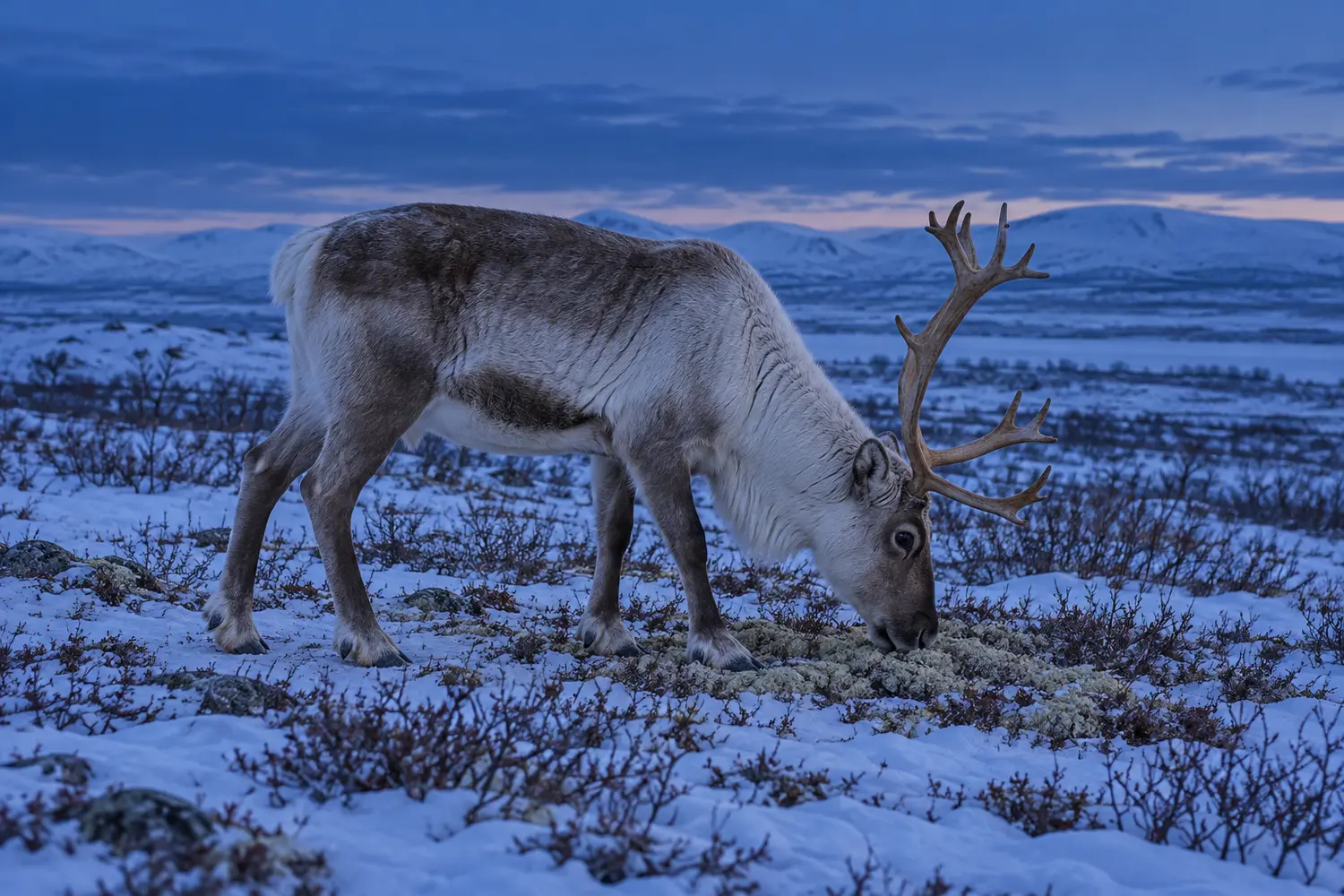
Could this help reindeer find food?
Reindeer vision also extends into ultraviolet wavelengths. In a 2023 study, Dominy, Hobaiter and Harris examined the reflectance of lichens eaten by reindeer in Scotland. Pale lichens that can blend into snow for human observers absorb ultraviolet light, potentially creating useful contrast for a reindeer.
This suggests a practical benefit for finding winter food, alongside proposed benefits for noticing predators. However, the study’s spectral measurements do not establish that every reindeer locates every food patch by ultraviolet vision. The authors present a promising explanation for feeding ecology, not a complete account of the animal’s perception.
What the evidence does—and does not—show
The central finding is well supported: the tapetum changes its reflective properties between seasons. Explaining exactly what that means for a moving animal in a complex landscape remains more difficult. Retinal sensitivity, visual sharpness and successful detection of food are related but different outcomes.
A useful reading rule is to keep those levels separate: tissue measurements establish the optical change; proposed mechanisms explain how it might happen; ecological studies investigate why it might matter. The real discovery is remarkable enough without neon-blue eyes or claims of sight in absolute darkness.
References
- Stokkan et al. (2013). Shifting mirrors: adaptive changes in retinal reflections to winter darkness in Arctic reindeer.
- Fosbury & Jeffery (2022). Reindeer eyes seasonally adapt to ozone-blue Arctic twilight by tuning a photonic tapetum lucidum.
- Adaptive optics in the Arctic? A commentary on Fosbury and Jeffery (2022).
- Dominy, Hobaiter & Harris (2023). Reindeer and the quest for Scottish enlichenment.