
Rhino vs hippo comparisons often turn two enormous African herbivores into imaginary fighting machines. In reality, “rhino” refers to five living species, while the familiar river hippo is Hippopotamus amphibius. Their size can overlap, but their bodies, habitats and defensive tools evolved for very different lives. No responsible comparison can assign a universal winner from weight, speed or a viral bite-force number.
Rhino vs hippo at a glance
| Trait | White rhinoceros | Common hippopotamus |
|---|---|---|
| Scientific name | Ceratotherium simum | Hippopotamus amphibius |
| Main habitat | Open grassland and savanna | Rivers, lakes and nearby grazing areas |
| Primary diet | Short grasses | Mostly grasses and other vegetation |
| Defensive anatomy | Large body, two keratin horns and rapid acceleration | Large body, wide gape, continuously growing incisors and canines |
| Typical social pattern | Variable; white rhinos are the most social rhino species | Groups in water, with territorial adult males |
Which rhinoceros are we comparing?
A generic “rhinoceros” weight is misleading because living rhinos differ greatly. The Sumatran rhino is much smaller than the white rhino. Since the viral comparison uses an animal near two metric tons, the most appropriate reference is the white rhinoceros, the largest living rhino species.
San Diego Zoo Wildlife Alliance lists the heaviest white rhinos at about 2,300 kilograms and notes that a black rhino can reach roughly 64 kilometers per hour. Those are upper figures, not measurements that every individual reaches. Sex, age, subspecies, health and measurement method all affect size and performance.
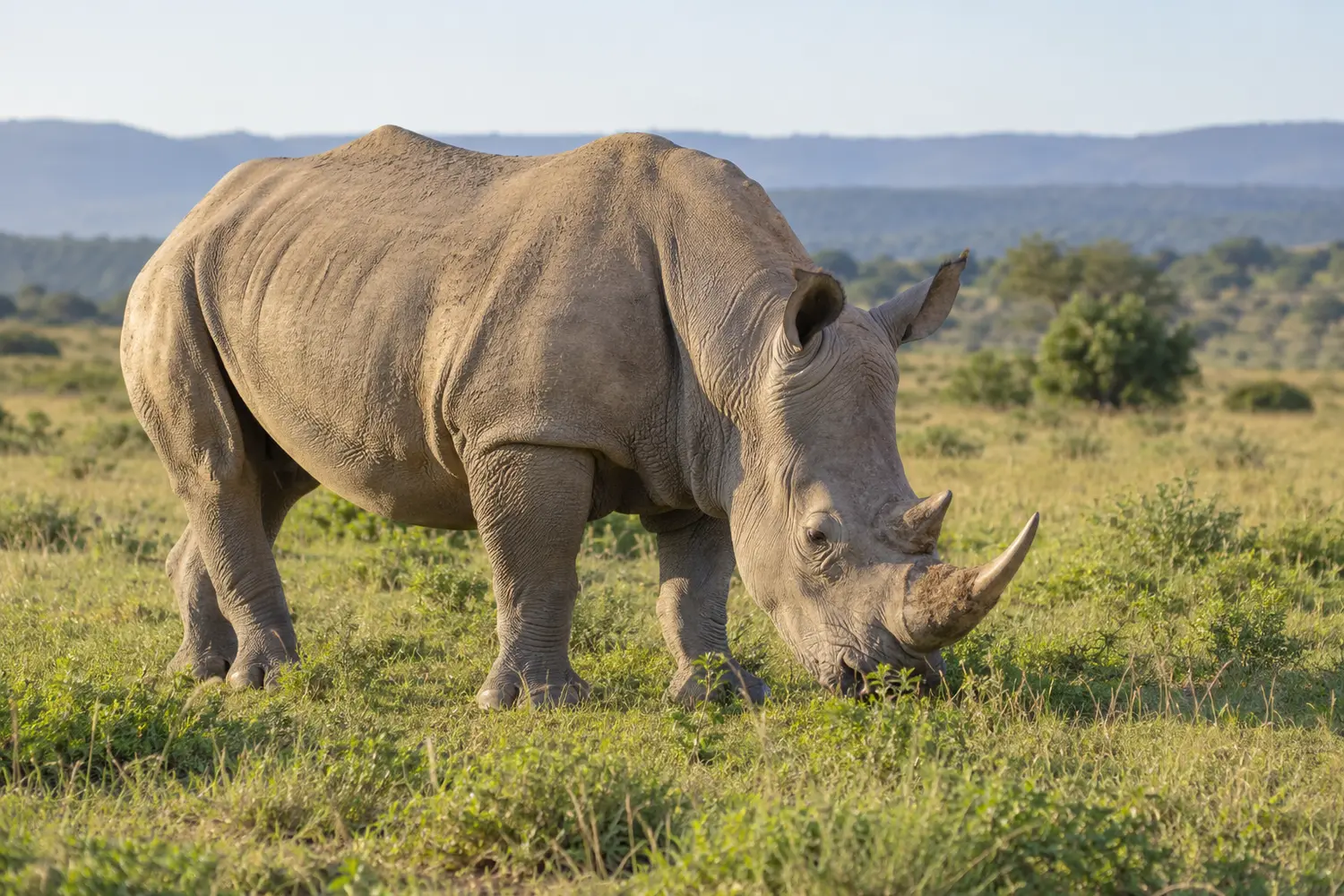
The white rhino is a grassland grazer
White rhinos have a long head and a broad, square upper lip adapted for cropping short grasses. Their mass is carried on four sturdy limbs, and the prominent shoulder hump supports the large head. Although they look slow, rhinos can accelerate rapidly when alarmed.
The two horns are not bone and do not contain a bony core like bovine horns. Anatomical and materials research shows that rhino horn is a compact, fully keratinous structure. It grows from specialized skin over the nasal region. The horn can be used in displays, defense and contests, but describing it as an “armor-piercing weapon” imports human combat language into normal animal anatomy.
Rhino skin is thick in places, yet it is not invulnerable armor. Rhinos wallow in mud partly to protect their skin from sun and insects. Wounds, parasites and heat still matter to an animal weighing well over a ton.
The common hippo is built around water
Common hippos require permanent or seasonal water and suitable grazing within traveling distance. They spend much of the day in water or mud and usually leave to feed after dark. Their eyes, ears and nostrils sit high on the skull, allowing most of the body to remain submerged while the animal monitors its surroundings.
Animal Diversity Web gives a broad body-mass range of approximately 1,300 to 3,200 kilograms for typical adults, with exceptionally large captive males reported above that. This overlaps the white rhino’s range and shows why a single “rhino is always heavier” rule fails.
Hippos have continuously growing, tusk-like incisors and canines. The lower canines may reach about 50 centimeters. Their jaw can open to roughly 150 degrees—not the often-repeated 180 degrees. A wide gape is useful in threat displays and in contests between hippos; it is not how they gather their normal grass diet.
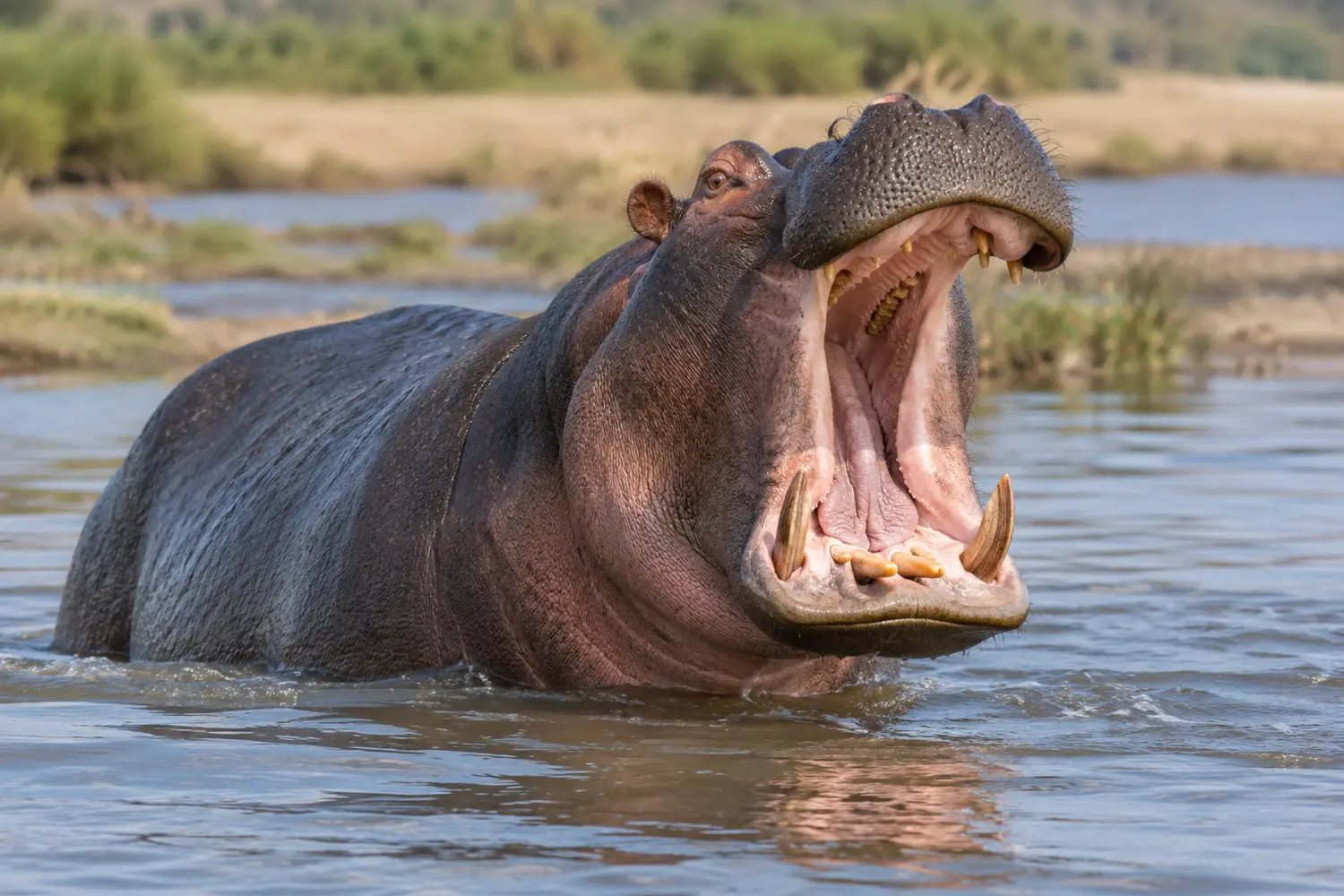
Why exact PSI rankings are unreliable
Posters commonly assign a hippo a bite of 1,600, 1,800 or 2,000 PSI. The changing number is a warning sign. Bite pressure depends on force, contact area, tooth position and gape. A value estimated from anatomy cannot automatically be compared with a direct measurement from another species, especially when the test method and sample are not reported.
Clinical reports make the important point without relying on a ranking: hippo bites can cause catastrophic crushing, penetrating injuries and tissue loss. Their jaws and enlarged teeth are clearly dangerous. That does not establish one universal PSI score for every hippo or prove how an encounter with a rhino would end.
Rhino horns and hippo jaws also perform different mechanical tasks. Comparing them with one number is like ranking a spear and a vise on a single scale. Direction, contact, movement, substrate and the behavior of both animals would all change the forces involved.
Do rhinos and hippos meet in the wild?
In parts of sub-Saharan Africa, the ranges of African rhinos and common hippos can overlap around rivers, floodplains and grasslands. Shared geography does not mean constant conflict. White rhinos primarily graze on land, while hippos rest in water by day and graze on land at night. Their daily schedules and preferred spaces often reduce direct competition.
Wild animals generally avoid unnecessary injury. Threat displays, changes in direction and maintaining distance can resolve an encounter without physical contact. A photograph or short video of one confrontation cannot support a universal rule about which species “dominates.”
Does water decide the outcome?
The claim that a hippo automatically wins in water and a rhino automatically wins on land is too simple. Water depth, bank shape, visibility, escape routes, age, sex, condition, surprise and whether young are nearby would all influence behavior. Hippos are highly adapted to moving through shallow water and along river bottoms, while rhinos are primarily terrestrial. Those facts describe locomotion—not a guaranteed fight result.
The biologically useful conclusion is that both animals are formidable because they are well matched to their own ecological roles. The white rhino is a giant grazer with powerful acceleration and keratin horns. The common hippo is a semi-aquatic grazer with a wide-gaping jaw and enlarged defensive teeth.
Frequently asked questions
Is a hippo heavier than a rhino?
Sometimes. Adult body-mass ranges overlap. A large white rhino may outweigh many hippos, while a large male hippo may outweigh many rhinos. Species, sex and individual condition matter.
Can a hippo open its mouth 180 degrees?
Reliable anatomical summaries generally give a maximum near 150 degrees. “180 degrees” is an exaggeration.
Is rhino horn made of hair?
Rhino horn is an entirely keratinous structure with a complex internal organization. Calling it merely “compressed hair” is an oversimplification.
Which would win, a rhino or a hippo?
There is no evidence-based universal answer. Real encounters depend on individual animals and circumstances, and most wildlife behavior favors avoiding needless injury.
References
- San Diego Zoo Wildlife Alliance: Rhinoceros
- San Diego Zoo Wildlife Alliance: White rhinoceros
- Animal Diversity Web: Hippopotamus amphibius
- IUCN SSC Hippo Specialist Group: Common hippopotamus
- Structure of white rhinoceros horn
- Chewing, dentition and tooth wear in Hippopotamidae
- Clinical report on hippopotamus bite injuries