
Sea turtles have rows of tough, backward-pointing projections lining the esophagus. Called esophageal papillae, these keratinized structures help direct food toward the stomach and retain it while excess seawater moves back out through the mouth. They look like teeth, but they are not teeth—and they do not make every swallowed object impossible to expel.
Key takeaways
- Sea-turtle esophageal papillae are keratinized projections, not true teeth or bony spines.
- They point toward the stomach, helping food move in one direction and reducing reflux.
- The esophagus also helps separate retained food from water taken in during underwater feeding.
- Papillae differ in size and arrangement among species and along the length of the esophagus.
- Plastic ingestion is a serious threat, but saying the papillae make regurgitation “nearly impossible” goes beyond the available evidence.
What are sea turtle esophageal papillae?
Esophageal papillae are pointed structures made from keratin—the durable protein also found in claws, beaks and the outer layer of skin. They arise from the lining of the esophagus and angle backward, toward the stomach.
Studies of green, olive ridley, loggerhead, hawksbill and leatherback sea turtles have found pointed papillae in the esophageal lining of every species examined. Their exact shape, density and distribution vary, so the dramatic interior of one species should not be treated as a perfect model for all seven living sea-turtle species.
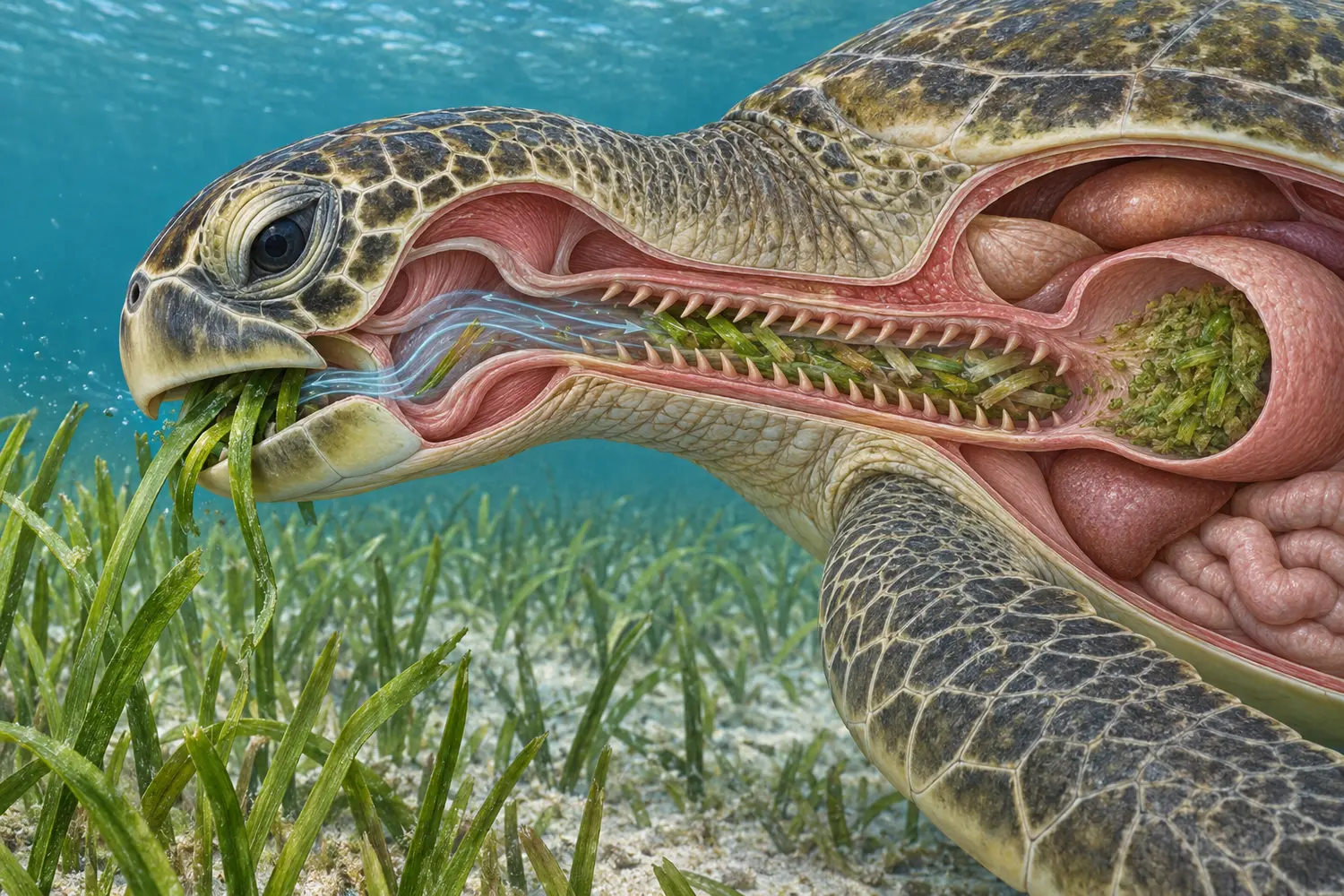
Why does a sea turtle’s throat have backward spikes?
A sea turtle cannot use lips and cheeks to create suction in the same way many fishes do. When it captures prey or bites vegetation underwater, food enters with surrounding seawater. Muscular movements of the throat and esophagus help move the meal inward while excess water is expelled through the mouth.
The backward orientation of the papillae provides friction against food moving in the wrong direction. Anatomical research also suggests that they facilitate swallowing and limit reflux, including reflux associated with pressure changes during diving.
The word “spikes” describes their appearance, but it can be misleading. These structures are part of living, flexible tissue and are covered with mucus. They form a specialized food-handling surface rather than a rigid trap made of separate needles.
Are the papillae teeth?
No. Modern turtles have no teeth. Their jaws are covered by a keratinized beak used to bite, crop, tear or crush food depending on the species. The papillae begin behind the mouth in the esophagus and help with transport rather than taking the initial bite.
| Structure | Location | Main role |
|---|---|---|
| Beak | Upper and lower jaws | Bites, tears, crops or crushes food |
| Esoph |