
Are all sharks dangerous? Sharks do not pose the same kind or degree of risk to people. A large predatory shark and a plankton-feeding whale shark have very different feeding systems. But a species label alone cannot tell you whether a particular encounter is safe, and a numbered “danger score” is not a substitute for evidence.
What the bite records can tell us
The Florida Museum’s International Shark Attack File (ISAF) confirmed 65 unprovoked bites worldwide in 2025, including nine fatalities. It separately recorded 29 provoked bites. “Unprovoked” means a bite occurred in the shark’s natural habitat without human provocation; it does not establish the animal’s motivation. These are documented incidents, not a complete count of every shark encounter. [1]
Those totals show that bites are uncommon on a global scale, but they cannot be turned directly into your chance of being bitten on a particular beach. Location, activity and exposure matter. A worldwide count is especially unsuitable for assigning every species a score out of ten.
Why white, tiger and bull sharks receive attention
ISAF highlights white sharks (Carcharodon carcharias), tiger sharks (Galeocerdo cuvier) and bull sharks (Carcharhinus leucas) as the “Big Three.” They are large, can cause serious injuries and overlap with places people enter the water. This identifies a meaningful hazard; it does not imply that every individual will approach or bite a swimmer. [2]
The same database warns that species identification is difficult. Distinctive sharks are easier to recognize than similar-looking coastal requiem sharks. Historical totals therefore reflect identification and reporting limitations as well as biology. They are not a controlled comparison in which every species had equal contact with people. [2]
Whale sharks: filter feeders still need space
The whale shark, Rhincodon typus, is the largest living fish. NOAA describes a diet of small organisms, including plankton, schooling fish and squid, strained from the water. Its feeding strategy is very different from that of a shark taking large prey. [3]
Calling it “zero danger,” however, turns a useful distinction into an absolute guarantee. NOAA explicitly asks observers to keep their distance. The practical message is to respect the animal’s space, rather than interpret its commonly docile behavior as permission to touch or crowd it. [3]
Why teeth and reputation are poor shortcuts
The sand tiger shark, Carcharias taurus, has conspicuous, narrow projecting teeth. The Florida Museum describes it as a slow-moving coastal shark and cautions that its size and teeth still demand respect. Its dramatic appearance alone does not establish an intention to attack. It is also called the grey nurse shark in Australia; that name does not make it a different risk category. [4]
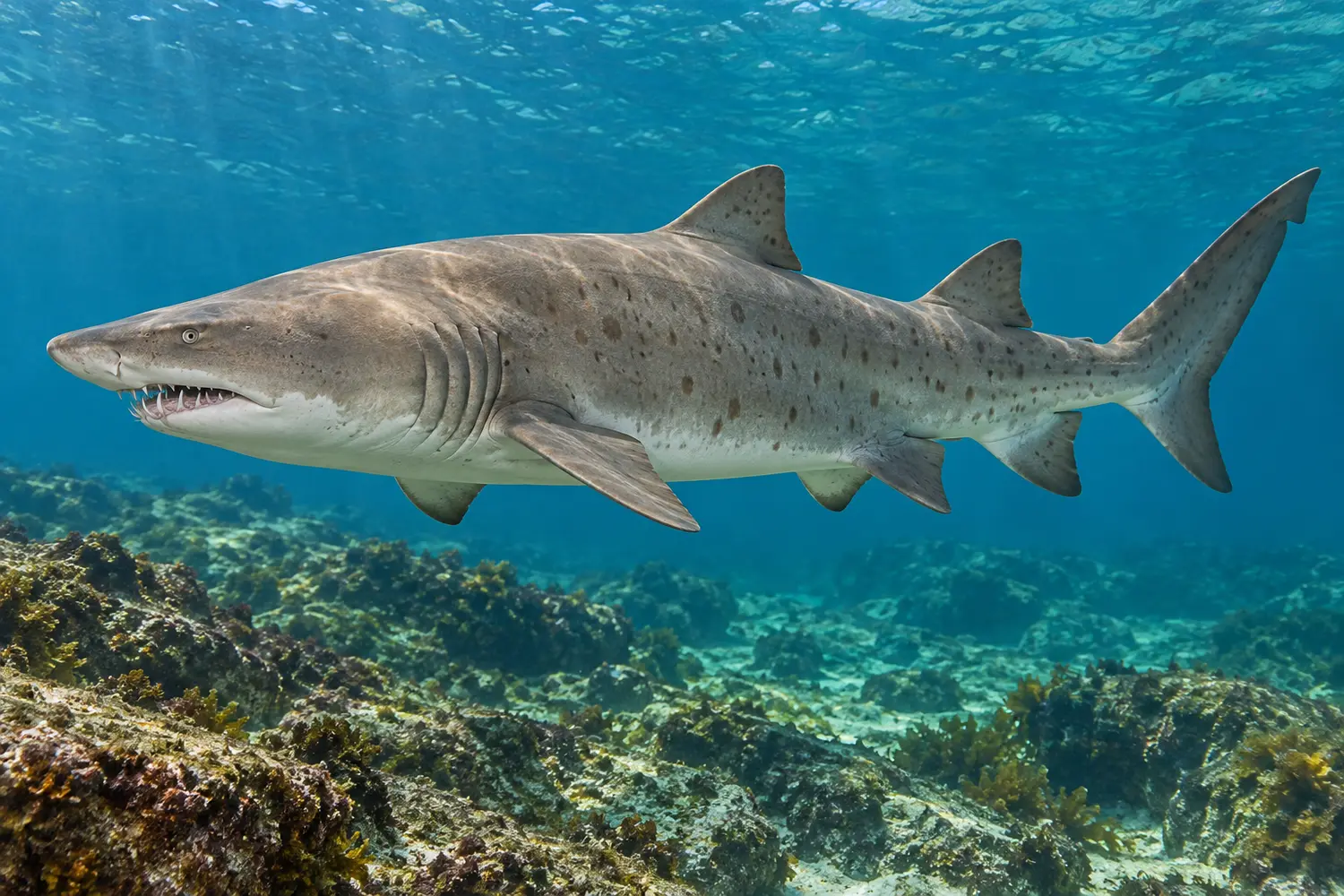
Lemon sharks and hammerheads should not be grouped under a promise of harmlessness either. ISAF lists confirmed unprovoked incidents involving both; “hammerhead” also covers multiple species. A reassuring label cannot capture differences in species, size or encounter conditions. [2]
How to use this information in the water
Avoid the opposite extremes of treating every shark as an attacker or assuming a familiar species is safe to approach. A sighting reveals presence, not a readable statement of intent. The available sources do not justify explaining all serious bites as exploratory or caused by murky water.
ISAF advises swimming with a buddy, avoiding low-light periods, and staying away from fishing, baitfish and feeding activity. Follow local warnings and closures. These measures reduce avoidable exposure; they do not create a guarantee. [5]