
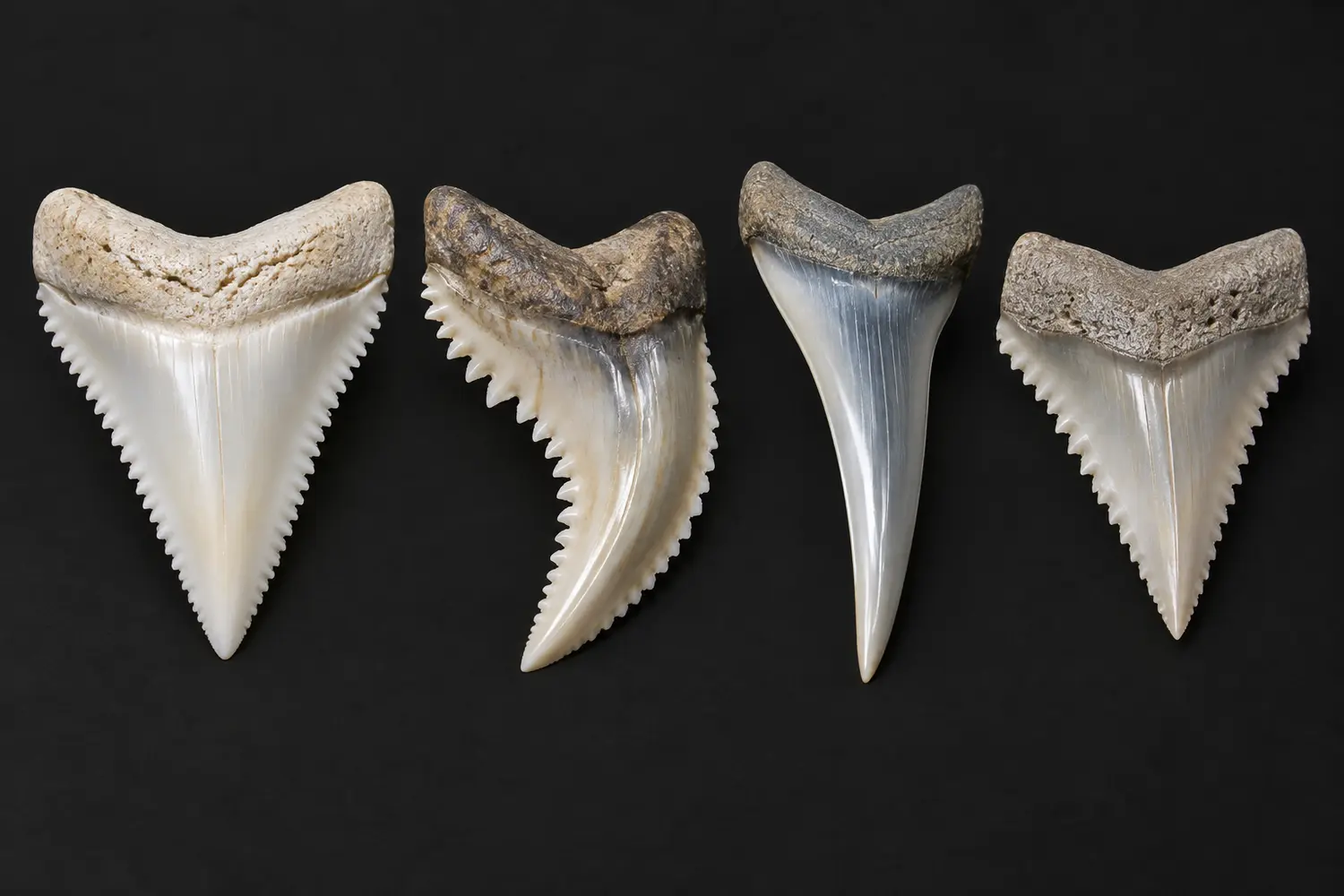
Shark teeth come in remarkably different forms because sharks eat in different ways. Broad, serrated teeth can cut large pieces from prey, while long, smooth-edged teeth help hold slippery fish. Yet tooth shape is only part of the story: jaw mechanics, head movement, body size and feeding behavior also determine what a shark can capture.
This comparison examines five familiar species—the great white, tiger, shortfin mako, great hammerhead and whale shark—and separates useful biological patterns from oversimplified viral claims.
Shark teeth types at a glance
- Great white shark: broad triangular teeth with serrated cutting edges.
- Tiger shark: strongly curved, notched and serrated teeth suited to a sawing bite.
- Shortfin mako: long, narrow, smooth-edged and recurved teeth that help grasp fish and squid.
- Great hammerhead: triangular, serrated teeth that become more oblique toward the corners of the mouth.
- Whale shark: thousands of minute teeth that do not perform the animal’s filtration.
The summary is useful, but it should not be read as a mechanical ranking. Experiments show that tooth performance depends on movement through prey, not simply the outline of a tooth pressed into a material.
How tooth shape relates to feeding
A shark tooth has a crown, cutting edges and a root, but the proportions differ widely among species and even within one mouth. Teeth near the center can differ from those toward the jaw corners, a pattern called heterodonty. Tooth form may also change as an animal grows and shifts to different prey.
Broad crowns spread and resist loads differently from slender points. Serrations concentrate force along many small cutting tips, while recurved points can help resist a struggling prey animal pulling free. But those statements describe tendencies—not guarantees. A complete feeding system includes the jaws, cartilage, muscles, head and neck motion, approach speed and prey behavior.
Great white shark teeth: broad serrated cutters
Adult great white sharks have broad, triangular teeth with coarse serrations. This geometry is effective for cutting into large prey and removing pieces during a bite-and-withdraw movement. The teeth are not tiny steak knives acting independently; rows of teeth work within a powerful jaw system while the shark moves its head and body.
Great white dentition also changes through life. Younger animals consume more fishes, while larger sharks increasingly take marine mammals and other substantial prey where available. Recent morphological work indicates that tooth shape varies with position in the jaw and with growth, reinforcing the point that “the great white tooth” is not one perfectly uniform object.
Tiger shark teeth: a curved, serrated saw
Tiger shark teeth are among the most distinctive in living sharks. Each crown is strongly curved and bears a deep notch plus serrated cutting edges. When the animal bites and moves its head from side to side, the tooth row can function like a saw.
That arrangement helps tiger sharks process both soft tissues and resistant prey, including sea turtles. Research has also described multiple scales of serrations on tiger shark teeth. The combination may contribute to cutting materials with different mechanical properties, although it does not mean every bite easily “crushes” any shell. Cutting, puncturing and fracture depend on the prey, bite location and behavior.
Shortfin mako teeth: long points for grasping
The shortfin mako is a fast pelagic predator that commonly takes active fishes and squid. Its teeth are long, narrow, smooth-edged and recurved rather than broad and heavily serrated. Their form is well suited to piercing and retaining slippery prey.
It is tempting to describe these teeth as “engineered for speed,” but speed itself does not sculpt a tooth for pursuit. Natural selection acts on the whole feeding system. The mako’s streamlined body, swimming performance, jaws and grasping teeth work together; the teeth do not explain its hunting style by themselves.
Great hammerhead teeth—and the real stingray pin
Great hammerheads have triangular, strongly serrated teeth. Teeth toward the corners of the mouth become more angled, reflecting positional differences across the jaw. The species eats fishes, crustaceans and cephalopods and is especially known for taking rays.
A popular claim says the teeth are specialized for pinning stingrays to the seafloor. Observations instead show that a great hammerhead can use its wide head—the cephalofoil—to strike and pin a ray against the bottom before biting. Its teeth then help seize and process the prey. Crediting the pinning behavior to the teeth confuses two complementary parts of the feeding sequence.
Whale shark teeth do not filter plankton
Whale sharks possess thousands of tiny teeth arranged in many rows, but they neither bite nor chew their usual food with them. The animals feed by taking in water containing plankton, small fishes and other organisms, then passing it through internal filtering pads associated with the gill region.
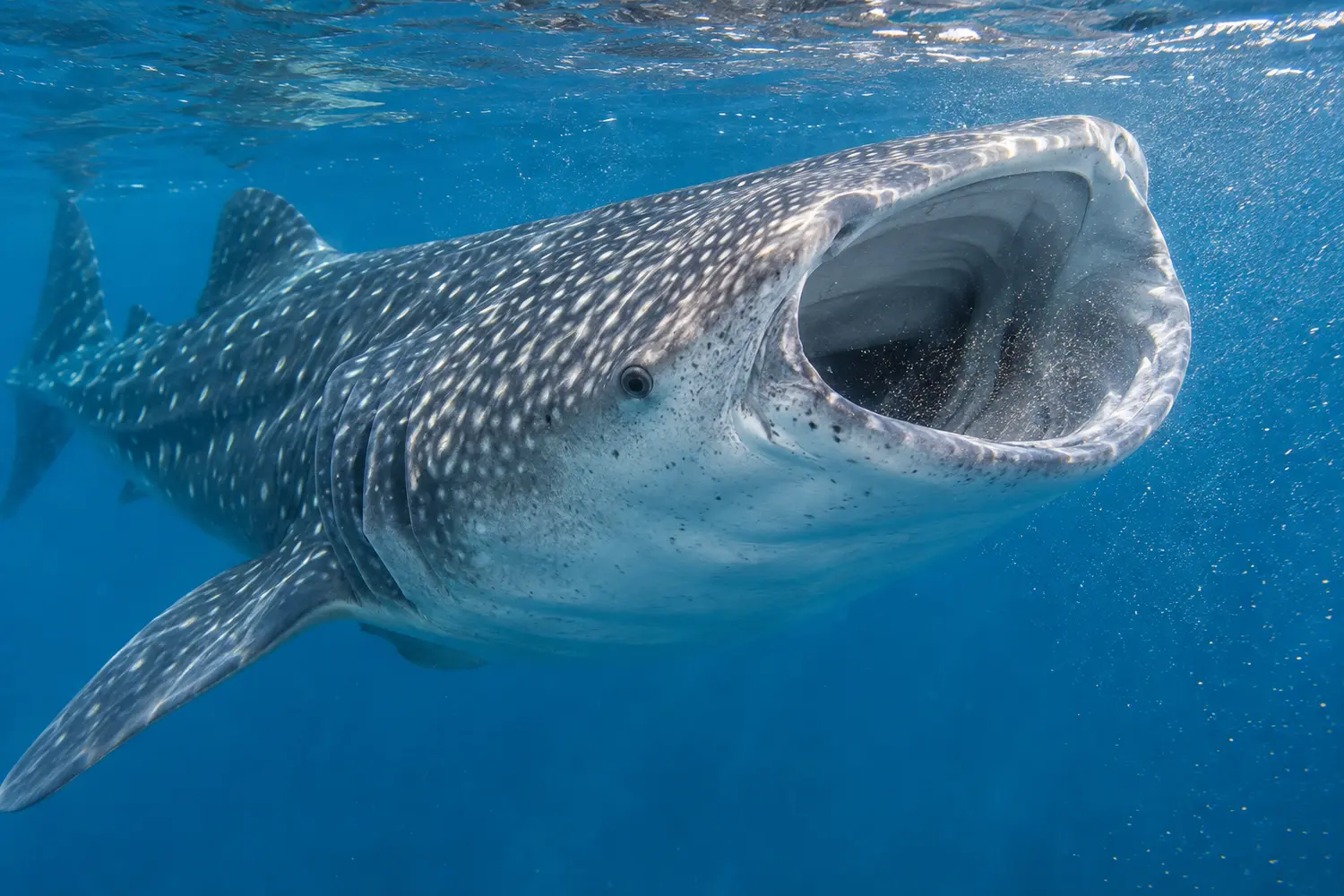
Descriptions sometimes say the teeth “work alongside gill rakers” to filter plankton. That wording is misleading because it implies that the teeth form part of the sieve. They do not. The mouth helps collect water, while specialized filtering structures retain food. Published and institutional estimates of tooth totals vary because counts and definitions differ, so “thousands of tiny teeth” is safer than treating one exact number as universal.
Why sharks have rows of replacement teeth
Shark teeth are not anchored in sockets like human teeth. They develop in rows within tissues of the jaw and move forward as functional teeth are shed or lost. Replacement is valuable because feeding can damage or dislodge exposed teeth.
Rates differ among species, ages and conditions, so claims that every shark replaces a tooth on one fixed schedule are unreliable. The visible rows also do not all bite simultaneously. Usually, the front functional series engages prey while developing teeth wait behind it.
Does form always predict function?
Tooth morphology provides genuine clues about diet and feeding ecology. Paleontologists and biologists use crown shape, serrations, wear and jaw position to develop hypotheses about extinct and living animals. Still, shape alone is not a perfect performance test.
Dynamic experiments have shown that teeth with different appearances can perform in unexpected ways when they move through realistic prey materials. Static puncture tests may miss the importance of slicing direction, motion and repeated contact. That is why confident labels such as “crusher,” “cutter” or “grasper” should be treated as concise descriptions rather than complete biomechanical diagnoses.
Frequently asked questions
Which shark has the sharpest teeth?
There is no scientifically standardized “sharpest shark” ranking. Sharpness can refer to tip radius, edge geometry, serrations or the force needed to penetrate a particular material. Different teeth excel in different tasks.
Do all sharks have serrated teeth?
No. Great white and tiger sharks have conspicuous serrations, while shortfin mako teeth are generally smooth-edged. Many other sharks have crushing, grasping or cutting dentitions with different combinations of cusps and edges.
Do whale sharks use their teeth?
Whale shark teeth are minute and are not used to bite or chew their planktonic food. Filtration is performed by specialized internal filtering structures, not by the teeth.
Do hammerheads pin stingrays with their teeth?
No. Observed great hammerheads have used the broad cephalofoil to pin rays to the seabed, then bitten them. The head and teeth play different roles in the sequence.
The bottom line
Shark teeth reveal how evolution can modify a shared vertebrate structure for very different diets. Great whites and tiger sharks emphasize cutting, makos emphasize grasping, and great hammerheads combine serrated teeth with unusual head-assisted hunting. Whale sharks are the striking exception: they retain many tiny teeth, while their actual food-capturing work is performed by a filtration system. Form matters, but it makes the most sense when viewed as one component of a living animal’s behavior and biomechanics.