
Snake fang types reveal different ways of delivering venom. A Gaboon viper can fold its long front fangs back when its mouth closes. King cobras and black mambas have the shorter, fixed front-fanged arrangement characteristic of elapids. The contrast is mainly about how the fangs are mounted and used—not a ranking of which snake is most dangerous.
Fangs are modified teeth. Depending on the lineage, they may have an open groove or a more enclosed venom channel. Their position also varies: not every venomous snake carries its venom-delivering teeth at the front of the mouth. Flinders University’s account of fang evolution explains these distinctions.
Gaboon viper: long fangs on a rotating support
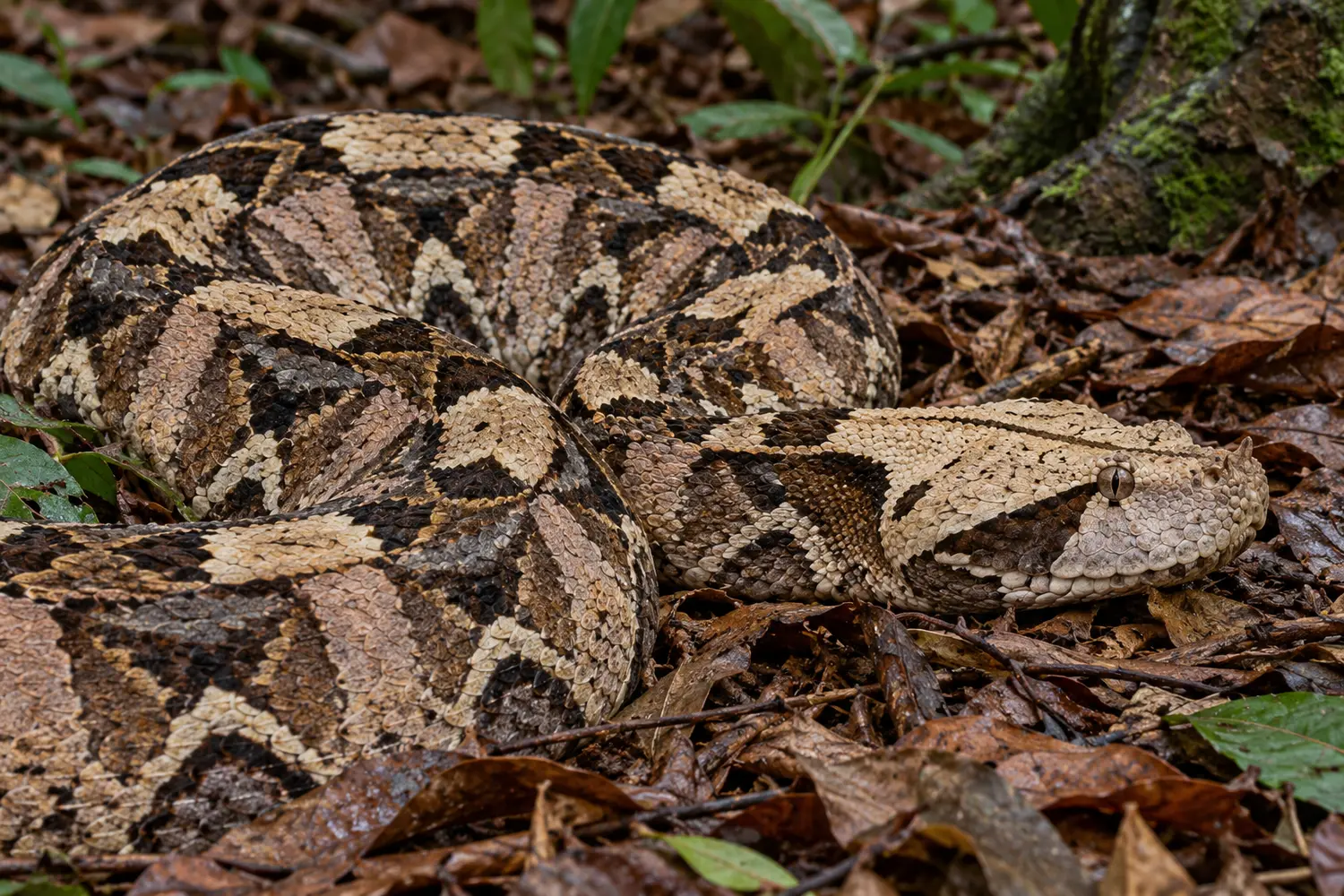
The Gaboon viper (Bitis gabonica) belongs to Viperidae. The Smithsonian’s National Zoo reports that its fangs can reach about 5 centimeters, or 2 inches. That is an upper-end capability, not the length of every individual’s fangs.
A viper’s long front fangs are carried on short upper-jaw bones that rotate. During a bite, this arrangement brings the fangs into position; at rest, they fold back along the roof of the mouth. “Hinged fangs” is useful shorthand, but the tooth itself does not bend like a flexible needle.
The Los Angeles Zoo’s western Gaboon viper account also describes the folding arrangement. Its subject is the related western species, Bitis rhinoceros, so the two names should not be treated as interchangeable.
King cobra and black mamba: fixed front fangs
King cobras (Ophiophagus) and the black mamba (Dendroaspis polylepis) are elapids. Their front fangs do not use the viper’s pronounced folding-and-erecting mechanism. “Fixed” refers to this mounting arrangement; it does not mean that the snake’s jaws or the rest of its feeding apparatus are immobile.
Research on elapid fang shape and size shows that this family still contains variation. Sharing a general architecture does not make two snakes mechanically identical. It also does not establish one universal fang length for every adult.
King cobra taxonomy needs care as well. A 2024 revision recognized four species within the group historically called Ophiophagus hannah. Here, “king cobra” refers to the group rather than assuming all populations belong to one species.
Why a fang-length chart is incomplete
The Australian Museum describes enclosed fangs as syringe-like structures that conduct venom under pressure. Their function depends on the venom-delivery system, not simply on how far the tip projects.
A careful comparison separates tooth length, fang position, jaw movement and biting behavior. A measurement also needs context: which species and specimen was measured, and how? The precise king-cobra and black-mamba length ranges sometimes circulated online are not used here without that supporting information.
Biting behavior adds another layer
A 2025 study of 36 venomous snake species used high-speed video to compare strikes against ballistic-gel targets. In the sampled snakes, vipers often repositioned their fangs after contact, whereas elapids repeatedly compressed the target with their jaws.
Those findings describe the tested animals and conditions. They should not become a claim that every cobra or mamba always uses one stereotyped strike. Anatomy provides possibilities; behavior determines how an animal uses them in a particular encounter.
The useful comparison
The main distinction is clear: vipers combine long front fangs with a folding mechanism, while king cobras and black mambas share a fixed front-fanged design. Neither arrangement is a simple danger score. Fang photographs are best used to understand anatomy, not to decide whether approaching a snake is safe.
References
Smithsonian: Gaboon viper; Los Angeles Zoo: Western Gaboon viper; Flinders University: Fang evolution; Australian Museum: Fangs; Palci et al.: Elapid fang variation; Das et al., 2024: King cobra revision; Kinematics of strikes in venomous snakes, 2025. Checked 23 October 2026.