
Snake pupil shape can offer clues about how a species hunts and when it is active, but it is not a perfect label. Across snakes, vertical pupils are strongly associated with nocturnal ambush hunting, while round pupils are more common among active foragers. Evolutionary history, habitat and exceptions matter, and the pupil itself changes dramatically with light.
Key takeaways
- Vertical slit pupils are especially common in nocturnal snakes that wait for prey, including many vipers and some pythons.
- Round pupils are common in active foragers, including king cobras and black mambas, but they do not prove that a snake is strictly diurnal.
- Foraging style predicts pupil shape more accurately than day-versus-night activity in a comparative study of 127 snake species.
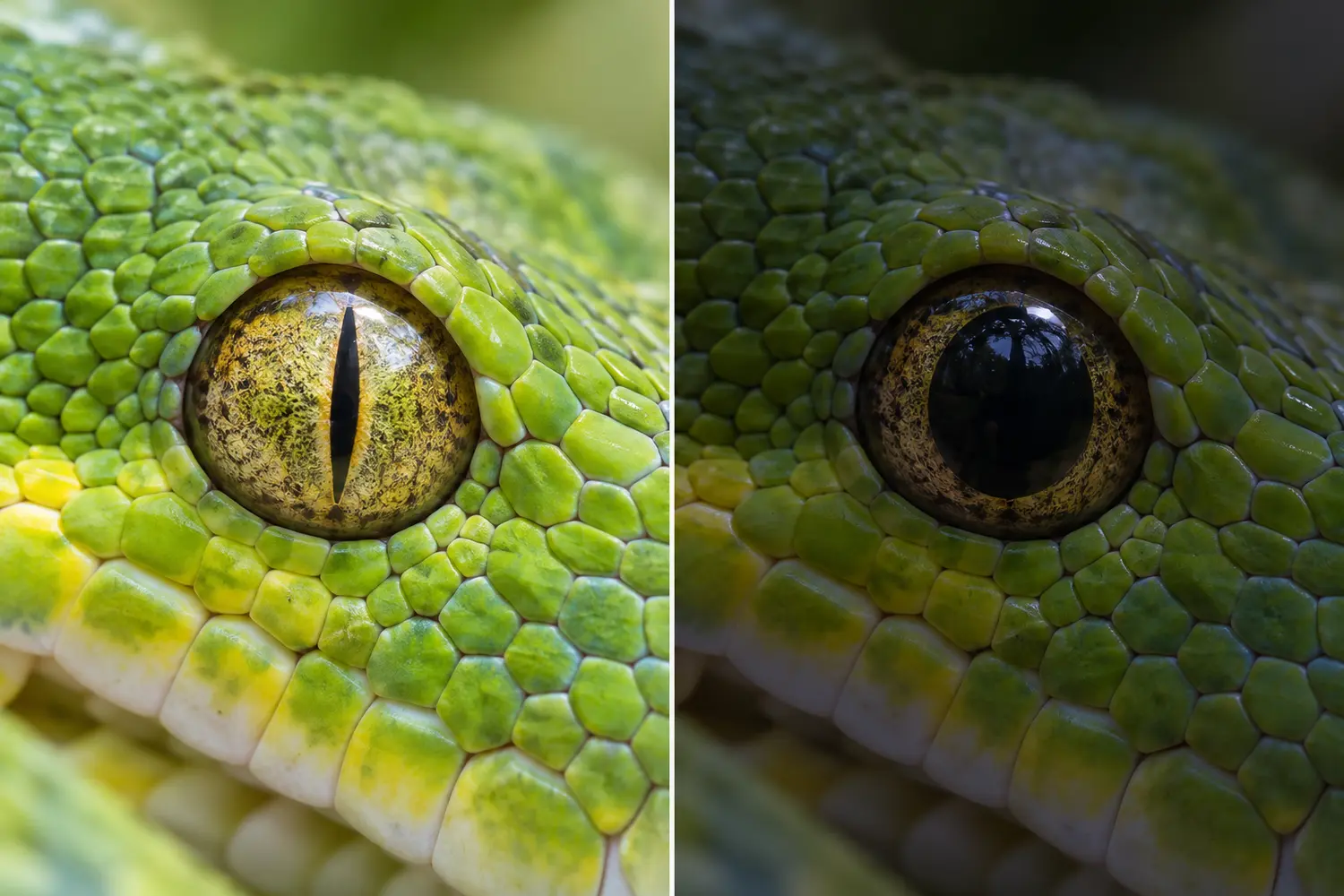
- A vertical pupil dilates in dim light and can become broad or nearly round, so photographs taken under different lighting may look surprisingly different.
- Some snakes have intermediate, oval or horizontally elongated pupils. Taxonomy and evolutionary history also influence eye design.
What does snake pupil shape actually reveal?
The strongest snake-specific evidence comes from a 2010 comparative study by François Brischoux, Ligia Pizzatto and Richard Shine. The researchers examined 127 species from five snake families and tested pupil shape against activity period and hunting mode. Most species with vertical pupils were nocturnal ambush foragers. Circular pupils occurred mainly among active foragers, although those active hunters were not always daytime specialists.
That distinction is important. A viral graphic may present vertical pupils as “night hunters” and round pupils as “day hunters,” but the real pattern is more nuanced. In the study, foraging mode predicted pupil shape better than diel activity did. In other words, whether a snake waits for prey or searches for it may be more informative than whether it is seen by day or night.
How a snake pupil changes with light
The pupil is an opening that regulates how much light reaches the retina. It is not a fixed black mark. Bright conditions cause the iris to constrict the opening; darkness causes it to dilate.
In a vertical-pupil snake, the narrow slit is most obvious when the eye is constricted. Under low light, the pupil expands and can look broad or almost circular. This is why saying that a slit pupil simply “collects more light at night” misses the mechanism. At night, the slit itself does not remain narrow: it opens.
A slit-shaped aperture can give the eye a very large operating range between its smallest and largest opening. When constricted, it may also shape optical blur and preserve useful directional information. A broad analysis of terrestrial vertebrates found strong links among pupil orientation, activity and ecological niche, but hypotheses about depth estimation in low-to-the-ground predators should not be treated as direct proof for every snake species.
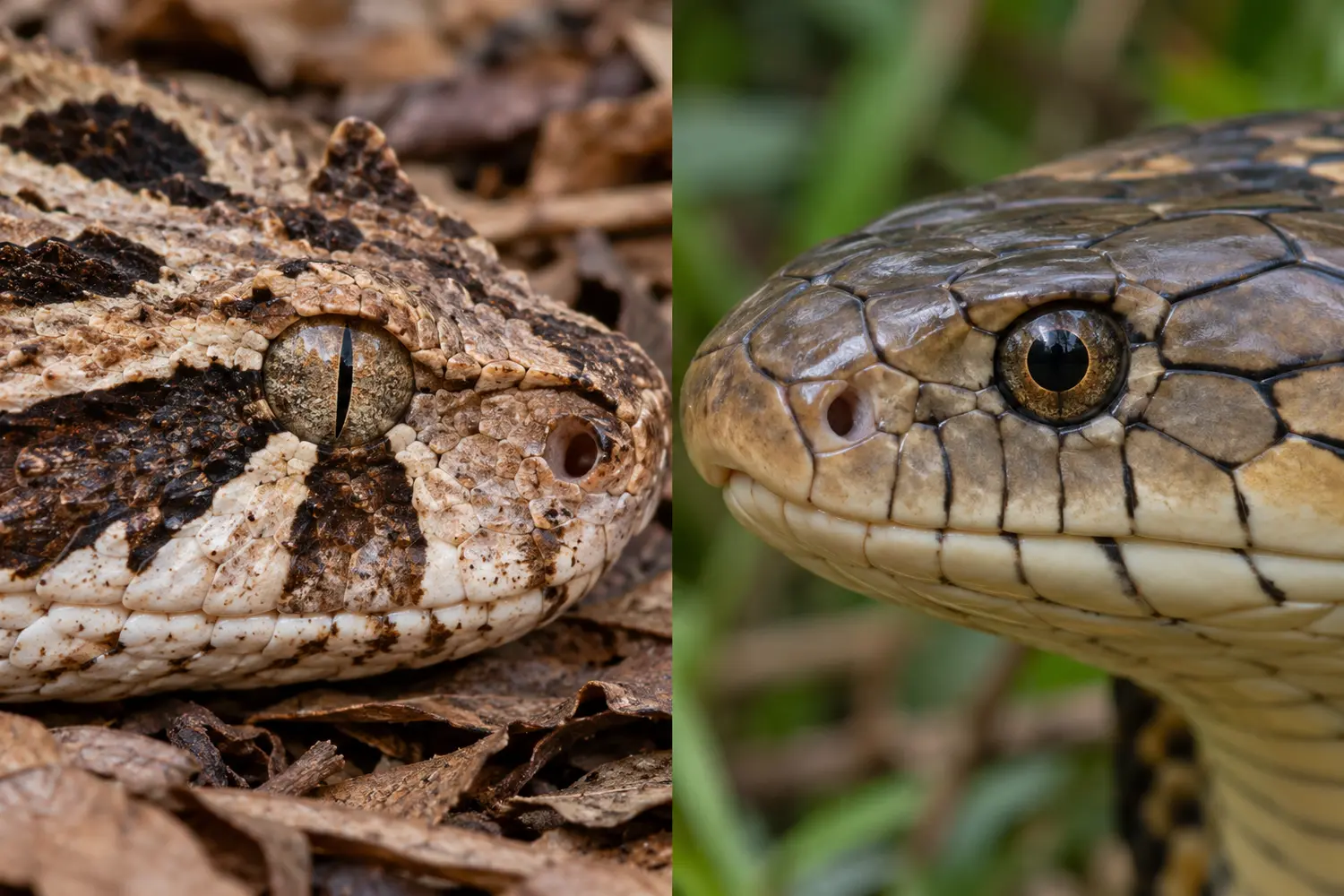
Why many ambush snakes have vertical pupils
An ambush predator spends long periods motionless, then must detect and accurately strike prey that enters range. Vertical pupils occur in many snakes with this lifestyle, especially those active in low light.
Gaboon vipers and rattlesnakes
Gaboon vipers are heavily camouflaged, terrestrial vipers that wait for passing prey. Many rattlesnakes also rely heavily on ambush, although behavior varies among species, seasons and circumstances. Their vertically elliptical pupils fit the broad statistical association between nocturnal ambush foraging and vertical pupil shape.
That does not mean the eye works alone. Pit vipers such as rattlesnakes also use heat-sensitive facial pits, chemical cues and mechanosensory information. A pupil is one component of a much larger sensory system.
Green tree pythons
Green tree pythons often rest coiled on branches and may hunt from a stationary position. Their vertical pupils are consistent with the same broad pattern. Yet even here, it would be inaccurate to infer a complete daily schedule from the pupil alone. Age, prey availability, temperature and local conditions can all affect activity.
What round pupils mean in snakes
Round pupils are common among snakes that actively move through their environment searching for prey. King cobras and black mambas are familiar examples. Both are primarily daytime-active hunters with round pupils, but the eye shape should not be described as creating “panoramic vision” or proving constant high-speed pursuit.
King cobras search for other snakes and use vision alongside a highly developed chemical sense. Black mambas actively hunt vertebrate prey and also spend time sheltering or waiting. Round pupils are compatible with their ecology, but they are not the sole reason these snakes can track prey.
Most importantly, round does not automatically mean diurnal. The 127-species analysis included many round-pupil active foragers that were nocturnal or active across more than one part of the daily cycle. Round pupils are therefore better read as one clue—often linked to active foraging—than as a clock.
Vertical versus round snake pupils
| Feature | Vertical pupil | Round pupil |
|---|---|---|
| Strongest broad association | Nocturnal ambush foraging | Active foraging |
| Appearance in bright light | Narrow vertical slit or ellipse | Smaller circle |
| Appearance in dim light | Widens and may look nearly round | Expands as a larger circle |
| Common examples | Gaboon viper, many rattlesnakes, green tree python | King cobra, black mamba and many colubrids |
| What it cannot prove | That the snake is always nocturnal or always ambushes | That the snake is always diurnal or chases prey at high speed |
Exceptions and other pupil shapes
Snake eyes do not fall into only two perfectly separated boxes. Some species have subcircular or elliptical pupils, and certain vine snakes have horizontally elongated pupils. Eye size also varies with habitat and activity patterns. These additional forms are reminders that an eye evolves as a package rather than as a single feature.
Related species may retain similar traits because of shared ancestry, even as they occupy somewhat different niches. Conversely, unrelated snakes facing similar visual challenges can evolve comparable features. Researchers therefore use phylogenetically informed comparisons rather than counting examples as if every species represented an independent experiment.
Three common myths about snake eyes
Myth 1: Every venomous snake has slit pupils
False. King cobras, black mambas, coral snakes and many other venomous species have round pupils. Pupil shape is not a safe identification test and should never be used to decide whether an unknown snake can be handled.
Myth 2: Every slit-pupil snake is nocturnal
False. The relationship is strong at the group level, not absolute for every individual at every time. Snakes may shift activity with temperature, season, prey and disturbance.
Myth 3: Round pupils give snakes panoramic vision
Unsupported. Field of view depends on eye position, head anatomy and visual processing—not simply whether the pupil is circular. A round aperture mainly describes the shape of the opening through which light enters.
Can you identify a snake by its pupils?
Pupils may support an identification when combined with range, scale arrangement, body pattern, head shape and other documented traits. They should never be the deciding feature. Light changes pupil size, photographs distort shapes, and many unrelated species share the same pupil type.
If a snake is unknown, keep a safe distance and consult a qualified local wildlife authority or identification resource. Do not approach it to inspect the eyes.
Frequently asked questions
Do all pythons have vertical pupils?
No single eye rule should be applied to an entire diverse snake lineage without checking the species. Many familiar pythons have vertical pupils, but pupil form and activity patterns should be verified species by species.
Why does a snake’s pupil look round at night?
A vertically shaped pupil expands in low light. Once widely dilated, it may appear broad or nearly circular. The narrow slit is most obvious under brighter illumination.
Are round-pupil snakes harmless?
No. Some highly venomous snakes, including king cobras and black mambas, have round pupils. Pupil shape does not indicate whether a snake is dangerous.
Which matters more: hunting style or time of day?
In the major comparative study of 127 species, foraging mode predicted pupil shape more accurately than diel activity. Both were related to pupil form, but neither produced an exception-free rule.