
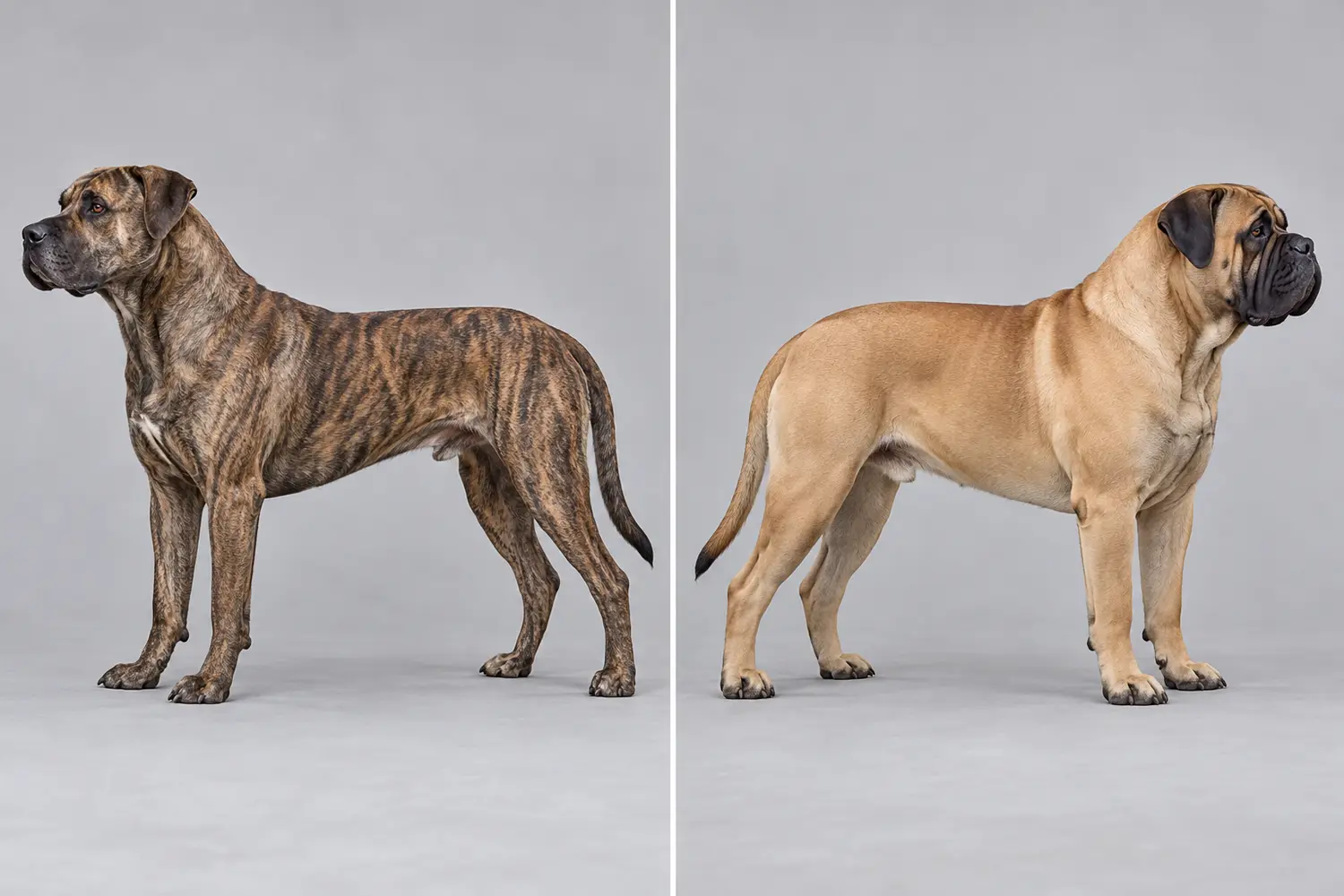
The main difference in a Spanish Alano vs Bullmastiff comparison is build: the Alano is a lighter, athletic working dog, while the Bullmastiff has substantially greater mass and a more compact outline. Both are muscular domestic breeds. Their histories explain those differences better than claims about which dog would win a confrontation.
Size: what the official standards actually say
For the Alano Español, Spain’s Real Sociedad Canina de España (RSCE) specifies the following adult ranges. Bullmastiff figures below follow the American Kennel Club (AKC) standard. These are breed-standard targets, not measured averages or guarantees for every dog. [1] [2]
| Breed and sex | Height at the withers | Weight |
|---|---|---|
| Spanish Alano male | 58–63 cm | 30–40 kg (about 66–88 lb) |
| Spanish Alano female | 55–60 cm | 25–35 kg (about 55–77 lb) |
| Bullmastiff male | 25–27 in (about 64–69 cm) | 110–130 lb (about 50–59 kg) |
| Bullmastiff female | 24–26 in (about 61–66 cm) | 100–120 lb (about 45–54 kg) |
The claim that Bullmastiffs “often top 130 pounds” is not established by these standards. In the AKC male range, 130 pounds is the upper boundary; it is not a minimum. An individual can fall outside a standard, but that does not establish how common the exception is.
Body shape and movement
The RSCE describes an Alano with a body slightly longer than its shoulder height, long limbs and an elastic gait. Its square head has a short, broad muzzle. That combination is consistent with an athletic working outline rather than an extremely bulky one. [1]
The Bullmastiff standard calls for a nearly square, compact body, a wide, deep chest and a broad head. Importantly, it also calls for activity and free, smooth movement. Greater mass should not be confused with clumsiness, and the breed is not described as a stationary block of muscle. [2]
Different working histories
Alanos traditionally helped manage cattle, hunted large game and guarded properties, according to the RSCE. “Catch dog” refers to that historical gripping role; it is not a scientific measure of bite force or precision. [1]
Bullmastiffs developed in England as gamekeepers’ dogs. The American Bullmastiff Association describes a dog intended to track, cover short distances quickly, then hold poachers for the gamekeeper. Its history therefore involved mobility as well as strength—not mass alone. This is historical context, not a suggestion to train a pet to confront people. [3]
Do size and ancestry predict strength or temperament?
The sources establish differences in body size and intended work. They do not provide a controlled head-to-head test of sprint speed, endurance, gripping accuracy or stopping power. It would therefore be misleading to turn their descriptions into a performance ranking or declare a winner.
Breed standards also describe desired temperament, not a promise about a particular dog. A 2022 study in Science, using owner surveys and genetic data from a broad population of dogs, found that breed explained about 9% of variation in the behavioral measures studied. That result does not mean ancestry has no effect, and it was not an Alano–Bullmastiff performance trial. [4]
For someone evaluating either breed, the useful comparison is the individual dog’s size, behavior and background alongside the household’s needs. A photograph or working-breed label cannot establish how that individual will behave.
References
- [1] Real Sociedad Canina de España: Alano Español breed standard (Spanish).
- [2] American Kennel Club: Official Standard of the Bullmastiff.
- [3] American Bullmastiff Association: About the Breed and breed history.
- [4] Morrill et al. (2022), Ancestry-inclusive dog genomics challenges popular breed stereotypes. Science 376, eabk0639. DOI: 10.1126/science.abk0639.