
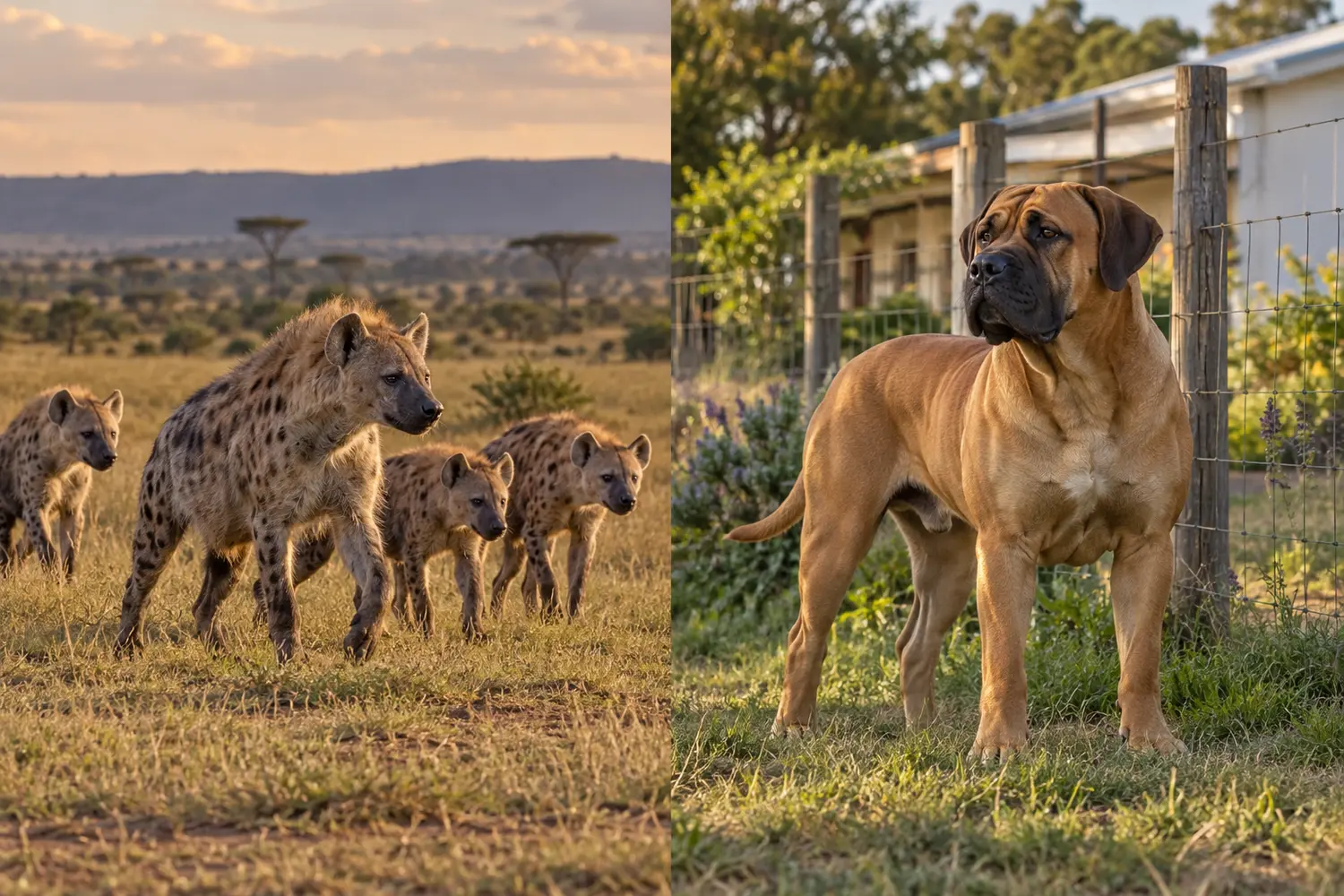
Spotted hyenas and Boerboels are both powerful African mammals, but comparing them as combatants hides the biology that makes each remarkable. The spotted hyena (Crocuta crocuta) is a wild social carnivore adapted to hunt, scavenge and process bone across African ecosystems. The Boerboel is a domesticated South African mastiff developed as a versatile farm and property guardian.
A Boerboel can be heavier than many spotted hyenas, while a hyena has a skull, teeth and feeding mechanics specialized by natural selection for a carnivore’s life. Those facts do not produce a scientifically defensible fight prediction. They explain two animals shaped for completely different environments and relationships with humans.
Spotted hyena vs Boerboel at a glance
| Feature | Spotted hyena | Boerboel |
|---|---|---|
| Scientific identity | Crocuta crocuta, family Hyaenidae | Domestic dog, Canis lupus familiaris |
| Origin | Wild populations across sub-Saharan Africa | South African working-dog breed |
| Body mass | Roughly 40–86 kg across populations; females often larger | Large mastiff; exact weight varies by sex, height and condition |
| Social system | Female-dominated clans with flexible subgrouping | Human-managed domestic social environment |
| Feeding anatomy | Specialized premolars, strong jaws and reinforced skull for processing bone | Generalized domestic-dog dentition |
| Primary role | Wild predator and scavenger | Farm, home and property guardian |
Ranges overlap, so a single weight cannot represent every animal. Sex, age, nutrition, genetics and measurement standards all matter.
What is a spotted hyena?
The spotted hyena is the largest living hyena species. Its body is immediately recognizable: powerful forequarters, a back that slopes toward the hindquarters, rounded ears and a sandy to gray coat marked with dark spots. Females are often larger than males.
Spotted hyenas live in complex societies called clans. A clan can contain only a few animals in a difficult habitat or dozens where food is abundant. Individuals frequently split into smaller parties and reunite later, a pattern biologists call fission–fusion dynamics. Females and their descendants occupy the top of the hierarchy, while immigrant adult males usually rank below resident females.
Hunter, scavenger—or both?
The old stereotype of a cowardly scavenger is wrong. Spotted hyenas hunt much of their own food in many ecosystems, and they also scavenge when the opportunity arises. Lions steal hyena kills, hyenas steal from lions, and the balance changes with group size, habitat and who reaches the carcass first.
This flexibility is an ecological strength. A hyena can pursue live prey, consume carrion and digest parts of a carcass that many other predators leave behind.
What is a Boerboel?
The Boerboel is a large, muscular domestic dog developed in South Africa. Historical selection favored a confident general farm dog able to remain close to people, monitor property and respond to threats. The modern breed standard emphasizes balance, sound movement and a calm, stable, confident temperament—not uncontrolled aggression.
According to the American Kennel Club standard, preferred height is about 66 cm at the withers for males and 61 cm for females, with minimum heights of 60 and 55 cm respectively. The standard does not prescribe one mandatory adult weight because a healthy weight must remain proportional to height, sex and structure.
Online descriptions often turn “large guardian dog” into “150–200 pounds of pure muscle.” Some Boerboels do fall within that broad range, but very high weight is not automatically desirable. Excess mass can impair movement and place additional stress on joints.
Body size: the dog may be heavier, but that is not the whole comparison
A large male Boerboel can outweigh many spotted hyenas. Published spotted-hyena summaries give a broad body-mass range of approximately 40–86 kg, and females often exceed males. Dog weights vary substantially because domestic breeding and body condition are highly variable.
Mass alone does not describe functional anatomy. Hyenas carry a high proportion of their muscle around the neck and forequarters, whereas a sound Boerboel should combine substance with agility and balanced movement. Comparing the silhouette of one unusually heavy dog with one small hyena can create a misleading generalization.

Why the spotted hyena can process bone
Spotted hyenas possess robust skulls, large jaw-closing muscles and teeth specialized for different jobs. The canines help seize, while the enlarged premolars toward the back of the jaw are particularly important for cracking bone. As a young hyena develops permanent teeth, it shifts bone-cracking activity toward those rear premolars, increasing mechanical advantage.
Finite-element studies show how stress travels through the vaulted skull during unilateral biting. These findings explain structural adaptation; they do not validate one universal bite-pressure number for every hyena.
What is wrong with “1,100 PSI”?
The widely repeated 1,100 PSI claim is often presented without a standardized in-vivo test, tooth contact area, bite position or individual measurements. Force and pressure are not interchangeable: force is measured in newtons, while pressure depends on how that force is distributed over an area.
Bite performance also changes with tooth position, skull size, age, motivation and method. A model of stress inside a skull is not the same as placing a pressure gauge in a living animal’s mouth. It is more accurate to say that spotted hyenas have exceptional bone-processing adaptations than to assign every individual the same PSI score.
Does the Boerboel have a measured bite-force record?
No standardized breed-wide experiment establishes a definitive Boerboel PSI value. Like other large dogs, an individual Boerboel can inflict serious injury, but viral rankings commonly recycle unsourced estimates and compare results obtained through different methods.
Breed purpose is better understood from behavior and conformation. A Boerboel was selected to be vigilant, confident and physically capable while remaining manageable by its owner. Responsible breeding should prioritize stable temperament, health and sound structure over exaggerated aggression or head size.
Social intelligence in very different settings
Spotted hyenas navigate one of the most complex carnivore societies. They recognize clan members, maintain rank relationships, cooperate and compete, defend territories and adjust behavior according to available social support. Research from long-term hyena projects shows that rank outcomes cannot be reduced to body mass or individual aggressiveness.
Boerboels evolved under domestication and must read human behavior, household routines and boundaries. Their social development depends heavily on early socialization, reward-based training, controlled exposure and responsible management. A guardian breed left to make every decision alone can become a safety problem.
Why “hyena vs Boerboel” fight predictions fail
No ethical controlled study could stage the encounter needed to answer which animal would win. Anecdotes, edited videos and imagined statistics cannot replace evidence. Outcome would vary with age, sex, health, experience, terrain, distance, motivation and whether either animal could retreat.
Statements such as “the hyena has higher pain tolerance” or “the Boerboel has superior leverage” are usually asserted without a measurable protocol. They make an artificial fight sound predictable when it is not.
The safe conclusion is that both can cause severe injury. They should never be deliberately brought together, and a guardian dog should not be treated as wildlife-control equipment.
Could a Boerboel safely protect a property from hyenas?
Large guardian dogs may deter some wildlife through their presence, scent and barking, but sending a dog into direct contact with a hyena creates serious risk for both animals. Spotted hyenas can operate alone or in groups, and conflict patterns vary by location.
Better livestock and property protection combines strong night enclosures, secure fencing, removal of accessible carcasses or waste, lighting where appropriate, attentive herding and locally tested nonlethal deterrents. Dogs require supervision, veterinary care and management suited to local predators.
Ownership and welfare considerations
A Boerboel is not suitable for every household. Its adult size, protective tendencies and strength require an experienced owner, secure space, ongoing training and careful introductions. Local laws or insurance rules may restrict ownership.
Healthy guardians need daily exercise, enrichment and family interaction. Punishment-based attempts to create aggression increase risk and damage welfare. Prospective owners should seek health-tested breeding lines and avoid breeders advertising extreme size or fighting ability.
Spotted hyenas are wildlife, not exotic pets. Their physical, dietary and social requirements cannot be recreated safely in a normal home.
Conservation status
The spotted hyena is currently listed as Least Concern under the global IUCN assessment, with an estimated 27,000–47,000 individuals. That category does not mean every population is secure. Persecution, habitat loss, declining prey, poisoning and conflict with livestock owners affect many local populations, especially outside protected areas.
Boerboels are a domestic breed rather than a wild conservation unit. Their welfare challenge is responsible breeding: maintaining sound hips and elbows, functional movement and stable temperament while avoiding selection for excessive bulk or aggression.
Frequently asked questions
Is a spotted hyena a dog?
No. Hyenas belong to Hyaenidae within the feliform branch of Carnivora. Domestic dogs belong to Canidae in the caniform branch. Similar body outlines do not make them close relatives.
Is a Boerboel larger than a spotted hyena?
Some large Boerboels are heavier than many spotted hyenas, but their ranges overlap. The answer depends on the individuals being compared.
Can a spotted hyena really crush bone?
Yes. Its skull, muscles and rear premolars are specialized for processing bone. That ability should not be reduced to one universal PSI number.
Are spotted hyenas only scavengers?
No. They are successful hunters and opportunistic scavengers. The proportion of hunted versus scavenged food varies by ecosystem and opportunity.
Is the Boerboel naturally aggressive?
The recognized breed standard calls for confidence, stability and protectiveness—not indiscriminate aggression. Genetics, socialization, training, health and management all influence behavior.
The bottom line
The spotted hyena is a wild bone-processing carnivore shaped by natural selection and complex clan life. The Boerboel is a domestic guardian shaped by human selection to work near farms, homes and families.
One may be heavier, while the other has more specialized feeding anatomy. Neither fact supports staged combat or a guaranteed winner. Their real biology is more useful—and more interesting—than the fight narrative.
Sources
- American Kennel Club — Official Standard of the Boerboel
- Animal Diversity Web — Spotted Hyena
- Spotted Hyena Fact Sheet — Summary
- Tanner et al. — Biomechanics of Bone-Cracking in Spotted Hyenas
- Binder & Van Valkenburgh — Development of Bite Strength and Feeding Behaviour
- Leibniz-IZW — Ngorongoro Hyena Project