
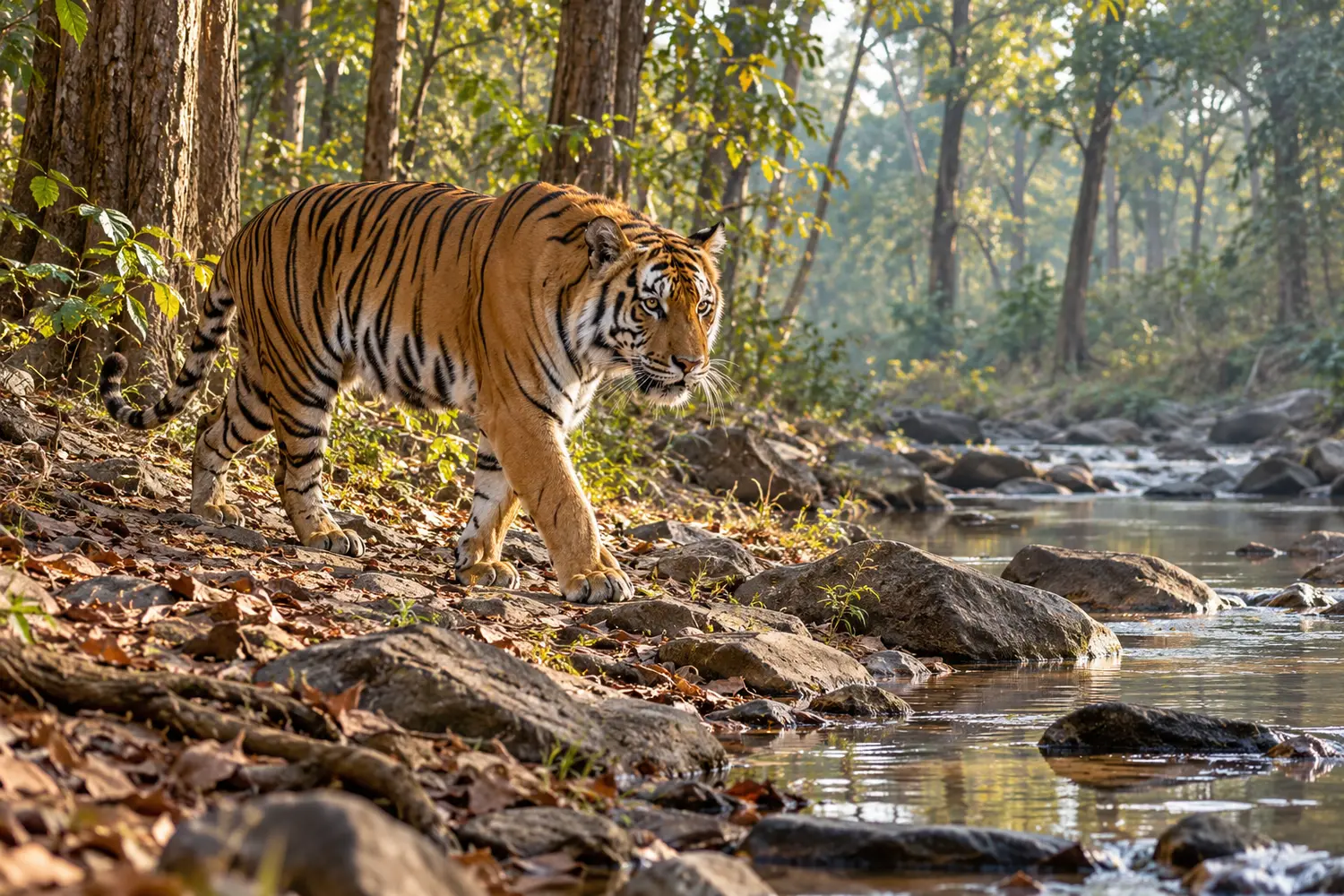
A tiger vs black panther comparison begins with a naming problem: a black panther is not a separate species. The label usually means either a melanistic leopard (Panthera pardus) or a melanistic jaguar (Panthera onca). Those two cats differ in geography, build and ecology, so any honest comparison must identify which animal is meant.
Tigers (Panthera tigris) are generally larger than either leopards or jaguars, but size alone does not turn wildlife biology into a predictable “fight result.” These cats evolved for different habitats and prey. The useful question is not which one would win; it is how their bodies, coats and behavior solve different survival problems.
What is a black panther?
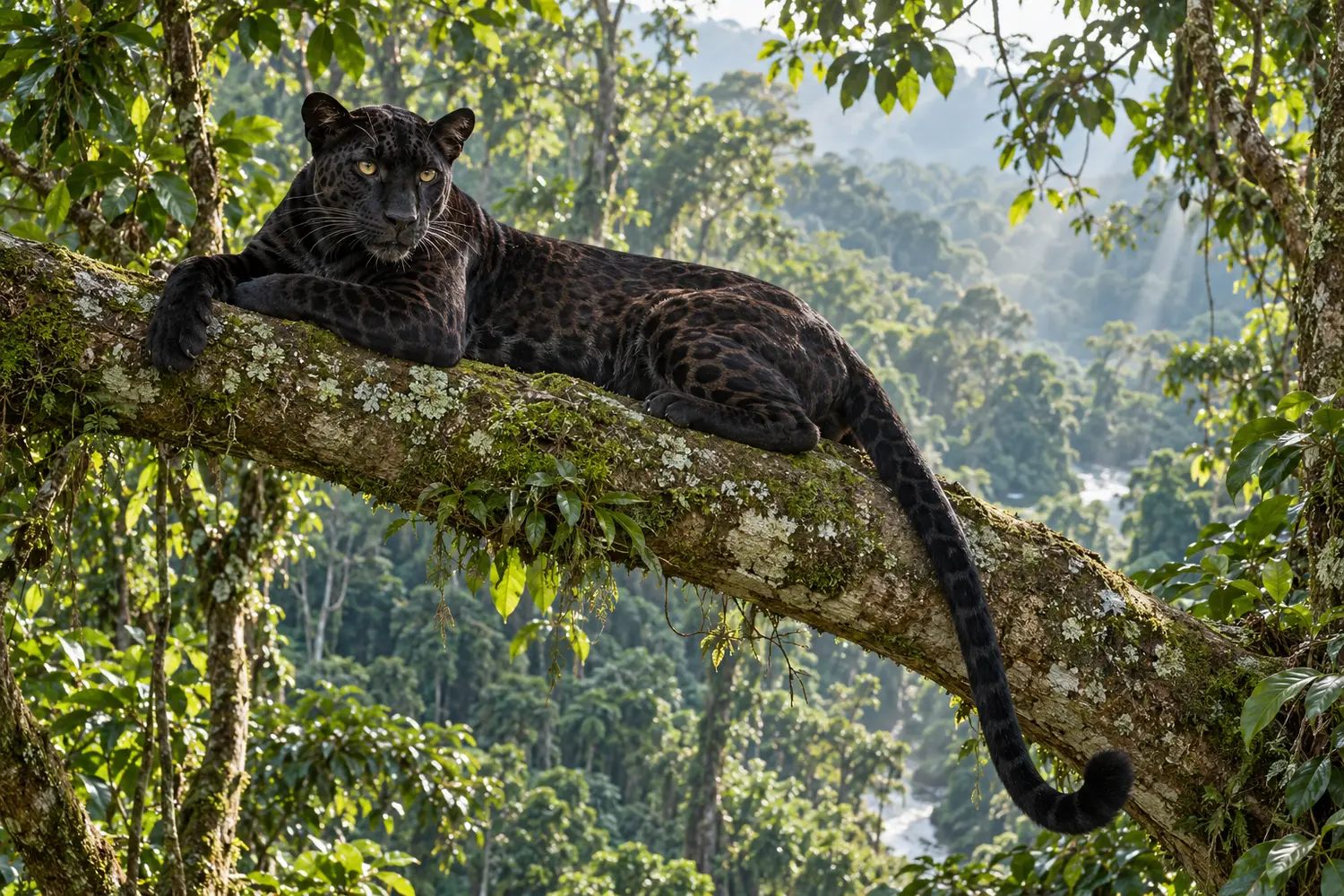
“Black panther” is an informal name for a dark-coated big cat. Conservation organization Panthera explains that both leopards and jaguars can show melanism, a genetic condition that produces unusually dark pigmentation. Their rosettes do not disappear. In suitable light, the pattern remains visible beneath the black background.
The underlying genetics are not identical. Research on wild cats links melanism in leopards to changes in the ASIP gene, while classic work on South American felids identified a different pathway involving MC1R in jaguars. The dark coat is therefore a color variant within each species—not evidence of a new species or a hybrid.
Geography offers the quickest clue. A black panther in Asia or Africa is a melanistic leopard. A black panther in the Americas is a melanistic jaguar. Tigers naturally occur in Asia, so only the leopard version shares wild landscapes with tigers.
Tiger vs black leopard: the real Asian comparison
Tigers and leopards overlap in parts of Asia. Both are solitary carnivores, but their average size differs sharply. A San Diego Zoo fact sheet gives living tiger subspecies a broad body-mass range of about 100–261 kilograms for males and 75–177 kilograms for females, with substantial variation by region. Animal Diversity Web lists male leopards at roughly 31–65 kilograms and females at 17–58 kilograms. These ranges overlap less than viral posters often imply.
That difference influences prey choice and space use. Tigers can subdue larger ungulates, while leopards often exploit smaller prey and use a wider range of vertical cover. Leopards are exceptional climbers and commonly carry food into trees, where it may be safer from larger competitors.
Coexistence is more nuanced than constant combat. A recent camera-trap study in Nepal’s Parsa National Park found tigers and leopards at many of the same sampling sites, but leopards appeared to avoid peak tiger activity periods. The study’s authors concluded that temporal separation and habitat quality can reduce direct interference. In other words, avoidance is itself an important survival strategy.
Tiger vs black jaguar: a comparison across continents
A melanistic jaguar is not a natural neighbor of the tiger. Jaguars live in the Americas, from Mexico south toward Argentina, whereas wild tigers are Asian. Any side-by-side image is therefore educational rather than a record of a real encounter.
Jaguars are usually stockier than leopards, with broader heads and more compact bodies. Their normal rosettes often contain central spots; those markings can still be seen on a melanistic individual. Jaguars are also strongly associated with water. Panthera documents their use of wetlands, flooded forests and rivers, where their rounded paws and swimming ability support hunting and movement.
Tigers can also swim well, but their ecology varies across forests, grasslands, mangroves and colder northern habitats. The two cats reached different solutions through evolution: the jaguar’s compact, robust build suits its prey and landscapes, while the tiger’s larger frame supports the capture of substantial ungulates across its Asian range.
Why viral bite-force numbers are misleading
Posters often assign a tiger about 1,050 pounds per square inch and a black panther 1,500 PSI. Those figures should not be treated as standardized measurements. “Black panther” already combines two species, and bite performance changes with body size, jaw position, tooth location, motivation and measurement method.
Peer-reviewed comparative studies usually estimate bite force from skull dimensions and muscle mechanics, then normalize it for body mass using a bite force quotient. That is not the same as placing living animals on an identical PSI test. The research can illuminate how skull form relates to feeding ecology, but it does not validate a simple internet leaderboard or forecast the outcome of an encounter.
Does a dark coat make a better night hunter?
Melanism may influence camouflage under some conditions, but “total nocturnal invisibility” is an exaggeration. A large study mapping melanistic leopards found that the trait is strongly associated with moist, densely forested environments, especially in parts of Southeast Asia. That pattern is consistent with natural selection acting differently across habitats, but coat color is only one element of hunting success.
Prey availability, wind, cover, experience, hearing and the ability to approach without detection all matter. A black leopard or jaguar remains the same species as its spotted counterpart, with the same basic anatomy and ecological role. Melanism changes appearance; it does not grant a separate set of superpowers.
Key differences at a glance
- Identity: Tiger is one species; “black panther” means a melanistic leopard or jaguar.
- Range: Tigers and leopards overlap in Asia. Jaguars live in the Americas and do not meet wild tigers naturally.
- Size: Tigers are generally much heavier than leopards and usually heavier than jaguars, although sex, region and individual condition create wide variation.
- Build: Leopards are relatively lean and highly arboreal; jaguars are stockier and closely tied to many wet habitats; tigers combine large body size with powerful ambush predation.
- Coat: Melanistic leopards and jaguars retain rosettes that can be visible in good light.
- Ecology: Where tigers and leopards coexist, differences in activity, prey and habitat use can reduce conflict.
Frequently asked questions
Is a black panther stronger than a tiger?
There is no single black-panther species and no controlled scientific contest that supplies a universal answer. Tigers are generally larger than leopards and jaguars, but strength is not one standardized number, and wildlife should not be framed as a fight prediction.
Can a tiger and black panther meet in the wild?
A tiger can share habitat with a melanistic leopard in Asia. A tiger cannot naturally meet a melanistic jaguar because jaguars live in the Americas.
Are black panthers born without spots?
No. Melanistic leopards and jaguars still carry their species’ spot or rosette pattern. The markings are often easiest to see in bright or angled light.
References
- Panthera: Jaguars, leopards and black panthers
- Panthera: Leopard species profile
- Panthera: Jaguar species profile
- San Diego Zoo Wildlife Alliance: Tiger physical characteristics
- Animal Diversity Web: Leopard
- PLOS ONE: Mapping melanism in leopards
- Ecology and Evolution: Tiger–leopard coexistence in Nepal
- Proceedings of the Royal Society B: Comparative bite force in mammals