
A tortoise does not carry a shell in the way a snail carries a portable house. Its shell is part of its skeleton: living bone, supplied by blood vessels and covered by keratinous scutes in most species. That unusual construction protects the animal, but it also forces nearly every other system—from breathing to walking—to work around a rigid body wall.
This guide explores tortoise anatomy without treating every species as identical. The familiar high dome and elephant-like legs describe many land tortoises, but pancake tortoises, giant tortoises and burrowing species show how varied the basic design can be.
Tortoise anatomy at a glance
- Carapace: the dorsal, or upper, part of the shell.
- Plastron: the ventral, or lower, part of the shell.
- Bridge: the bony connection between carapace and plastron.
- Scutes: keratin plates covering most hard-shelled tortoises; their borders do not exactly match the seams between the bones below.
- Ribs and vertebrae: broadened and incorporated into the carapace rather than moving freely around the lungs.
- Lungs: paired organs positioned high beneath the carapace.
- Heart: two atria and a single, internally subdivided ventricle—the arrangement commonly summarized as a three-chambered heart.
The shell is a living part of the skeleton
The shell has two major sections. The carapace covers the back, while the plastron protects the underside. These parts meet along the bridge. A series of bones forms the shell, and the outer surface is usually covered by scutes made of keratin, the same structural family of material found in claws and beaks.
The carapace is not simply armor laid over an ordinary rib cage. Research on turtle development shows that its central elements are continuous with modified ribs and vertebrae. In other words, the torso is reorganized around the shell. Even the shoulder girdle sits inside the rib cage, reversing the arrangement familiar from most other four-limbed vertebrates.
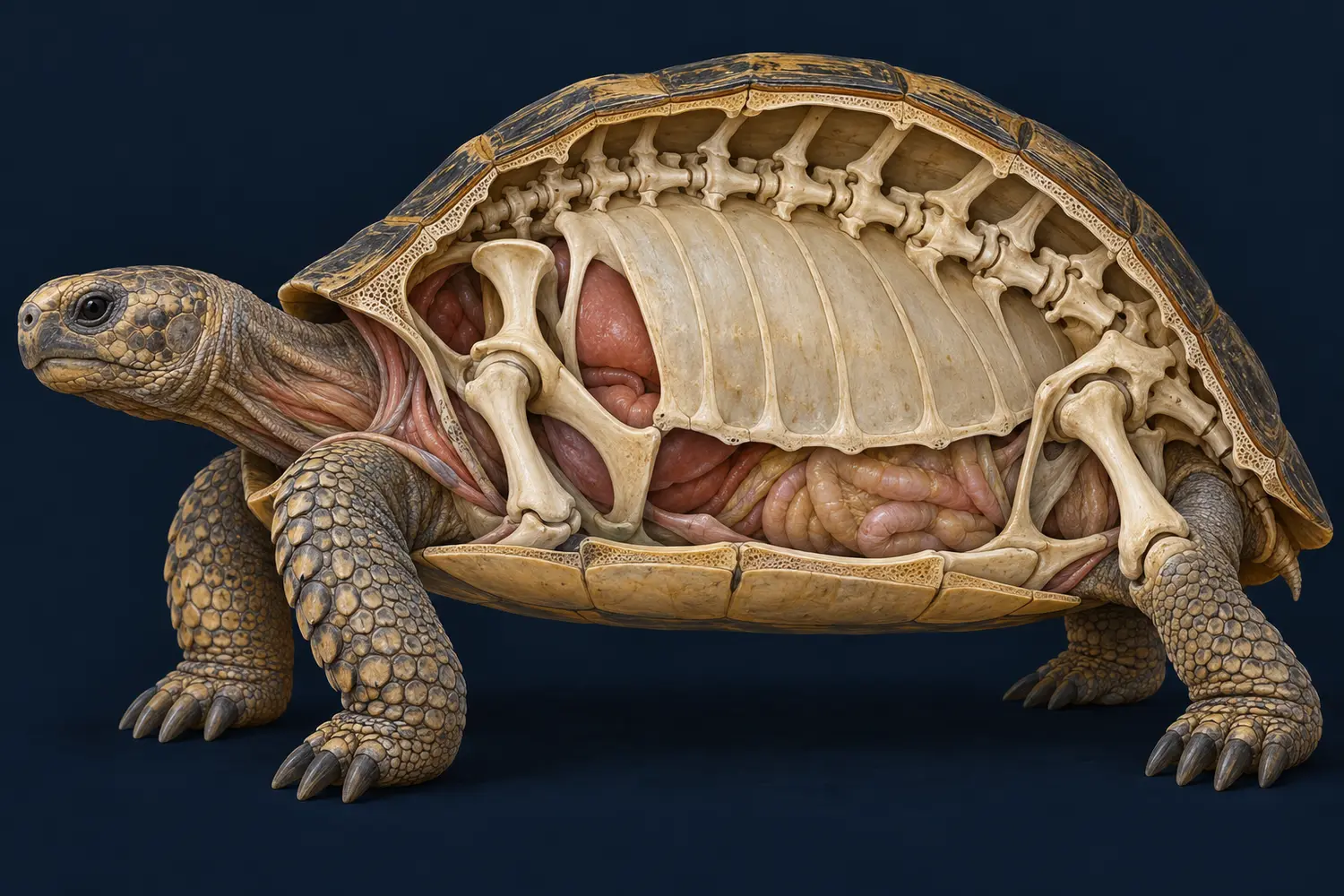
The shell is strong, but it is not impenetrable. Predators can crack or pierce it, vehicles can cause devastating fractures, and poor nutrition or husbandry can deform growing bone. The African pancake tortoise is an especially useful reminder that there is no single “tortoise shell shape”: its shell is unusually flat and flexible, and the animal escapes danger by squeezing into rock crevices rather than relying on a massive dome.
Can a tortoise feel its shell?
Yes. Bone and overlying tissues contain nerves and blood vessels, so the shell is not a dead, insensitive casing. A tortoise may respond to touch on the shell, and injuries require veterinary care. The keratin surface can wear, grow and be damaged, while the living bone beneath repairs slowly.
Growth lines on scutes may reflect periods of growth, but they are not a dependable universal calendar. Wear, irregular growth, climate and diet can blur or add lines, especially in older animals. Counting rings should not be treated as an exact way to determine age.
How does a tortoise breathe inside a rigid shell?
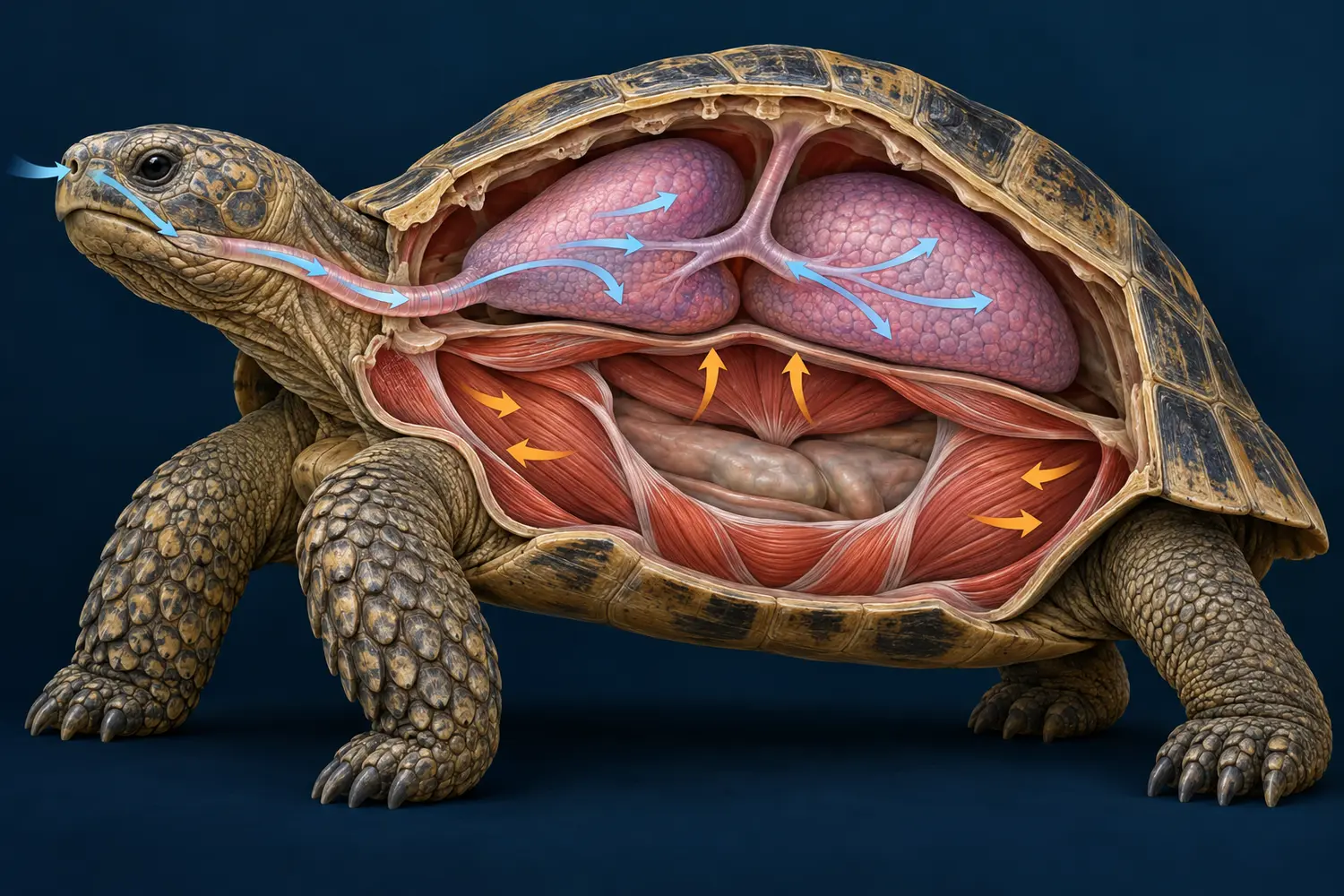
Mammals expand the chest largely by moving the ribs and diaphragm. Tortoises cannot use the same solution: their ribs are incorporated into the shell, and they do not have a mammalian diaphragm. Instead, specialized muscles associated with the abdomen and limb girdles alter pressure inside the body cavity, moving the viscera and drawing air into or pushing it out of the lungs.
The lungs lie just beneath the carapace. Their broad dorsal position helps fit a large respiratory surface into the available space. Studies of living turtles and fossil relatives indicate that this muscular ventilation system evolved as the trunk became rigid. Breathing is therefore not a passive consequence of moving the legs, although limb position and locomotion can influence ventilation differently among species.
A three-chambered heart is not a simple mixing bowl
The phrase “three-chambered heart” is useful but incomplete. A tortoise has two atria and one ventricle. Muscular ridges subdivide that ventricle into functional regions, helping direct oxygen-rich and oxygen-poor blood. The separation is not identical to the complete right-left ventricular wall of birds and mammals, and turtles can alter cardiac shunting as breathing, temperature and activity change.
That flexible circulation is normal reptile physiology, not evidence that the heart is weak or primitive. Calling it “resilient” may sound appealing, but the meaningful story is its ability to route blood through a partially divided ventricle under different conditions.
How the head, neck and beak work
Tortoises have no teeth. Their jaws are covered by a keratinous beak, or rhamphotheca, whose edges crop, tear and crush food. Beak shape varies with feeding ecology, so it is safer to describe it as a versatile cutting surface than as a single-purpose foliage shear.
Living tortoises belong to the hidden-necked turtle lineage, Cryptodira. They withdraw the neck mainly in a vertical S-shaped curve, bringing the head backward beneath the front edge of the shell. Retraction can protect vulnerable skin and eyes, but speed and completeness vary with species, age and shell proportions. Giant tortoises, for example, may have long necks that reach vegetation well above the ground.
Column-like legs built for life on land
Many tortoises have thick, weight-bearing limbs with robust scales. The forefeet often carry strong claws used for traction and digging; the hind limbs support and propel the body. Unlike the flattened flippers of sea turtles or the webbed feet of many freshwater turtles, these limbs are adapted primarily for terrestrial travel.
“Slow” does not mean mechanically simple. Each step must move the shell and its contents while maintaining balance on uneven ground. Limb posture, claw length and digging behavior differ sharply among species. A sulcata may excavate a deep burrow to escape heat, while a giant island tortoise follows established paths across open ground.
Digestion: generally slow, but not identical in every species
Most familiar tortoises eat predominantly plant material, and several species can extract substantial energy from fibrous vegetation. Food may remain in the digestive tract for long periods, allowing microbial fermentation in the hindgut. Temperature, hydration, food quality and body size all affect passage time and digestion.
However, “all tortoises are strict herbivores” is too broad. Some species are generalist herbivores, while others consume fungi, carrion or small animal matter opportunistically. Speke’s hinge-back tortoise, for example, is described in research as omnivorous. Anatomy and diet should therefore be discussed species by species rather than reduced to one slow-metabolism formula.
Why the dome helps—but is not universal
A high dome can resist some crushing forces and leaves room for organs and retracting limbs. Yet shell shape also reflects habitat, movement and evolutionary history. Open-country and giant tortoises often have substantial domes; saddle-backed giant tortoises have a raised front opening associated with longer neck reach; pancake tortoises have traded heavy armor for flexibility in rocky terrain.
The plastron is not always perfectly flat, either. Its shape varies among species and individuals, and adult males of some tortoises have a concave plastron that helps during mating. Hinges occur in certain lineages, allowing part of the plastron or carapace to move.
Frequently asked questions
Is a tortoise shell fused to its spine?
The central carapace includes bones continuous with broadened ribs and vertebrae. Saying the shell is “fused to the spine” conveys part of the idea, but the more accurate description is that ribs and vertebral elements are built into the shell during development.
Can a tortoise leave its shell?
No. The shell is part of the skeleton, and major muscles and internal structures attach to it. Removing a tortoise from its shell would be fatal.
Do tortoises breathe through their shells?
No. Air travels through the nostrils, mouth region, trachea and lungs. Muscles change pressure within the rigid body cavity to ventilate the lungs.
Are tortoise shells bulletproof?
No. Shell strength varies, and a shell can be fractured or penetrated. “Bulletproof” and “impenetrable” are misleading descriptions.
Are all tortoises high-domed?
No. Many are domed, but the African pancake tortoise has a notably flattened, flexible shell, and other species show different contours linked to habitat and life history.
The real engineering story
Tortoise anatomy is remarkable not because every component is maximized for strength, but because many systems are integrated around one constraint: a rigid shell made from the skeleton itself. Ribs that cannot pump the lungs require a different breathing mechanism. A protected torso changes the position of the shoulder girdle. Heavy armor favors sturdy terrestrial limbs, while species in rocky habitats may evolve a lighter alternative.
The result is not an indestructible fortress. It is a living compromise—protective, sensitive, variable and inseparable from the animal inside.
Sources
- Nature Communications: Origin of the unique ventilatory apparatus of turtles
- Body plan of turtles: an anatomical, developmental and evolutionary perspective
- Lung mechanics in juvenile and adult red-footed tortoises
- Cardiac anatomy and function in Aldabra giant tortoises
- Digestive flexibility in two generalist herbivorous tortoises
- Smithsonian’s National Zoo: African pancake tortoise