
Unique pig breeds show how dramatically selective breeding can reshape one domesticated animal. The curly-coated Mangalitsa, spotted Gloucestershire Old Spots, compact Vietnamese pot-bellied pig and black-and-white Berkshire all belong to the domestic pig, yet they differ in coat, body form, history and the roles people selected them to perform.
These differences are real, but several popular descriptions are misleading. A Mangalitsa does not grow sheep’s wool. Pot-bellied pigs are not guaranteed to remain tiny. “Orchard pig” reflects a traditional farming system, and “Kobe beef of pork” is a marketing comparison rather than a scientific breed classification.
Why do domestic pig breeds look so different?
Domestic pigs descend from wild boar and have been raised by people for thousands of years. Farmers selected animals for local climates, available feed, body size, fat or lean growth, temperament, fertility and meat characteristics. Geographic isolation and pedigree registries then helped make some of those traits more consistent.
A breed is not a separate species. Mangalitsa, Gloucestershire Old Spots, Vietnamese pot-bellied pigs and Berkshire pigs can all interbreed. Their distinctive appearances reflect inherited variation maintained by people, not four independent evolutionary lineages.
1. Mangalitsa: the curly-coated “sheep-pig”
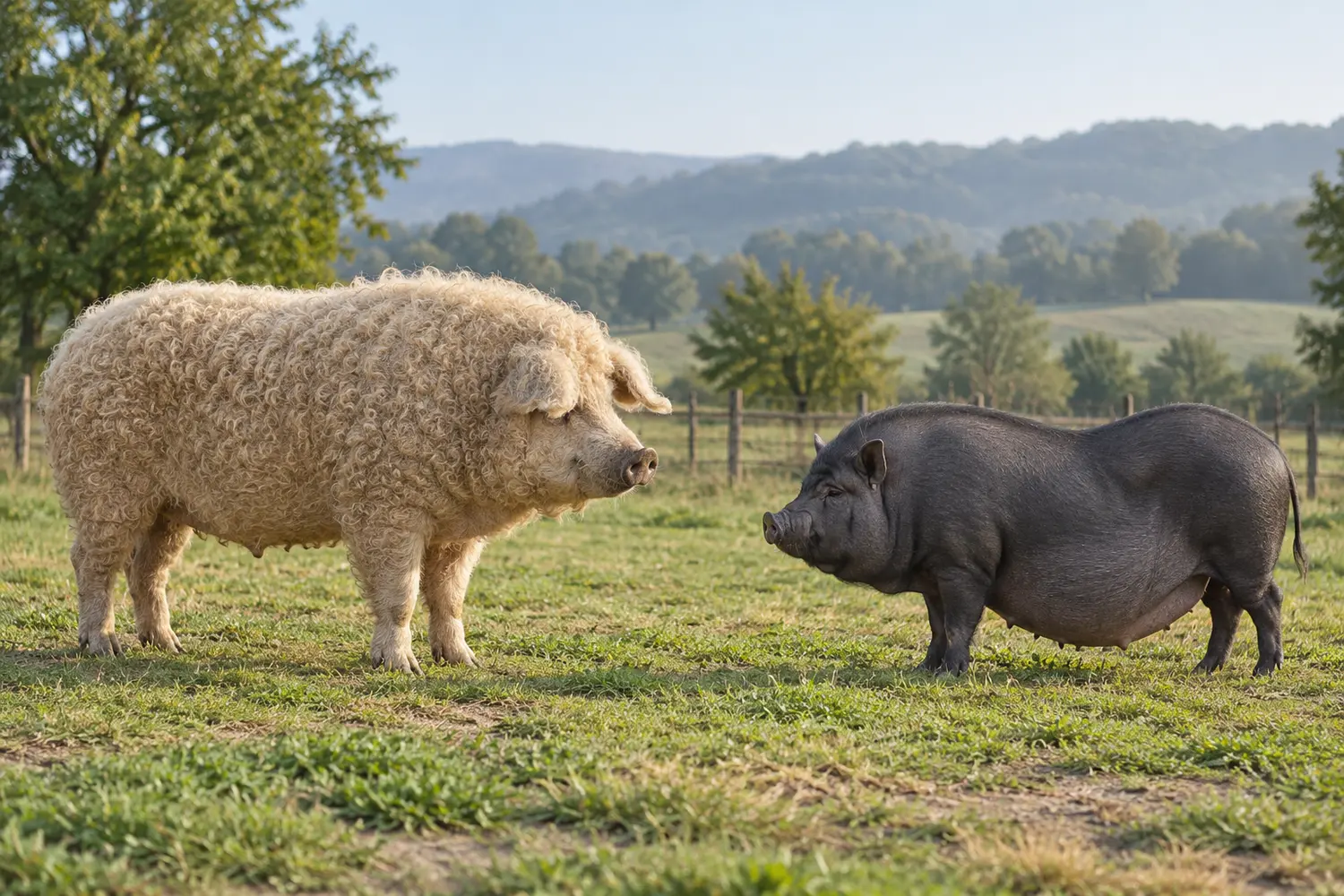
The Mangalitsa—also spelled Mangalica or Mangalitza—is a Hungarian heritage breed famous for its dense, curly hair. At a glance, a blond individual may resemble a sheep, which explains the nickname “sheep-pig.” Up close, however, the coat consists of pig hair, not wool.
The curls are usually most conspicuous in cooler conditions. Mangalitsa pigs are medium-sized, sturdy animals traditionally classified as a lard-type breed. They were once widespread in Hungary, Serbia and neighboring areas before leaner commercial breeds displaced them during the 20th century. Conservation and specialty farming later helped the breed recover.
Three color varieties are commonly recognized: blond, red and swallow-bellied. The last has a dark upper body with a lighter underside. Coat color alone does not prove that an animal is a purebred Mangalitsa; pedigree and conformation also matter.
Is the curly coat for extreme cold?
The heavy seasonal coat provides insulation and can support outdoor hardiness, but it should not be treated as a license to leave pigs without shelter. All domestic pigs still need shade, dry bedding, clean water and protection from dangerous weather. The curly hair is the breed’s most visible feature, not a complete welfare system.
2. Gloucestershire Old Spots: the traditional orchard pig
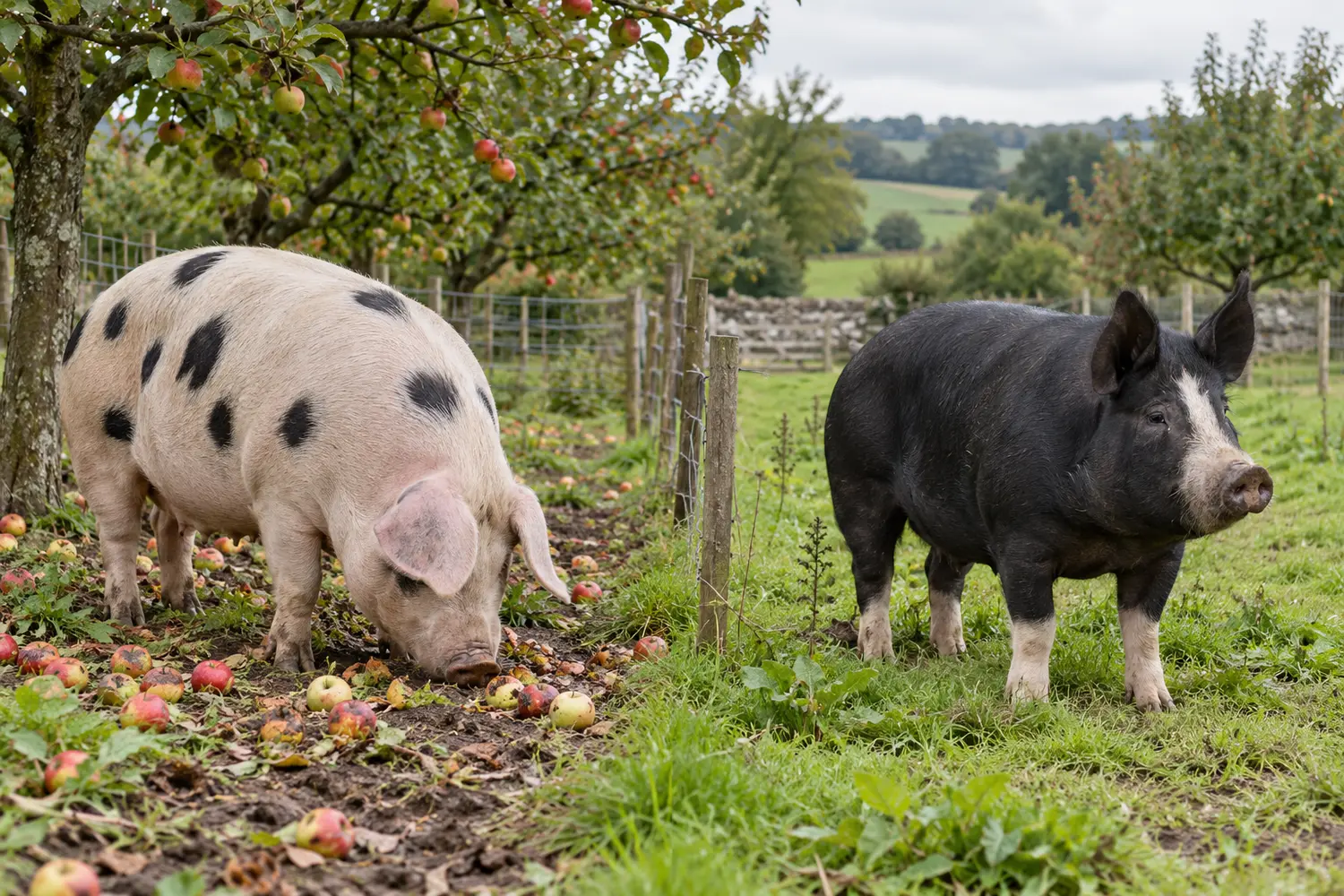
The Gloucestershire Old Spots is a large English breed with a predominantly white coat, distinct black spots and broad drooping ears. It is often called the Orchard Pig or Cottager’s Pig.
Those nicknames came from the breed’s association with small farms in and around the Vale of Berkeley. Pigs could forage on windfall fruit, cider-press leftovers and dairy by-products. The Gloucestershire Old Spots Pig Breeders’ Club notes that folklore attributed the black spots to bruises caused by falling apples, but the markings are inherited pigmentation—not bruises.
A breed society and herd book were established in 1913. The breed’s deeper ancestry is not documented with certainty, although historical accounts often propose crosses between an older local Gloucestershire pig and the unimproved Berkshire.
Modern breed descriptions emphasize the Old Spots’ large frame, lop ears and generally docile reputation. Temperament still varies among individuals, and even calm pigs require secure fencing and experienced handling.
3. Vietnamese pot-bellied pig: compact, not “teacup”
The Vietnamese pot-bellied pig became internationally familiar through small farms, zoos and the pet trade. Typical features include short legs, a compact body, small erect ears, a pronounced belly and a mildly swayed back. Many are black, although other colors occur.
It is reasonable to call the type miniature relative to commercial farm pigs. It is not reasonable to promise that an adult will remain the size of a small dog. The Merck Veterinary Manual notes that mature pot-bellied pigs in trim condition can weigh well over 100 pounds, and modern pet-pig populations vary because of crossbreeding.
Why “micro pig” promises are risky
Labels such as teacup, micro, nano or pocket pig do not guarantee a standardized adult size. Restricting food to keep a pig abnormally small can cause serious welfare problems. Prospective keepers should plan for the animal’s mature size, rooting behavior, strong social needs, veterinary care and local livestock regulations.
Pot-bellied pigs are intelligent and trainable, but that does not make them easy apartment pets. They need space, enrichment, hoof care, appropriate nutrition and opportunities to perform normal pig behaviors.
4. Berkshire: an old black-and-white British breed
The Berkshire originated in England and became influential in pig breeding far beyond Britain. Today’s breed is typically black with white on the face, feet and tail, plus erect ears. The American Berkshire Association describes the ideal pattern as six white points: the face, four socks and tail tip.
The association, founded in 1875, is the oldest swine registry in the United States. Historical stories trace the breed’s reputation to the English county of Berkshire, but accounts involving Oliver Cromwell’s soldiers are best treated as breed legend rather than independently verified history.
Berkshire pork is promoted for intramuscular fat, tenderness and eating quality. Those traits are evaluated in breed programs, but “Kobe beef of pork” is not a scientific designation and does not mean every Berkshire animal produces identical meat. Diet, age, management, genetics within the breed and processing all influence the final product.
How the four pig breeds compare
| Breed | Origin | Key identifying traits | Traditional or modern role |
|---|---|---|---|
| Mangalitsa | Hungary and the surrounding region | Dense curly hair; blond, red or swallow-bellied varieties | Heritage lard-type pig and specialty farming |
| Gloucestershire Old Spots | England | White coat with black spots; large lop ears | Small farms, orchards and heritage pork |
| Vietnamese pot-bellied pig | Vietnamese ancestry; developed internationally as miniature swine | Short legs, deep belly, erect ears and compact frame | Smallholder, zoo, research and companion settings |
| Berkshire | England | Black body, white points and erect ears | Pedigree production and meat-quality programs |
The table compares typical breed traits, not absolute rules. Crossbred pigs may resemble a named breed without meeting registry standards, and individuals within a breed can vary in size, coat and behavior.
Are heritage pig breeds better than commercial pigs?
“Heritage” usually refers to established breeds maintained over generations, often with documented pedigrees and links to older farming systems. It does not automatically mean healthier, more humane or environmentally superior.
Animal welfare depends heavily on daily management: suitable housing, social contact, diet, veterinary care, freedom of movement, thermal comfort and humane handling. A rare breed in poor conditions does not benefit from its heritage label, while a commercial cross can experience good welfare under responsible care.
Why conserving pig breeds matters
Maintaining diverse breeds preserves genetic options for future farming. Traits related to maternal ability, foraging, climate tolerance, disease resilience, carcass quality and behavior may become useful as production systems and climates change.
Conservation is more complex than keeping a few visually unusual animals. Healthy breed populations need enough unrelated breeding stock, accurate pedigree records and long-term participation by farmers. Selecting only for exaggerated appearance can narrow genetic diversity or create welfare problems.
Breed conservation also protects cultural history. The Old Spots’ orchard associations, Mangalitsa’s Central European farming legacy and Berkshire registry traditions connect domestic animals to particular landscapes and food systems.
Frequently asked questions
Is a Mangalitsa pig crossed with a sheep?
No. Mangalitsa is entirely pig. Its sheep-like appearance comes from inherited curly hair.
Are Gloucestershire Old Spots born with black spots?
The breed is genetically characterized by a white coat with black markings. The spots are pigmentation, not bruises from apples.
How small is a Vietnamese pot-bellied pig?
It is smaller than most commercial farm pigs, but mature animals commonly exceed 100 pounds and may approach or exceed 200 pounds depending on lineage and condition. “Teacup” is not a reliable adult-size guarantee.
Is Berkshire pork always red or pink?
Raw pork color varies and should not be used alone to identify a breed. Berkshire is better identified by pedigree and breed conformation; meat color, marbling and tenderness also vary among animals and production systems.
Which is the rarest of these pig breeds?
Population status differs by country and registry, so there is no single worldwide ranking. Mangalitsa and Gloucestershire Old Spots have both required conservation efforts, while Berkshire has a broader international production base.
The bottom line
These four unique pig breeds are striking for different reasons: Mangalitsa for curly hair, Gloucestershire Old Spots for orchard history and spotted coloring, Vietnamese pot-bellied pigs for compact conformation, and Berkshire for its black-and-white pattern and long pedigree tradition.
Their real stories are more interesting than the viral shorthand. None is a separate species, a “teacup” guarantee or a marketing slogan made flesh. Each is the result of people selecting domestic pigs for particular environments, farming systems and cultural preferences.