You cannot reliably tell whether a snake is venomous from its head shape or pupils alone. Those clues describe some groups, but exceptions occur on both sides. The safe response to an unknown snake is to keep your distance, avoid touching or trapping it, and use a qualified local expert for identification.
The familiar rules—“triangular head means venomous” and “slit pupil means dangerous”—are especially risky when applied worldwide. They simplify real anatomical trends into universal tests that do not exist.
Can You Tell if a Snake Is Venomous by Looking at It?
Sometimes a knowledgeable observer can identify a snake from a combination of range, scale arrangement, color pattern, body proportions and other species-level features. That is very different from using one visual shortcut. Reliable identification depends on the species and location, and it should never require approaching the animal.
| Popular shortcut | Why it fails | Safer interpretation |
|---|---|---|
| Triangular head = venomous | Many harmless snakes flatten the head when threatened | Head shape may support an expert identification, but is not a venom test |
| Round pupil = harmless | Coral snakes, cobras and many other venomous elapids have round pupils | Pupil shape is linked more closely to visual ecology than danger to people |
| Slit pupil = venomous | Some harmless or medically insignificant nocturnal snakes have vertical pupils | Never approach a snake to inspect its eyes |
| Bright colors = dangerous | Venomous and harmless species can share similar colors | Use local, species-specific resources from a safe photograph |
Myth 1: A Triangular Head Always Means Venom
Many vipers do have broad heads with a distinct neck. Their venom-delivery anatomy contributes to that silhouette. In North America, pit vipers such as rattlesnakes, copperheads and cottonmouths often look noticeably broad-headed.
But “often” is not “always.” A harmless snake may spread the rear of its head and neck when frightened, producing an impressively triangular outline. Hognose snakes are famous for dramatic defensive displays, and several watersnakes and other colubrids can broaden the head too. Even the Florida Museum’s copperhead guide warns that head shape is not a reliable way to identify that species.
The opposite problem is just as important: several dangerous snakes do not have the stereotypical heavy viper head. Cobras, mambas, kraits and coral snakes belong to Elapidae and commonly present a comparatively slender profile. Judging “safe” from a narrow head can therefore be a serious mistake.
Myth 2: Slit Pupils Reveal a Venomous Snake
Vertical pupils occur in many pit vipers, so the association did not appear from nowhere. Yet pupils are not venom detectors. A comparative study of snake eyes found that vertical pupil shape is associated with ecological factors such as foraging mode and activity pattern; it may also help camouflage the eye in ambush predators. The trait has evolved in snakes with very different venom systems and levels of medical significance.
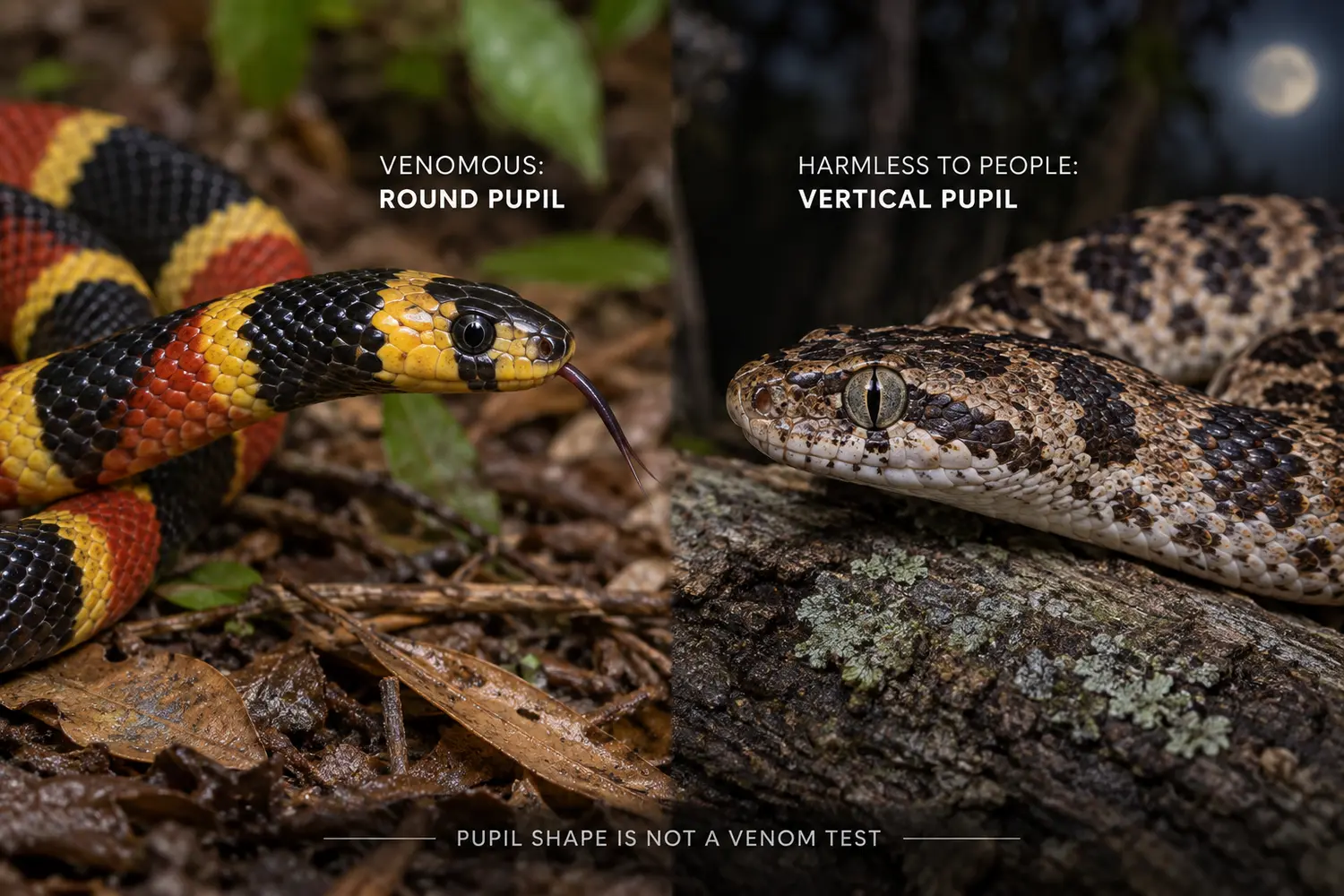
Venomous coral snakes generally have round pupils. So do many cobras and mambas. Meanwhile, night snakes and several other small nocturnal snakes can have vertical pupils without posing the same danger to people as a viper. Light also changes pupil width, making casual judgments even less useful.
There is a practical flaw too: getting close enough to inspect a wild snake’s pupil is exactly what a cautious observer should avoid. A clue that requires unsafe proximity is not a sensible field test.
Venomous, Poisonous and Harmless Are Not the Same
A venomous animal actively delivers toxins through a bite or sting. A poisonous animal causes harm when touched or eaten. Snakes of medical concern are described as venomous, not poisonous.
“Non-venomous” is also an imperfect everyday label. Some rear-fanged snakes produce venom used on prey but are not generally considered medically important to humans. Conversely, even a snake without medically significant venom can bite, and any bite can become contaminated. The useful question is not whether a social-media rule labels the animal harmless; it is whether you can avoid contact and obtain competent identification.
What Clues Do Experts Actually Use?
Experienced herpetologists combine multiple features. These can include geographic range, habitat, overall proportions, scale counts, arrangement of head scales, facial markings, dorsal pattern, tail structure and defensive behavior. Which clues matter depends entirely on the local fauna.
Some characters are diagnostic within a narrow region but fail elsewhere. The well-known red-yellow-black rhyme for North American coral snakes, for example, is not dependable across all coral snake species and mimics. Likewise, a facial pit helps distinguish North American pit vipers, but checking for one at close range would be reckless.
For a non-expert, the best “identification tool” is often a zoomed photograph taken without moving closer, followed by consultation with a local wildlife agency, museum, poison center or reputable snake-identification service. Location is crucial; include the country, state or province and nearest city without revealing sensitive wildlife sites.
What to Do When You Encounter an Unknown Snake

- Stop and give the snake room. Back away slowly rather than stepping over or around it.
- Keep children and pets away. Use a leash outdoors in snake habitat.
- Do not poke, pin, pick up or attempt to kill the snake. Many bites happen during handling.
- If the snake is inside a building, isolate the area if this can be done safely and call local animal control or a qualified snake remover.
- If useful, take a photograph with zoom from a safe distance. Do not delay leaving the area to get a better image.
The CDC advises people not to touch or handle any snake. Outdoor workers should also use boots, long pants and gloves when moving brush or debris where snakes may be hidden.
What Should You Do After a Snakebite?
Treat an unidentified snakebite as a medical emergency. Move away from the snake, keep the bitten person calm, remove rings or watches before swelling begins, and seek emergency care immediately. Do not drive yourself if symptoms could impair you.
Do not cut the wound, suck out venom, apply ice, use electric shock or tie a tourniquet. Do not try to catch or kill the snake. The CDC says a photograph from a safe distance may assist identification, but obtaining one must not create another exposure or delay care.
Frequently Asked Questions
Do all venomous snakes have triangular heads?
No. Many vipers have broad triangular heads, but venomous elapids such as coral snakes and cobras may look slender-headed. Harmless snakes can also flatten their heads into a triangle.
Are snakes with round pupils safe?
No. Round pupils occur in numerous venomous snakes. Pupil shape should never be used alone to decide whether approaching or handling a snake is safe.
Can a harmless snake imitate a viper?
Some non-venomous snakes broaden or flatten the head when threatened, creating a viper-like silhouette. Whether this evolved specifically as mimicry can vary, but the behavior clearly makes the head-shape shortcut unreliable.
The Bottom Line
When comparing venomous vs. non-venomous snakes, anatomy offers patterns—not a universal checklist. Head shape, pupils and color can all mislead. Distance is the one rule that works everywhere: leave an unknown snake alone and let local experts identify it without putting anyone at risk.