
Warthogs and wild boars are both members of the pig family, Suidae, but they are not the same animal. The common warthog (Phacochoerus africanus) is a long-legged African grazer adapted to open country, while the Eurasian wild boar (Sus scrofa) is a heavier-bodied, highly adaptable omnivore native across much of Eurasia and North Africa. Their size ranges overlap, and both carry tusks, yet their faces, bodies, diets and defenses reflect very different lives.
Viral “warthog vs. wild boar” comparisons often turn those differences into a fictional fight. That framing misses the more interesting biology. These animals do not routinely meet across most of their native ranges, and no scientific formula can declare a universal winner from body mass or tusk length alone.
Warthog vs. wild boar at a glance
| Feature | Common warthog | Eurasian wild boar |
|---|---|---|
| Scientific name | Phacochoerus africanus | Sus scrofa |
| Native distribution | Much of sub-Saharan Africa | Much of Europe, Asia and North Africa |
| Typical build | Relatively tall-legged, lean, long-faced | Compact, deep-bodied, densely bristled |
| Feeding emphasis | Mainly grasses, roots and other plant foods; opportunistically omnivorous | Broad omnivorous diet, including roots, mast, crops, invertebrates and carrion |
| Tusks | Large curved upper canines plus sharper lower canines | Prominent lower canines sharpened against upper “whetters” |
| Distinctive protection | Fibrous facial warts; tusks; speed and refuge use | Dense bristles and a collagen-rich shoulder shield in mature males |
| Social pattern | Females and young often form sounders; adult males are more solitary | Females and young often form sounders; adult males are commonly solitary outside breeding |
They belong to different branches of the pig family
Both species are even-toed ungulates in Suidae, so their shared snout, hooves and canine tusks reflect genuine kinship. However, the common warthog belongs to the genus Phacochoerus, whereas the Eurasian wild boar belongs to Sus. Domestic pigs descend from wild boar, not from warthogs.
“Warthog” can also refer to two living species: the common warthog and the desert warthog (Phacochoerus aethiopicus). This comparison uses the common warthog, the more widespread species and the animal most general-audience articles mean by the name.
Size: wild boar varies enormously
Simple maximum-weight claims are misleading. Body mass in both species changes with sex, age, geography, season and nutrition. Male common warthogs are larger than females and can become substantial animals, but the often-repeated figure of 150 kilograms describes a very large individual rather than an everyday warthog.
Wild boar show even greater geographic variation. Many adults are far below 200 kilograms, while exceptional males in productive populations can exceed that benchmark. Introduced populations and domestic-wild hybrids can further blur online comparisons. A defensible summary is that wild boar are generally more compact and heavy-bodied, while warthogs look taller and leaner for their mass.
Warthog facial “warts” are not fat pads
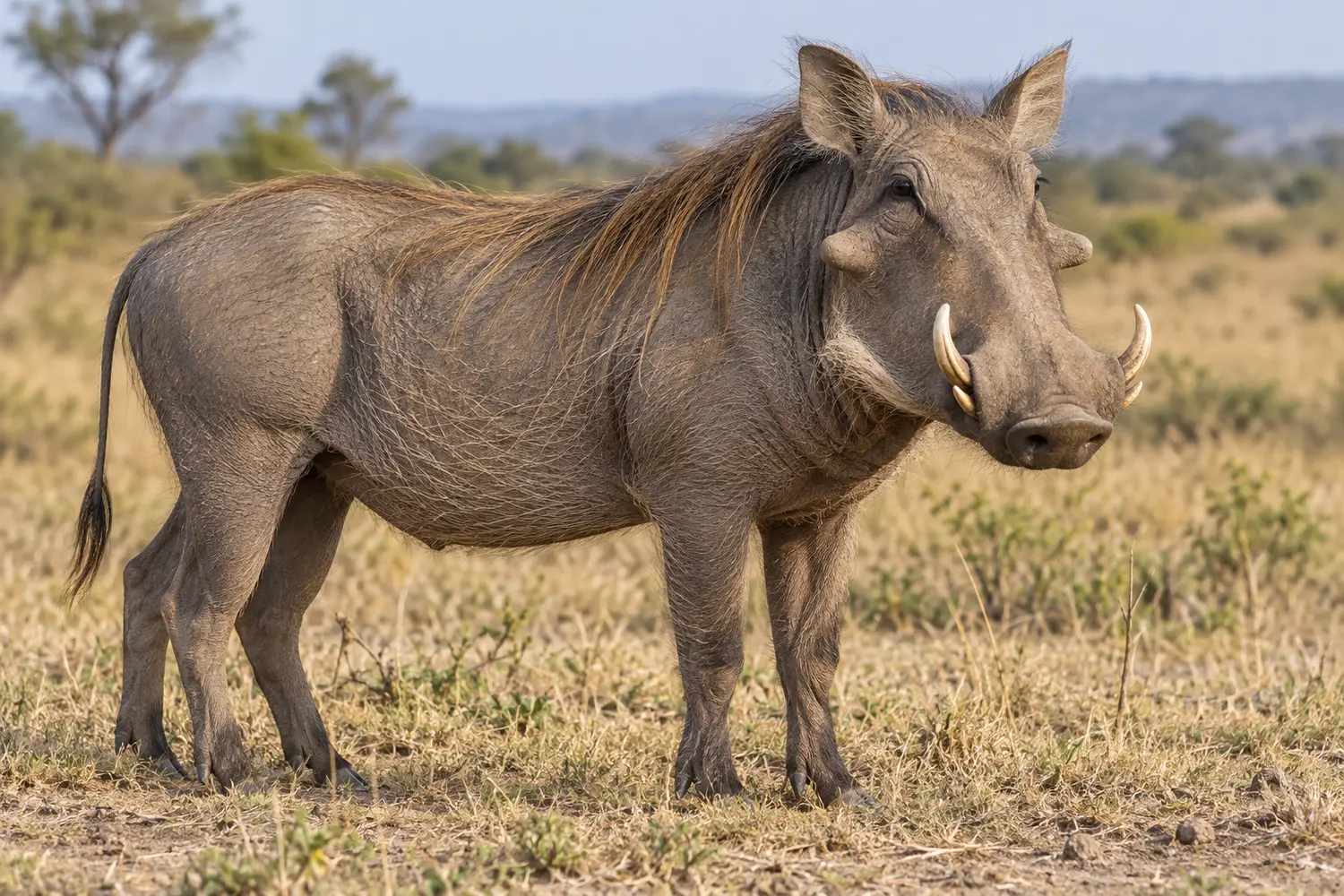
A warthog’s face carries paired protrusions that become especially conspicuous in adult males. Despite a persistent internet description, these are not simply protective fat pads. Anatomical references describe them as fibrous or cartilaginous connective-tissue structures. Their prominence varies with sex and age.
The warts may help protect the eyes and face during pushing and tusk-to-tusk contests between males, but they are not rigid armor. Calling them “shock absorbers” also goes beyond what their anatomy alone proves. They are better understood as sexually dimorphic facial structures that can offer some physical separation during close contact.
Tusks: enlarged canine teeth with different emphasis
In both animals, tusks are enlarged canine teeth. A common warthog’s sweeping upper canines create its most recognizable profile. Adult males can develop particularly long upper tusks; published species accounts report broad ranges rather than one universal four-inch measurement. The lower canines are shorter, sharper and rub against the upper pair.
Wild boar reverse the visual emphasis. The lower canines, often called tushes or cutters, project upward and outward. They continually wear against the upper canines, or whetters, maintaining cutting edges. Tusks serve in display, digging, defense and contests, but their dimensions vary markedly among individuals.
Neither tusk system should be reduced to a single “weapon score.” Reach, angle, wear, age and behavior all matter, and an animal normally uses threat displays and avoidance before risking injury.
The wild boar’s shoulder shield is real—but it is not cartilage armor
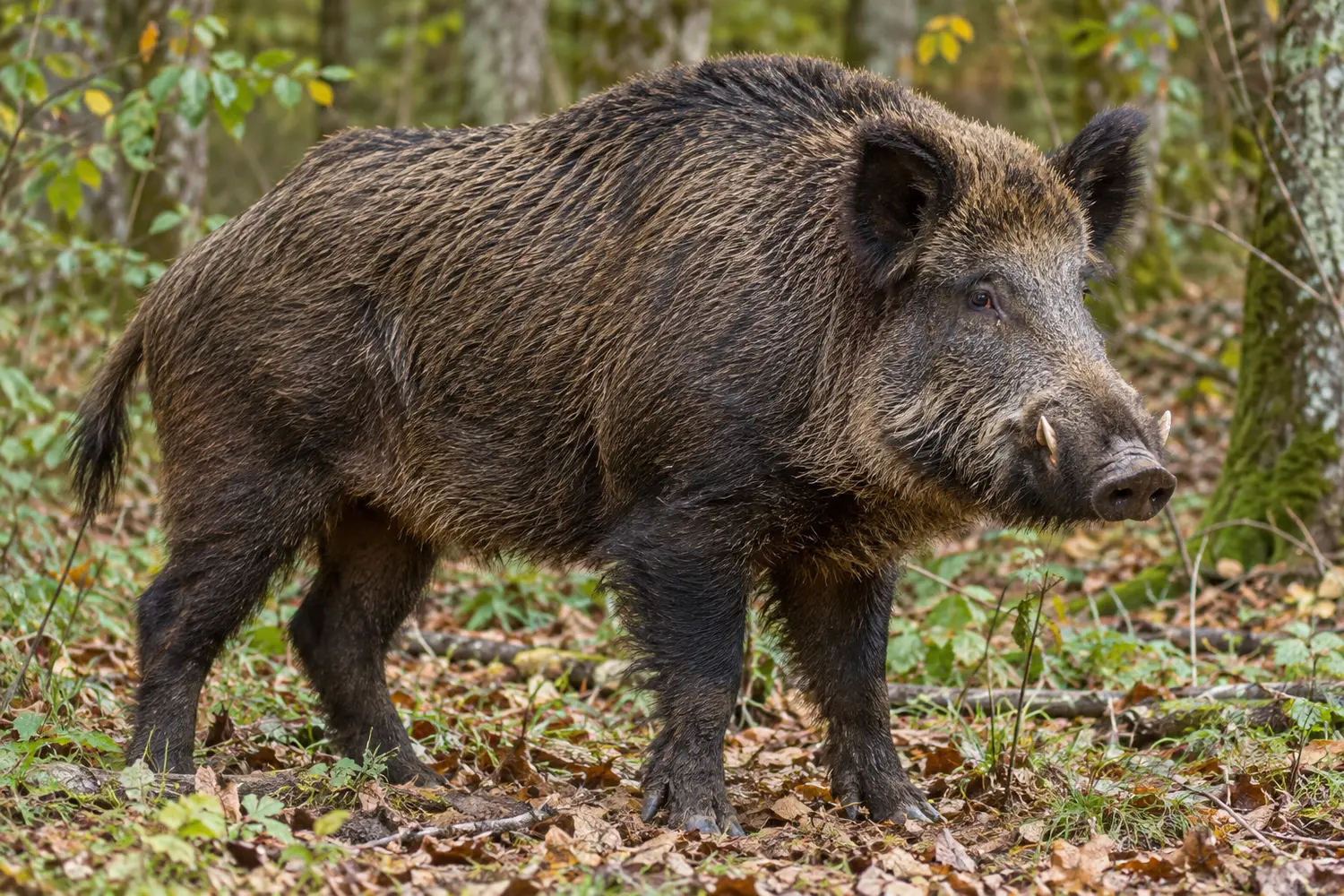
Mature male pigs can develop a thickened layer over the shoulder region commonly called the shield. Histological studies describe dense, collagen-rich tissue in the skin and subcutaneous layer. In older boars it can be much firmer and less fatty than ordinary backfat.
The shield is associated with maturity and is plausibly useful during contests in which a rival’s tusks contact the shoulder area. However, “cartilaginous armor” is inaccurate, and “bulletproof” is a dangerous myth. Its development varies with age, individual condition and reproductive state. It does not cover the whole animal, and it does not make a boar invulnerable.
Habitat and range usually keep them apart
Common warthogs occupy savannas, grasslands and open woodland across sub-Saharan Africa where grazing areas, water and refuge are available. They commonly use burrows—often excavated by other animals—as shelter and breeding sites. Their long legs and mobile lifestyle suit open landscapes.
Wild boar are native across a vast span of Europe and Asia, with native populations also in North Africa. They thrive in forests, shrublands, wetlands and agricultural mosaics. Humans have introduced them to many other regions, where they can become invasive and cause ecological and agricultural damage.
Because those native distributions are largely separate, a warthog-versus-boar confrontation is not a standard natural interaction. Captive, introduced or heavily managed settings can create unusual proximity, but that does not make a staged matchup ecologically meaningful.
Diet and foraging reflect different ecological strategies
Common warthogs are often seen kneeling on their calloused wrists while cropping short grasses. They also dig for roots, bulbs and rhizomes, especially when surface forage is scarce, and they may consume fruit, carrion or small animal matter opportunistically. “Herbivore” captures their usual feeding emphasis better than it captures every item they may eat.
Wild boar are broad generalists. Their muscular snouts turn soil and leaf litter in search of roots, tubers, acorns, seeds, fungi and invertebrates. They also consume crops, eggs, carrion and small vertebrates when available. This dietary flexibility helps explain why Sus scrofa can prosper in environments ranging from woodland to farmland and suburban edges.
Temperament: neither species is permanently aggressive
Both animals can defend themselves forcefully, especially if injured, cornered or accompanied by young. That does not mean either spends its life seeking combat. Avoidance, vigilance, threat displays and escape reduce the risk of injury.
Female warthogs and their young commonly live in social groups known as sounders. Adult males are more often solitary or form loose bachelor associations. Wild-boar sounders are likewise centered on females and offspring, while mature males often range alone outside the breeding season.
Descriptions such as “built to tank damage” or “notoriously aggressive” turn flexible wildlife behavior into a video-game trait. Context matters more: distance to cover, reproductive condition, prior experience, human pressure and whether an escape route exists.
So which would win?
There is no scientifically meaningful universal answer. A large mature wild boar may outweigh many warthogs and has a robust body plus a shoulder shield. A warthog has long tusks, a different body plan and strong acceleration in open country. But body size overlaps, individuals vary, and an actual encounter would be shaped by motivation and environment rather than species averages.
The truthful conclusion is not a winner. It is that evolution equipped two related pigs for different ecological problems: the warthog for open African landscapes and grazing-centered life, and the wild boar for flexible omnivory across an exceptionally wide range of habitats.
Frequently asked questions
Is a warthog a type of wild boar?
No. Both are members of Suidae, but the common warthog is Phacochoerus africanus and the Eurasian wild boar is Sus scrofa. They belong to different genera.
Are warthog warts made of fat?
No. Reliable anatomical descriptions identify them as fibrous or cartilaginous connective-tissue growths. They are not simple fat pads.
Is a wild boar’s shoulder shield made of cartilage?
No. Studies describe dense, collagen-rich skin and subcutaneous tissue over the shoulder region of mature males. It is not an external shell or a cartilage plate.
Which animal has longer tusks?
Common warthogs are known for dramatically long, curved upper tusks. Wild boar usually show less sweeping upper canines, but their sharpened lower canines are important cutting structures. Individual variation is considerable.
Do warthogs and wild boars live together?
Not ordinarily across their principal native ranges. Common warthogs are sub-Saharan African animals; wild boar are native mainly to Eurasia and North Africa, although humans have introduced wild boar far beyond that range.