Home > Mammal Articles > Whale Flipper vs. Human Hand: The Same Bone Plan?

Whale Flipper vs. Human Hand: The Same Bone Plan?

Published on

A whale flipper and a human hand are built from the same basic forelimb plan, but they are not anatomically identical. Both contain a humerus, radius and ulna, wrist bones, hand bones and digits. Evolution reshaped those inherited parts for very different jobs: steering a massive body through water versus gripping and manipulating objects.

Key takeaways

  • Whale flippers and human arms are homologous structures: they share an underlying pattern inherited from a common tetrapod ancestor.
  • The correspondence is real, but “nearly identical” is too strong. Bone proportions, joints, digit number and phalange count can differ substantially.
  • Many cetaceans evolved hyperphalangy—more finger bones than the usual mammalian pattern—and some lineages reduced a digit.
  • Living anatomy agrees with fossils and genetic evidence showing that whales evolved from land-dwelling mammals.

Whale flipper vs. human hand: a bone-by-bone comparison

RegionHuman forelimbWhale forelimb
Upper armHumerusHumerus
ForearmRadius and ulnaRadius and ulna
WristCarpalsCarpals
Hand/palmMetacarpalsMetacarpals
DigitsPhalanges arranged as five fingersPhalanges enclosed within the flipper; number and pattern vary by cetacean group

This repeated sequence—not a perfect visual match—is the important evolutionary clue. The bones occupy corresponding positions and develop as parts of the same inherited forelimb system.
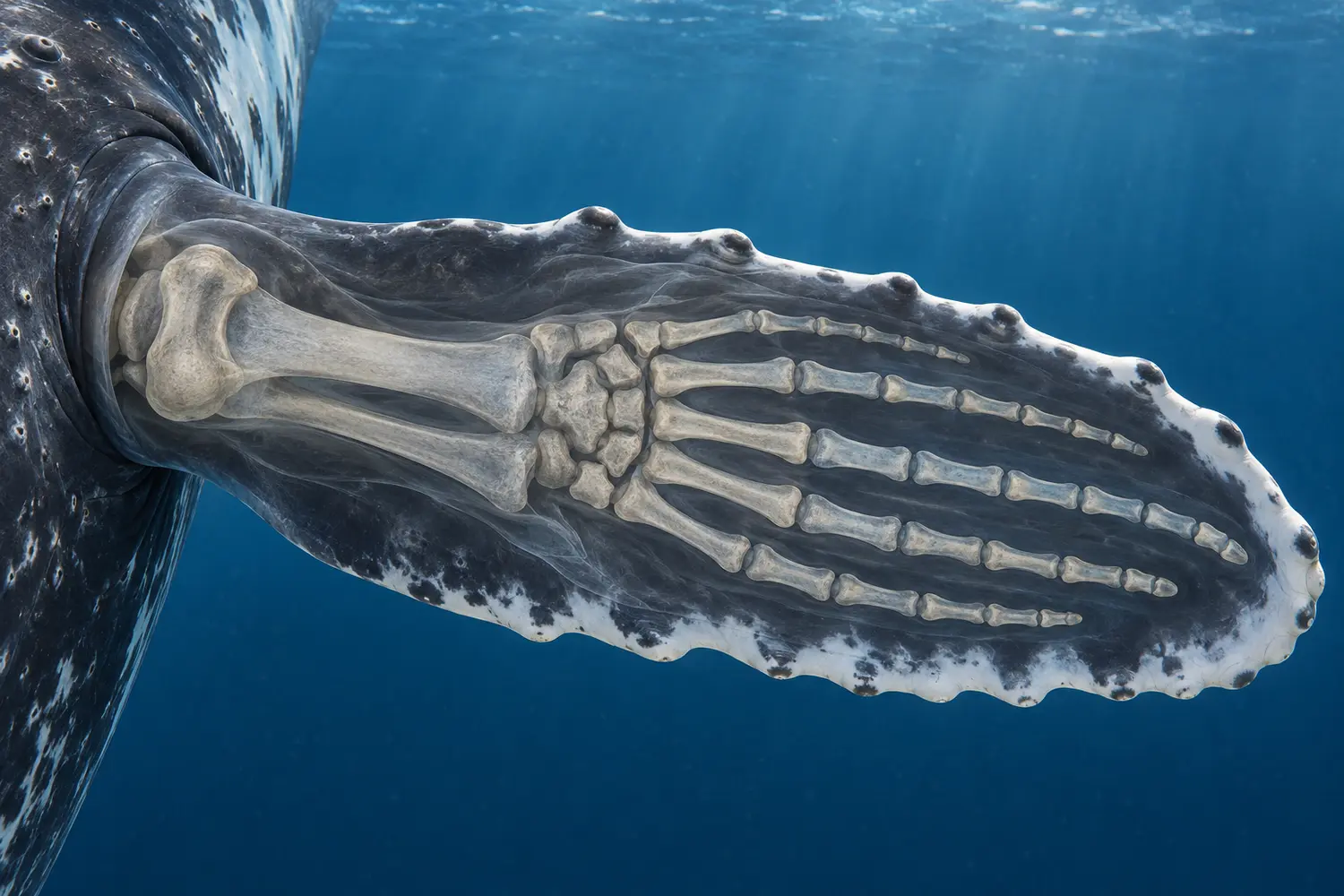
AI-generated schematic showing the humerus, radius, ulna, wrist and digit bones within a whale flipper.
AI-generated schematic of the whale forelimb plan. Exact bone proportions and phalange counts vary among species.

What does “homologous” actually mean?

In evolutionary biology, homologous structures share a common origin even when natural selection has adapted them to different functions. A human arm, a bat wing, a horse foreleg and a whale flipper all preserve variations of the tetrapod forelimb plan.

Homology does not mean two structures must look alike or do the same job. That distinction matters here. A whale’s pectoral appendage is flattened into a hydrodynamic flipper, while a human hand has highly mobile fingers and an opposable thumb. Their shared architecture points backward to ancestry; their differences record adaptation.

How evolution changed the whale forelimb

Whale evolution did not replace the ancestral mammalian forelimb with a completely new structure. It modified the one already present. The upper-arm and forearm bones became relatively short and broad in many species, the elbow lost much of its mobility, and the digits were enclosed in connective tissue to form a stiffened paddle.

The details are more varied than a simple classroom diagram suggests. A comparative study of living cetaceans found that whales and dolphins are the only mammals known for widespread hyperphalangy, meaning an increased number of phalanges within a digit. The same research described different digit patterns among toothed and baleen whales: many toothed whales retain five digits, while many baleen whales have four and lack the first digit. Species therefore should not be forced into one universal “whale hand” formula.

AI-generated documentary-style view of a humpback whale showing its exceptionally long pectoral flippers.
A humpback whale’s unusually long pectoral flippers help it maneuver. AI-generated wildlife illustration.

Why a whale needs flippers instead of hands

A whale’s powerful up-and-down tail strokes provide its main thrust. The paired pectoral flippers help control direction, balance, banking and pitch. Their broad surface interacts with moving water much as an underwater wing does.

That role rewards a firm, streamlined appendage rather than independently moving fingers. Humpback whales take the design to an extreme: their exceptionally long pectoral flippers improve maneuverability for such a large animal. Humans experienced a different set of evolutionary pressures, retaining a flexible wrist and digits capable of precision grips, tool use and complex touch.

What fossils add to the story

Comparative anatomy alone reveals a shared forelimb plan, but fossils show the transition in much greater detail. Early whales lived more than 50 million years ago and still possessed weight-bearing limbs. Forms such as Ambulocetus combined features suited to walking and swimming, while later archaeocetes became progressively more aquatic.

Across that sequence, hind limbs diminished, bodies became streamlined, nostrils shifted toward the top of the skull, and forelimbs became flippers. Modern molecular evidence places cetaceans within the even-toed ungulate branch of mammals; hippos are their closest living relatives. This does not mean whales evolved from modern hippos. It means both lineages share a more recent common ancestor with each other than either does with most other living mammals.

Are the bones really “the same”?

The most accurate short answer is: the same basic plan, extensively remodeled. Calling the skeletons identical hides biologically meaningful differences. Whale species vary in their digit complement, phalange numbers, proportions and joint mobility. Even within cetaceans, a dolphin’s compact flipper and a humpback’s enormous pectoral appendage are not interchangeable designs.

What remains persuasive is the ordered correspondence. The humerus connects to the radius and ulna; these lead into carpals, metacarpals and phalanges. That nested pattern is exactly what common descent predicts when an ancestral limb is modified rather than invented from scratch.

Frequently asked questions

Do whales have fingers inside their flippers?

Whales have digit bones homologous to fingers, but the digits are enclosed within the flipper and cannot move independently like human fingers.

Do all whales have five digits?

No. Digit number varies among cetacean lineages. Many toothed whales have five, while many baleen whales have four; phalange counts also differ among species.

Does the similarity prove whales once lived on land?

The forelimb homology is one strong line of evidence. The conclusion is much stronger because it is independently supported by transitional fossils, genetics, embryology and other anatomical traits.

References