
Squirrels bury nuts to store food for later, a behavior called scatter hoarding. Some cached seeds are recovered and eaten, while others are stolen, spoiled, moved again or left underground. When an intact acorn survives in a suitable place, it may germinate and contribute to forest regeneration. The familiar story is broadly true—but not because squirrels simply forget most of their food.
Key takeaways
- Tree squirrels often divide nuts among many small caches instead of keeping everything in one location.
- Gray squirrels can remember cache locations and may organize caches in ways that reduce memory demands.
- Unrecovered, viable acorns can germinate, so scatter hoarding sometimes helps oaks disperse and regenerate.
- Squirrels are also seed predators. Whether their net effect helps or harms trees depends on species, seed type, habitat and season.
Why do squirrels bury nuts?
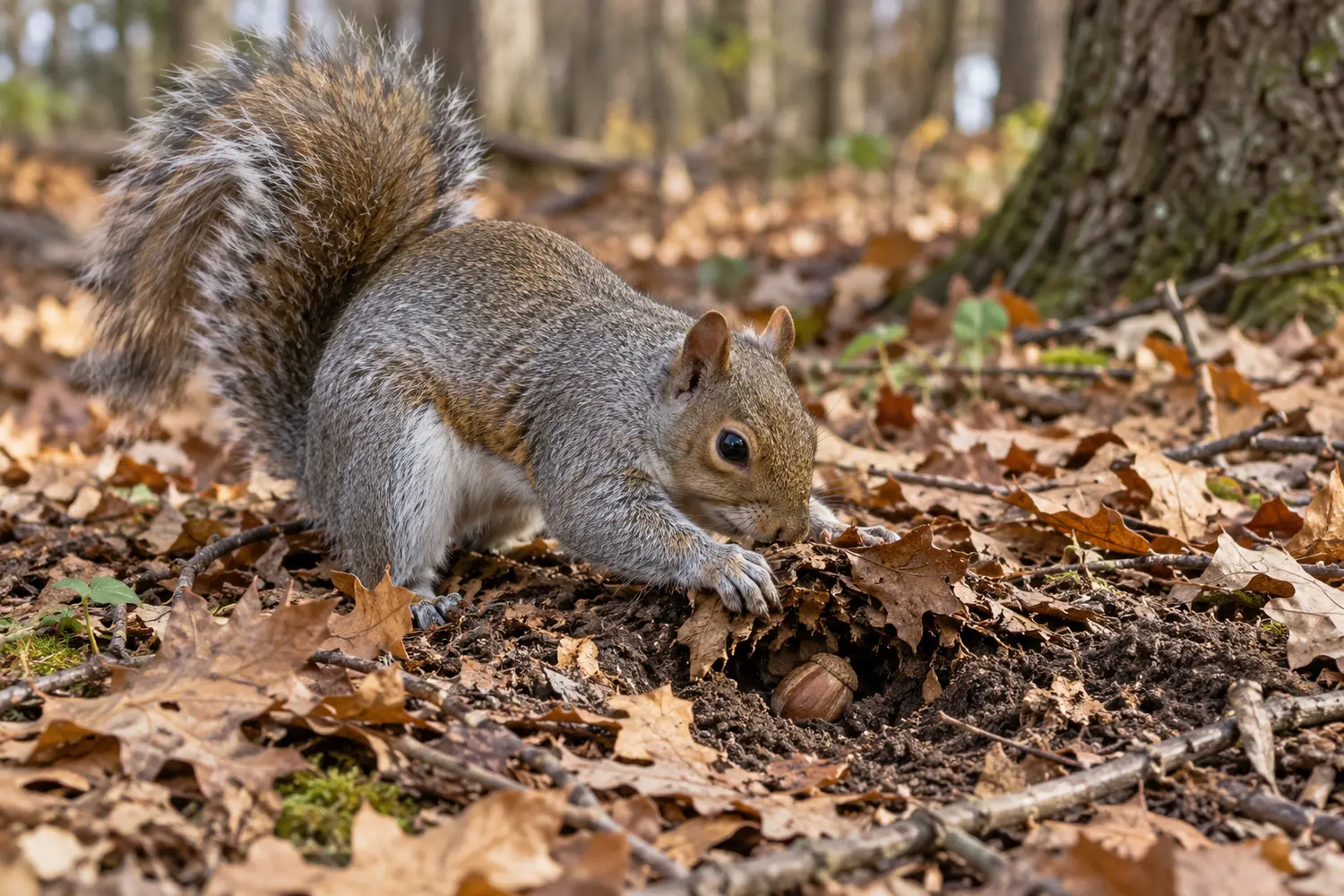
For many squirrels, autumn produces more food than can be eaten immediately. Burying nuts creates reserves that can be used when fresh food becomes scarce. Eastern gray squirrels and fox squirrels commonly scatter-hoard, placing individual nuts or small groups in many locations. Spreading the stores lowers the risk that a single thief will discover the entire supply.
This is a food-storage strategy, not deliberate tree planting. Squirrels inspect, carry, bury, retrieve and sometimes re-cache nuts according to factors such as seed quality, perishability, theft risk and the surrounding habitat. A review of squirrel–seed interactions describes squirrels as both seed predators and seed dispersers, with outcomes that vary among forest systems and plant species (Steele et al., 2020).
Do squirrels forget where they buried nuts?
They sometimes fail to recover caches, but “forgetful squirrel” is an incomplete explanation. Experiments with gray squirrels show that they can remember their own cache locations and recover them more successfully than another squirrel’s sites. Field tests also found gray squirrels relocating buried food with notable precision after a 20-day delay (Macdonald, 1997).
Fox squirrels may even use a memory strategy called spatial chunking. In a controlled study, caches containing different nut species tended to occupy different areas, potentially organizing the cache field and reducing memory load (Delgado and Jacobs, 2017).
Cache loss has several causes besides forgetting. Another animal may pilfer a nut. The original squirrel may move it to a new site, eat it earlier than expected or die before returning. Weather, fungi and insects also affect seed survival. The ecological result is therefore produced by many interacting events, not a simple memory failure.
How buried nuts can become trees
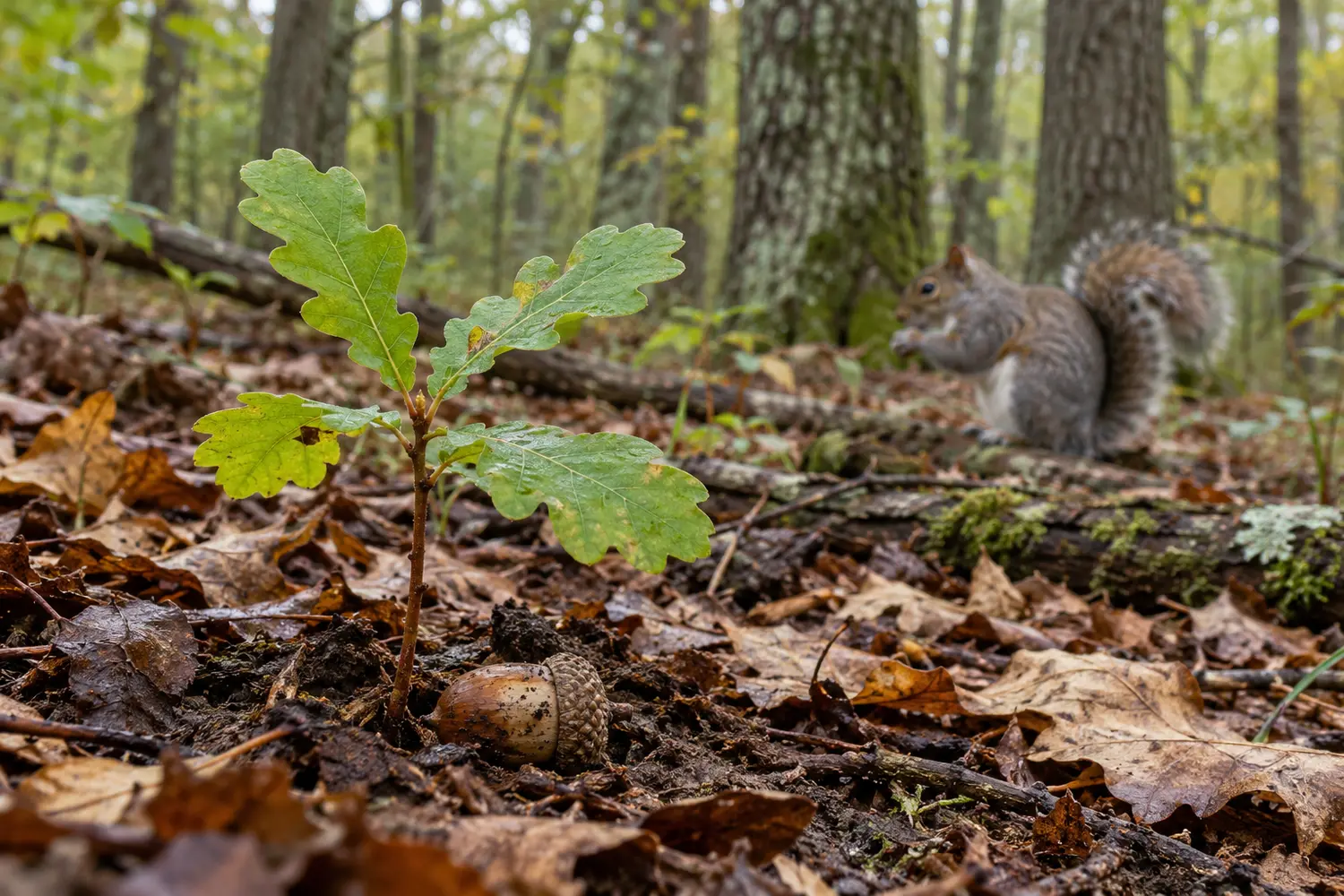
An acorn is a seed with stored energy for a developing oak. When a squirrel carries it away from the parent tree and buries it shallowly, the seed may gain several advantages: reduced crowding, some protection beneath soil and leaf litter, and a chance to reach habitat beyond the tree’s canopy. USDA Forest Service accounts identify seed-caching animals as important acorn dispersers for several oak species, including California black oak (USDA Forest Service).
But burial alone does not guarantee a tree. The acorn must remain viable, avoid later consumption and land where moisture, temperature, light and competition permit germination and seedling survival. Even after sprouting, browsing, drought, disease and shade can prevent an oak from reaching maturity.
Are squirrels always good for forests?
No. The relationship is conditional. A squirrel that eats an acorn destroys that seed’s chance to become a tree. Some squirrels also remove the embryo from rapidly germinating white-oak acorns before caching them, stopping germination and preserving the nut as food. Other squirrel species rely more heavily on central larders than scattered caches, which changes their role as dispersers.
Research therefore treats scatter-hoarding animals as both consumers and transporters of seeds. In some places their caching supports regeneration; in others seed predation can outweigh the dispersal benefit. Habitat structure matters too. Vegetation cover, dead wood, fire history and the distance from parent trees can influence whether a buried acorn is recovered, survives or becomes a seedling.
Do squirrels bury thousands of nuts?
Some scatter-hoarding animals create hundreds or thousands of caches over a season, but a single universal number should not be applied to every squirrel. The family Sciuridae includes tree squirrels, ground squirrels, chipmunks, marmots and flying squirrels, with very different diets and storage strategies. Even within one species, food abundance, climate and competition alter caching behavior.
The safest conclusion is that certain tree squirrels can create many widely distributed caches, not that every squirrel buries thousands of acorns each year or loses a “huge portion” through poor memory.