
The wild cats of the Americas occupy ecological worlds that could hardly look more different. Jaguars patrol tropical rivers, pumas range from northern forests to Patagonia, jaguarundis move through dense lowland cover, and Andean cats survive on cold, rocky plateaus. Their contrasting bodies and behaviors show how one mammal family diversified across two continents.
Key takeaways
- The jaguar (Panthera onca) is the largest native cat in the Americas, but its range no longer continuously extends across every place it once occupied.
- The puma (Puma concolor) has the broadest geographic range of any native terrestrial mammal in the Western Hemisphere.
- The jaguarundi (Herpailurus yagouaroundi) is mainly associated with lowlands and dense ground cover, although records above 2,000 meters exist.
- The Andean cat (Leopardus jacobita) is a rare high-elevation specialist of the arid Andes.
- These four examples represent only part of American felid diversity; ocelots, margays, bobcats, lynx and several small spotted cats also occur in the region.
Four American wild cats at a glance
| Species | Defining build | Representative habitat | Broad range |
|---|---|---|---|
| Jaguar | Large, robust and powerfully muscled | Tropical forest, wetland and wooded savanna | Mexico through Central and South America |
| Puma | Large, long-tailed and adaptable | Forest, mountain, grassland and desert | Western Canada to southern South America |
| Jaguarundi | Small, elongated and low-slung | Dense low vegetation in open and wooded landscapes | Mexico to central Argentina and neighboring regions |
| Andean cat | Small, thick-furred, with a long ringed tail | Rocky, arid high Andes | Argentina, Bolivia, Chile and Peru |
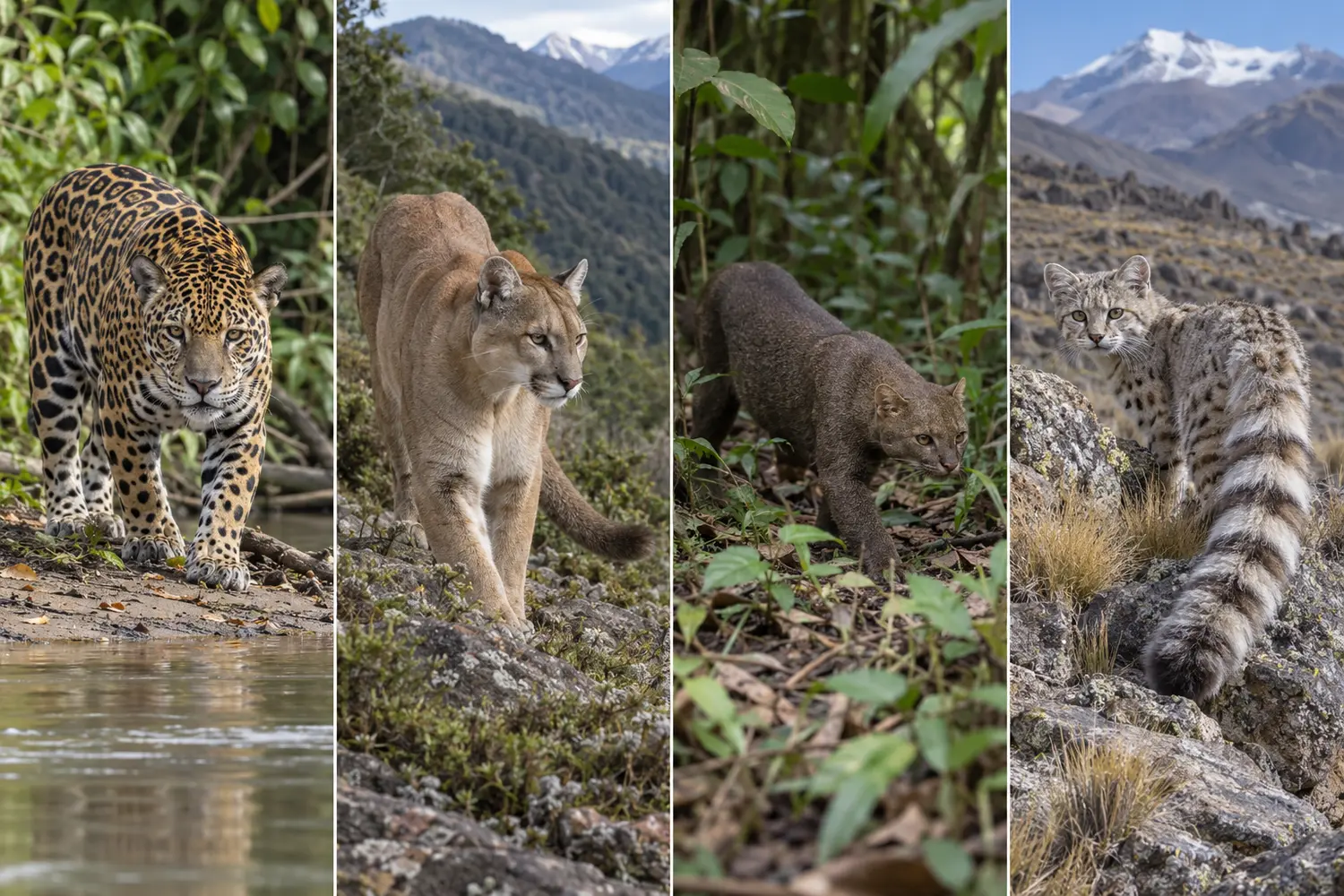
Jaguar: the river-and-forest powerhouse
The jaguar is the largest living felid native to the Americas. Its deep chest, broad head and relatively short, muscular limbs suit an ambush predator that must overpower prey at close range. The coat usually carries large rosettes, many containing smaller central spots—one useful clue when distinguishing a jaguar from a leopard, which is native to Africa and Asia.
Jaguars are strongly associated with tropical and subtropical forests, floodplains and wetlands, although they can occupy drier woodland and scrub where cover and prey remain. They are capable swimmers and regularly use rivers and flooded landscapes rather than merely tolerating water. Their diet can include mammals, reptiles and aquatic prey.
The queued description p