
Wild water buffalo and African buffalo are two of the largest living bovids, but they are not rival versions of the same animal. The wild water buffalo (Bubalus arnee) evolved around floodplains and wetlands in South and Southeast Asia. The African buffalo (Syncerus caffer) occupies habitats ranging from rainforest to open savanna across sub-Saharan Africa.
A large wild water buffalo can outweigh a Cape buffalo and carry a far wider pair of horns. An adult male Cape buffalo, however, has a distinctive horn boss and often relies on the collective vigilance and defense of a herd. Those differences reflect ecology—not a meaningful answer to which species would “win” in a fight.
Wild water buffalo vs African buffalo at a glance
| Feature | Wild water buffalo | African buffalo |
|---|---|---|
| Scientific name | Bubalus arnee | Syncerus caffer |
| Native range | South and Southeast Asia | Sub-Saharan Africa |
| Typical habitat | Floodplain grassland, swamp edge and wet forest | Savanna, woodland, forest and wetlands |
| Largest published body mass | Up to about 1,200 kg in large adults | Adult males of the largest subspecies can exceed 800 kg |
| Horn form | Very long, widely spreading crescents | Heavy lateral horns; mature Cape buffalo bulls develop a central boss |
| IUCN status | Endangered | Near Threatened |
These figures describe species-level ranges, not guaranteed measurements for every animal. Sex, age, subspecies, habitat and nutrition all affect body size and horn development.
They belong to different genera
Both animals belong to the cattle family Bovidae and the tribe Bovini, but they are placed in different genera. The wild water buffalo is a member of Bubalus, the lineage that also includes domestic water buffalo. The African buffalo is the only living species in Syncerus.
The word “buffalo” therefore describes related Old World bovids rather than one uniform body plan. Neither species is an American bison, despite the common North American habit of calling bison “buffalo.”
Wild water buffalo: the larger wetland giant
The wild water buffalo is among the heaviest living wild cattle. The IUCN SSC Asian Wild Cattle Specialist Group gives a body-mass range of roughly 700–1,200 kg, a shoulder height of 1.5–2 m and a head-and-body length of 2.4–3 m. Males are generally larger than females.
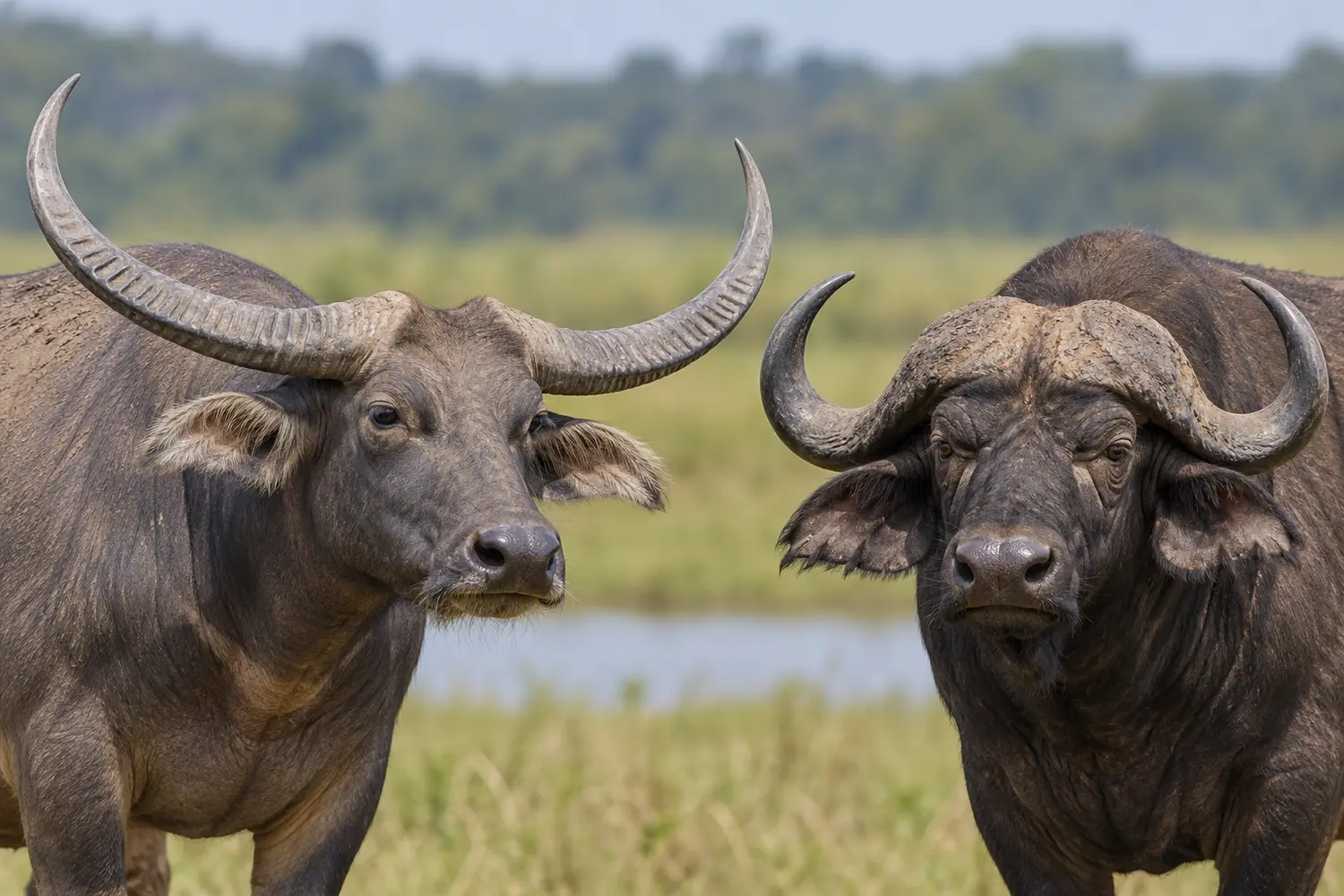
Its most conspicuous feature is a pair of exceptionally long horns that spread outward before curving back and upward. Exceptional specimens can span around two metres or more when measured across the outer curve or tips, but viral claims often treat record-sized horns as if they were normal for every individual.
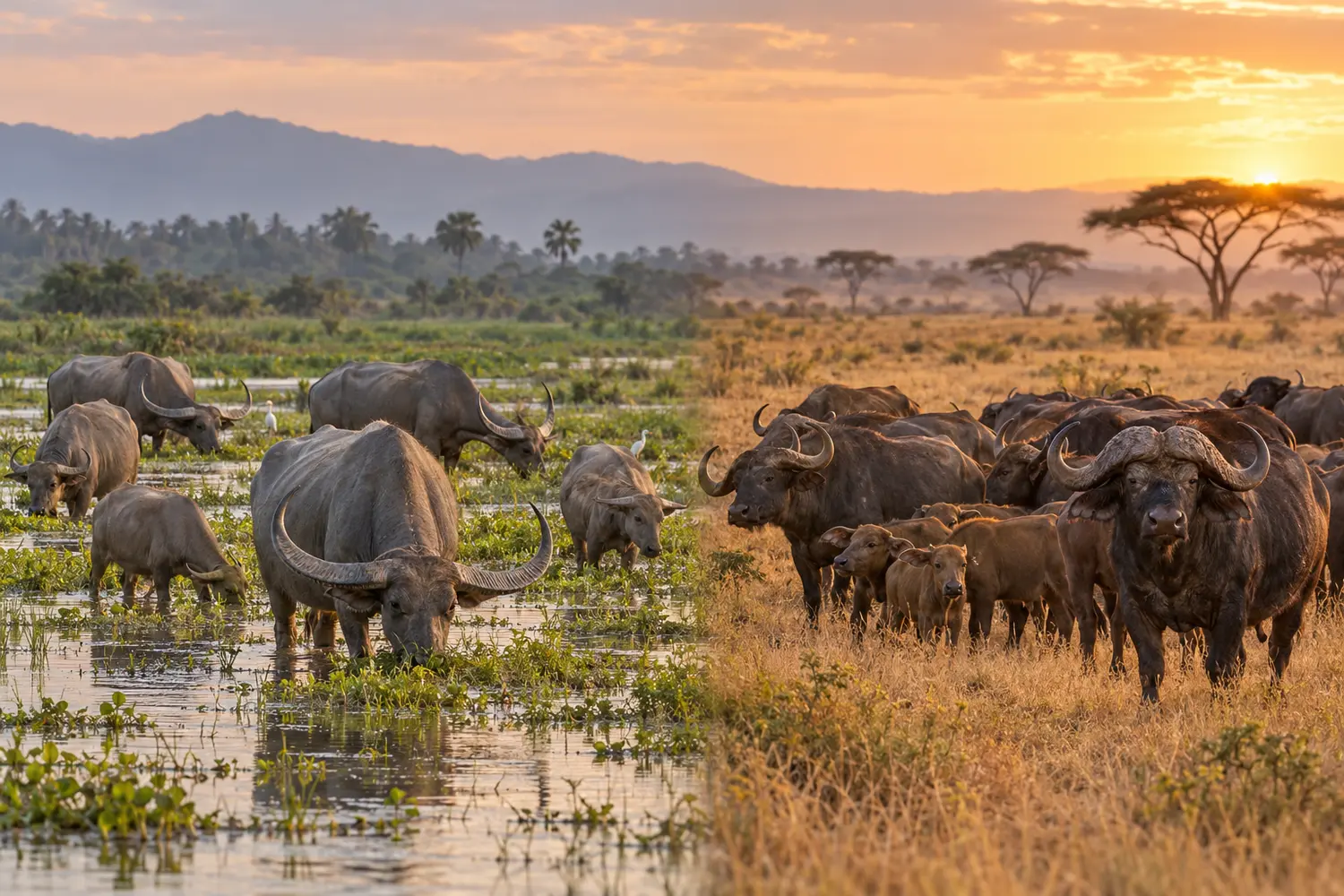
Wild water buffalo are strongly associated with low-lying, waterlogged habitats. Maternal groups graze and browse in floodplain grasslands, swamp margins and floodplain forests. Water and mud help the animals cool themselves and can provide some relief from biting insects.
Wild does not mean feral
True wild water buffalo should not be confused with domestic or feral water buffalo. The wild form is generally treated as Bubalus arnee, while domestic water buffalo are usually called Bubalus bubalis. The distinction matters because interbreeding with domestic buffalo can obscure wild ancestry and threatens the genetic integrity of small wild populations.
African buffalo: several forms, not one fixed size
African buffalo vary substantially across their range. The large southern and eastern Cape buffalo, Syncerus caffer caffer, is the form most people picture: dark, muscular and equipped with heavy horns. Forest buffalo are smaller and often reddish, with differently shaped horns. Treating the largest Cape buffalo measurements as universal for the species is misleading.
In the largest subspecies, adult males can exceed about 835 kg, while females are generally lighter. That is enormous, but it does not make every Cape buffalo an 850 kg animal. Age, rainfall, food quality and local population all influence body condition.
What is the horn boss?
In mature Cape buffalo bulls, the horn bases enlarge and approach each other across the forehead, forming the structure called the boss. The horns consist of keratin sheaths over bony cores. The boss can help absorb and distribute forces during clashes between bulls, but “bulletproof head shield” is sensational language, not anatomy.
Females usually have slimmer horns and a less-developed boss. Young males also lack the massive fused-looking structure seen in fully mature bulls.
Which buffalo is bigger?
The wild water buffalo has the higher upper body-mass range. Published profiles report very large males reaching approximately 1,200 kg, whereas the biggest African buffalo subspecies has adult males that can exceed 800 kg.
That does not mean a wild water buffalo always outweighs an African buffalo. Their size ranges overlap, and a mature Cape buffalo bull may be heavier than a younger or female wild water buffalo. A fair comparison must specify sex, age and population.
Which buffalo has larger horns?
Wild water buffalo generally win the horn-span comparison. Their long crescents may sweep far beyond the sides of the head. Cape buffalo horns are usually shorter in overall span but much heavier at the base in mature bulls.
The different shapes serve overlapping but not identical functions. Both species use their horns in social contests and defense. Wide horns can increase reach, while a thick boss and robust horn bases suit the head-to-head pushing and hooking contests of mature Cape buffalo bulls. Horn size by itself is not a scientific measure of “power.”
Are African buffalo more aggressive?
African buffalo are capable of severely injuring lions, people and other animals when threatened. However, describing them as animals that “actively hunt predators” misrepresents their behavior. Researchers distinguish vigilance, investigation, flight, preventive aggression and reciprocal aggression as different anti-predator responses.
Buffalo may confront or pursue a predator during defense, especially when a calf or herd member is at risk. That is not the same as hunting for food. African buffalo are herbivores.
The nickname “Black Death” is common in safari and hunting culture, but it is not a biological classification or an objective global danger ranking. Wild buffalo of either species should be given substantial distance. Individual behavior changes with injury, surprise, herd position and previous contact with people.
Herd defense and social behavior
African buffalo are famous for large herds. Group living increases the number of animals watching for danger and can reduce an individual’s risk of being selected by a predator. When necessary, adults may bunch together or face a threat with their horns outward. Herd size varies with habitat, season and population density.
Wild water buffalo also form social groups. Females and young commonly occupy maternal herds, while mature males may live alone or in smaller bachelor groups outside the breeding season. Their wetland habitat shapes movement, feeding and access to wallows.
Why a fight prediction is not useful
A hypothetical battle ignores nearly everything biologists need to explain animal performance: sex, age, health, footing, motivation, distance, herd support and whether either animal can retreat. It also encourages false precision, as if body mass and horn length could be inserted into a formula that predicts an outcome.
The defensible conclusion is narrower. Wild water buffalo can attain greater mass and much wider horns. Cape buffalo bulls have a specialized boss, and African buffalo are well documented using coordinated or collective anti-predator behavior. Neither fact establishes a guaranteed result in an artificial encounter.
Conservation: the most important difference
The wild water buffalo is listed as Endangered. Its surviving distribution is a fraction of the former range, and many populations are small. Habitat loss, hunting, disease transmission and competition with livestock matter, but hybridization with domestic and feral buffalo is an especially serious problem.
The African buffalo is listed as Near Threatened following the IUCN assessment published in 2019. The species remains much more numerous and widespread than the wild water buffalo, yet many populations are declining because of poaching, habitat conversion and expanding human and livestock populations.
These categories do not say that every African buffalo population is secure or every wild water buffalo population faces identical pressure. Conservation decisions depend on local population trends, genetic integrity, protected habitat and disease management.
Frequently asked questions
Is a wild water buffalo the same as a domestic water buffalo?
No. They are closely related, and the wild species is the ancestor of domestic water buffalo, but conservation authorities distinguish the wild form as Bubalus arnee. Hybridization makes identification difficult in some areas.
Is a Cape buffalo different from an African buffalo?
Cape buffalo usually refers to the large southern and eastern form, Syncerus caffer caffer. African buffalo refers to the species as a whole, including smaller regional forms such as the forest buffalo.
Is the Cape buffalo’s boss bulletproof?
No. It is a thick horn structure supported by bone and can protect the forehead during clashes, but it is not literal ballistic armor.
Do African buffalo kill lions?
They can injure or kill lions during defensive encounters. Lions also prey on buffalo, particularly vulnerable individuals. The relationship is a variable predator–prey interaction, not a simple story in which one species always dominates.
Which species is more endangered?
The wild water buffalo faces the greater global extinction risk: Endangered versus Near Threatened for the African buffalo under the cited IUCN assessments.
The bottom line
Wild water buffalo are generally larger at the upper end and carry the broader horn spread. African buffalo—especially mature Cape buffalo bulls—have heavier horn bases and a prominent boss, while their herd behavior can provide formidable collective defense.
The most meaningful comparison is not “mass versus aggression.” It is how two related bovids evolved different bodies and social strategies for Asian wetlands and African landscapes—and why the rarer wild water buffalo urgently needs genetically intact populations and secure habitat.