
A black panther is not a separate species. In the Americas, the name usually means a melanistic jaguar (Panthera onca); in Africa and Asia, it usually means a melanistic leopard (Panthera pardus). So a “jaguar vs. black panther” comparison can describe the same species with different coat colors—or two different species, depending on geography.
Key takeaways
- “Black panther” is an informal color description, not a scientific species name.
- A black jaguar and a normally colored jaguar are the same species.
- Melanistic jaguars and leopards still carry rosette patterns, which may appear in angled or strong light.
- Range, body proportions and rosette structure are more useful than color alone when separating jaguars from leopards.
- Popular bite-pressure rankings and fixed prey-hoisting claims should not be treated as standardized biological measurements.
Jaguar vs. black panther: the short answer
If the black panther is from the Americas, it is most likely a black jaguar. The comparison is then like comparing a golden jaguar with a black-coated jaguar: the coat differs, but the species, anatomy and basic behavior do not. If the black cat is from Africa or Asia, it is more likely a melanistic leopard, making the comparison one between two species.
| Feature | Jaguar | “Black panther” |
|---|---|---|
| Scientific identity | Panthera onca | Usually a melanistic jaguar or leopard |
| Natural range | Americas | Americas if jaguar; Africa or Asia if leopard |
| Coat | Usually tawny with dark rosettes; melanism also occurs | Very dark coat with underlying rosettes often still visible |
| Body shape | Generally stocky, broad-headed and powerfully built | Jaguar-shaped in the Americas; typically more slender and long-tailed if a leopard |
| Taxonomic status | Species | Informal term, not a species |
What does “black panther” actually mean?
Panther is sometimes used casually for several large cats, but there is no living species formally named “black panther.” The animals most often given that label belong to the genus Panthera: jaguars in the New World and leopards in the Old World.
The dark appearance is called melanism, an inherited increase in dark pigmentation. A landmark genetic study found that melanism evolved independently multiple times in the cat family. In jaguars, the studied dark phenotype was associated with a variant affecting the melanocortin-1 receptor pathway; in leopards, inheritance follows a different genetic route. This is a useful reminder that similar-looking black coats are not evidence that the cats form one black-coated species.
Why can you still see rosettes on a black panther?
Melanism darkens the background and markings; it does not simply erase the pattern-building biology of the coat. The contrast becomes subtle, but the rosettes can remain visible when sunlight strikes the fur at an angle or when an image preserves enough shadow detail. These faint markings are often called “ghost rosettes.”
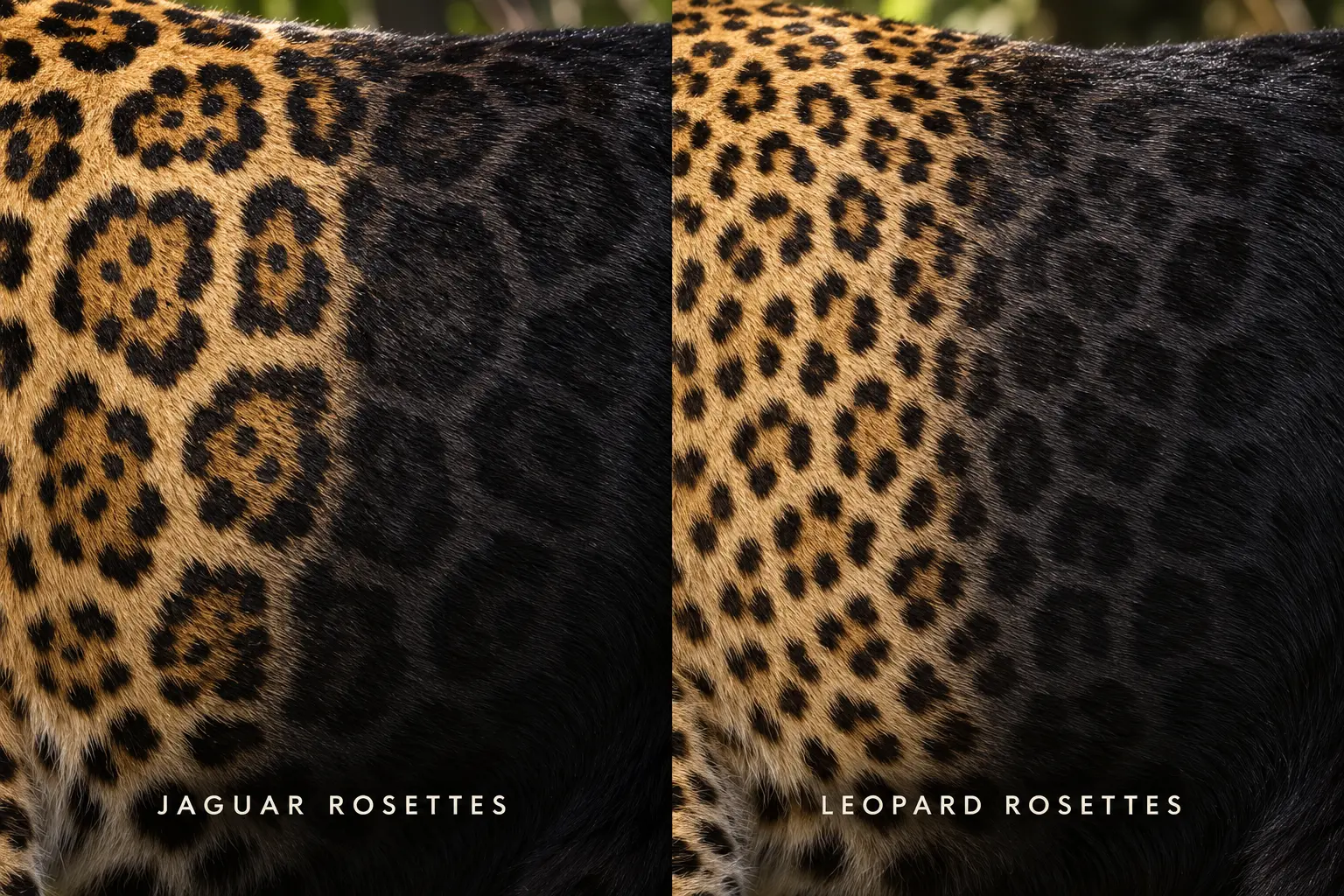
Rosettes alone require care as an identification tool. Jaguar rosettes are often larger and may contain one or more central spots, while leopard rosettes are generally smaller and more open. Individual variation, viewing angle and coat region can blur that distinction, especially on a nearly black animal.
Is every black panther a jaguar?
No. Location is the quickest first clue. Wild jaguars are native to the Americas, from Mexico through parts of Central and South America. Wild leopards occur across portions of sub-Saharan Africa and Asia. A black big cat photographed in the Brazilian Amazon may be a melanistic jaguar; one documented in India, Malaysia or Kenya would be a melanistic leopard.
Geography is not infallible in captivity, where either species can be housed far from its natural range. For captive animals, reliable facility records or expert identification matter more than the location of the photograph.
How to tell a black jaguar from a black leopard
Color is the least helpful feature because both can be nearly black. Look instead at the whole animal and its documented origin.
- Build: Jaguars tend to look more compact and robust, with a broad head, deep chest and relatively shorter tail.
- Leopard proportions: Leopards generally appear lighter-framed, with a relatively longer tail that aids balance while climbing.
- Rosettes: Jaguar rosettes often look larger and may include central dots; leopard rosettes are usually smaller and lack those central spots.
- Range: A wild cat’s verified location can separate the American jaguar from African or Asian leopards.
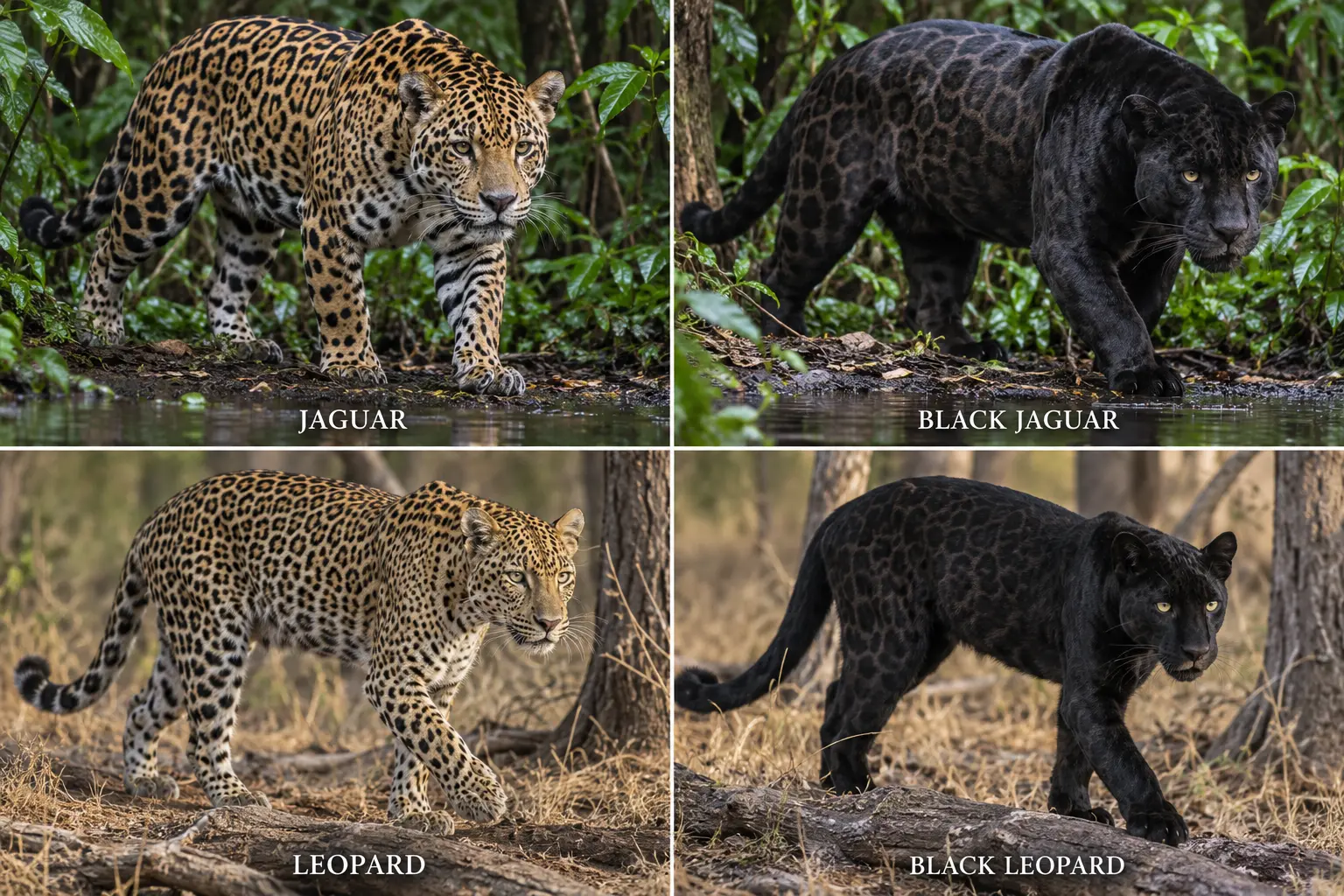
These are tendencies, not a license to identify a distant animal from one blurry frame. Camera exposure can hide pattern, distort body proportions and make a dark cat look uniformly black.
Do black jaguars behave differently?
A black jaguar remains a jaguar. It shares the species’ muscular body plan, solitary habits, broad prey base and strong association with habitats that provide cover and prey. Jaguars use forests, wetlands, savannas and seasonally dry landscapes; they should not be reduced to an “Amazon-only” cat. They are also capable swimmers, but swimming is not a trait limited to melanistic individuals.
Scientists have investigated whether melanism can be favored in certain environments. Dark coats occur relatively often in some forest populations, suggesting that habitat, light and natural selection may influence their distribution. However, a plausible camouflage benefit should not be presented as a universal explanation for every black jaguar or leopard. Coat-color frequencies reflect inheritance, population history and local ecology together.
What viral comparisons get wrong
Online jaguar comparisons often assign a precise “1,500 PSI bite force.” Such rankings usually combine estimates from different methods, body sizes or models and present them as if they were directly measured under identical conditions. Jaguars have unusually robust skulls and powerful jaws for their size, but a single universal pressure number is not a dependable species specification.
Claims that leopards routinely hoist prey weighing exactly twice their own mass also need context. Leopards do cache prey in trees, especially where competitors could steal it, but prey mass, cat size, tree structure and circumstances vary. A dramatic maximum should not be turned into a routine rule.
The scientifically useful comparison is not “which panther wins?” It is how two species—and a coat trait that evolved through different genetic changes—can produce animals that look remarkably similar at first glance.
Frequently asked questions
Can a jaguar give birth to black cubs?
Yes. Melanism is inherited, so melanistic cubs can occur where the relevant variant is present. A litter may include more than one coat phenotype depending on the parents’ genes.
Are black panthers completely black?
They can appear uniformly black in dim conditions, but their rosettes are often visible in suitable light. Their eyes and other anatomy do not define a separate black-panther species.
Are black panthers more dangerous than other jaguars or leopards?
There is no sound basis for treating melanistic individuals as inherently more dangerous because of coat color. Risk depends on species, circumstances and human behavior—not whether the fur is dark.
The bottom line
In a jaguar vs. black panther comparison, first identify what “black panther” means. A black jaguar is simply a melanistic member of Panthera onca. A black leopard is Panthera pardus. Geography, body proportions and rosettes reveal that distinction more reliably than the dramatic color itself.